

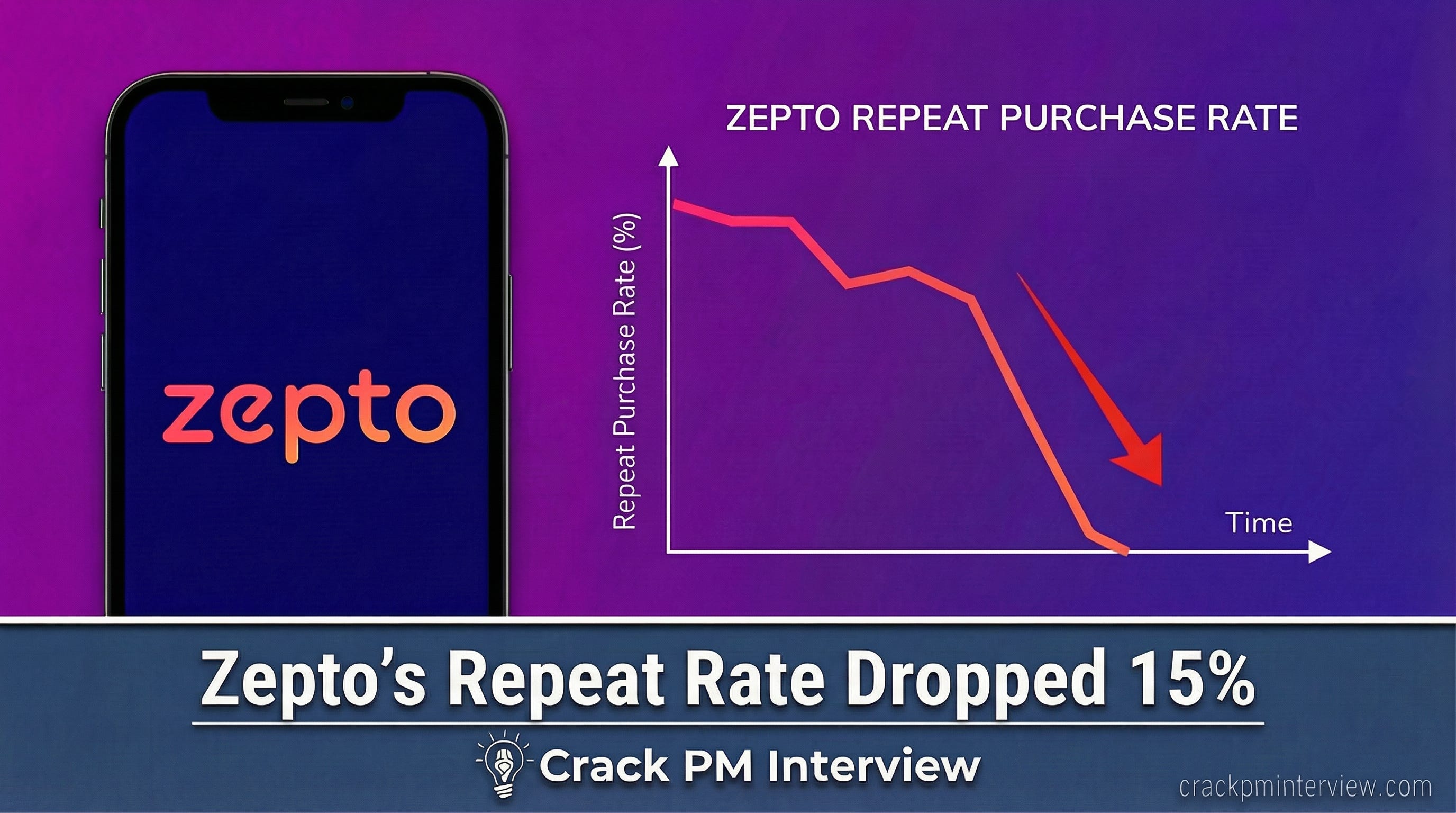
You’re in your PM interview at an Indian quick-commerce startup, Zepto.
The interviewer leans forward and asks:
→ “Our repeat rate dropped 15% last month. Find out why.”
This isn’t just any metric drop - it’s repeat rate. The lifeblood of quick-commerce. The metric that determines whether you’re building a sustainable business or just burning cash on one-time users.
Most candidates panic.
They start listing obvious things w/o any structure:
“Maybe delivery got slower?”
“Price increased?”
“Competitors offering discounts?”
But, here’s what separates good answers from great ones:
Understanding that repeat rate isn’t just about product quality - it’s about habit formation.
It’s about whether you’ve become essential to someone’s daily routine or just a convenient one-time solution.
In this walkthrough, I’ll show you exactly how to tackle this question using the 6-step framework to answer Problem Solving (or, Root Cause Analysis) questions.
This is the same structured approach that impresses interviewers at Zepto, Blinkit, Swiggy Instamart, Dunzo, and any other quick commerce.
How to Answer Problem Solving / RCA Questions?
Here’s the framework I recommend for every Problem Solving or RCA question. Master this, and you’ll be able to tackle any variation thrown at you.
Use the below framework:
Problem - Clarify the Problem
Hypotheses - Structure Your Hypotheses
Prioritize - Prioritize What to Investigate
Data - Deep Dive with Data
Validate - Validate Your Hypotheses
Recommend - Recommend Next Steps
Refer this deep-dive to read in detail - how to answer any problem-solving or RCA question in a PM interview.
Now, Let’s think through this question out loud using the framework, just like you should in your interview.
Step 1: Clarify the Problem
Before I jump into analysis, I need to understand exactly what we’re measuring and the context around it.
Questions I’d ask the interviewer:
I) About the Metric:
“When you say ‘repeat rate,’ are we measuring the percentage of users who made at least 2 orders in a given period? Or is it something else like orders per user?”
“What’s the time window we’re looking at? Repeat within 7 days, 30 days, or something else?”
“Is this repeat rate for all users, or just users who made their first order during a specific period (cohort-based)?”
“Are we looking at repeat order rate or repeat user rate?”
II) About the Timeframe:
“Which month are we comparing? For example, November vs October?”
“Did the drop happen suddenly or gradually throughout the month?”
“Is this statistically significant, or could it be within normal variance?”
III) About Scope:
“Is this drop across all cities, or concentrated in specific markets?”
“Are all user segments affected equally - new users vs existing users?”
“Any differences by order value, category mix, or time of day?”
IV) About Context:
“Have there been any product changes - delivery fees, minimum order values, UI changes?”
“Any operational changes - delivery time promises, dark store locations, inventory availability?”
“What’s happening in the competitive landscape - Blinkit, Swiggy Instamart, Dunzo pricing or promotions?”
“Any major marketing campaigns that might have changed user acquisition quality?”
Interviewer’s Response:
“Good questions.
Repeat rate is defined as the percentage of users who place a second order within 30 days of their first order.
We’re comparing November cohort (users who made first order in November) vs October cohort. The drop was gradual throughout November. It’s statistically significant.
The drop appears most pronounced in Tier-2 cities where we recently expanded. We did increase delivery fees from ₹20 to ₹35 in early November, and our average delivery time increased from 10 minutes to 14 minutes due to dark store optimization.
Competitors have been aggressive with discounting.”
Step 2: Structure My Hypotheses
Now I’ll organize my thinking using the Internal vs External framework, with special attention to quick-commerce specific factors.
Internal Factors (Product/Business/Operations)
I) Pricing & Economics:
Delivery fee increase (₹20 to ₹35 - mentioned by interviewer) making second order less attractive
Reduced promotional offers for repeat users
Minimum order value changes
Price increases on frequently purchased items
Removal of loyalty benefits or cashback
II) Delivery Experience:
Delivery time increase (10 to 14 minutes - mentioned)
Dark store optimization reducing coverage or increasing distances
Delivery slot availability issues
Order accuracy problems (wrong items, substitutions)
Packaging quality deterioration
III) Product Availability:
Stockouts of popular items increasing
Category breadth reduction
Dark store inventory management issues
SKU rationalization affecting variety
IV) User Experience:
App performance issues or bugs
Checkout friction increases
Payment failures
Push notification fatigue or reduction
Search and discovery problems
Reorder functionality issues
V) User Acquisition Quality:
Expansion to Tier-2 cities (mentioned) bringing lower-intent users
Marketing campaigns attracting deal-seekers, not habit-builders
First-order discounts too aggressive, attracting one-time users
Referral quality deteriorating
External Factors
I) Competitive Dynamics
Aggressive discounting by Blinkit and Swiggy Instamart
Faster delivery promises from competitors
Better product selection on competing platforms
Exclusive partnerships secured by competitors
II) Market & Seasonality
End of the November festival season leading to a post-Diwali demand slump
Monthly income cycles impacting mid-month purchase behavior
Weather changes influencing order frequency
Tier-2 city behavior patterns differing from metro cities
III) User Behavior
Novelty wearing off in newly launched markets
Users comparing quick-commerce with traditional grocery options
Macroeconomic conditions affecting discretionary spending
Shift from urgent, impulse-driven needs to more planned purchases
IV) Measurement Issues
Changes in cohort definitions
Attribution issues with repeat orders
Data pipeline delays
Bot activity or fraudulent transactions affecting metrics
Step 3: Prioritize What to Investigate
I’ll prioritize based on likelihood, impact given the context, and ease of verification.
Top Priority (Investigate First):