You’re sitting across from your interviewer at a leading AI company (Anthropic, Open AI, Google). The behavioural questions went well. You aced the product strategy question. Then they lean forward and ask:
“Design an AI system that can autonomously learn and execute new tasks without human intervention.”
Your mind races:
“Autonomously?
Learn new tasks?
This isn’t traditional software...”
This is the future of PM interviews. (or, let me say it - AI PM interviews)
As AI agents become mainstream (GitHub Copilot Workspace, ChatGPT plugins, AutoGPT, Microsoft Copilot), product managers need to design systems that aren’t just predictive or generative - but agentic.
What makes this question different from traditional system design:
Not static software (it adapts and learns continuously)
Not traditional ML (not just prediction models)
Not just generative AI (not just creating content)
Requires thinking about autonomy, safety, and control
Tests understanding of emerging AI paradigm
For a deep-dive on “How to answer technical questions in PM Interview? ” - read here to tackle any Technical question.
Join our WhatsApp channel for quick PM insights and latest Job updates
What you’ll learn in this guide:
How to approach agentic AI system design questions
S.P.E.C.T.S. framework adapted for AI agents
Key components of autonomous AI architecture
Critical trade-offs: autonomy vs control, safety vs speed
Learning mechanisms: RAG, few-shot, fine-tuning
Safety and evaluation strategies
Why this matters:
2026-2027 is the year of AI agents or rather, this decade’s applications will be built on Agentic AI layer. Companies are shipping:
Coding agents (GitHub Copilot Workspace, Devin)
Customer service agents (Intercom AI Agent)
Research agents (Perplexity, Claude with tools)
Personal assistants (scheduling, email, tasks)
PMs who can design these systems will shape the next decade of software.
Check out more technical questions for PMs
Now, Let’s dive in and first, understand Agentic AI and how it is different.
Understanding Agentic AI: What Makes It Different
Before we apply the framework, let’s define what we’re actually building.
If you already know the fundamentals then skip this section and jump straight to “How to answer Agentic AI System Design question?”
What is an Agentic AI System?
An agentic AI system is software that can:
Perceive: Understand tasks and environment
Decide: Make autonomous decisions toward goals
Act: Take actions in the world (not just output predictions)
Learn: Improve from experience without explicit programming
Adapt: Handle new situations and tasks
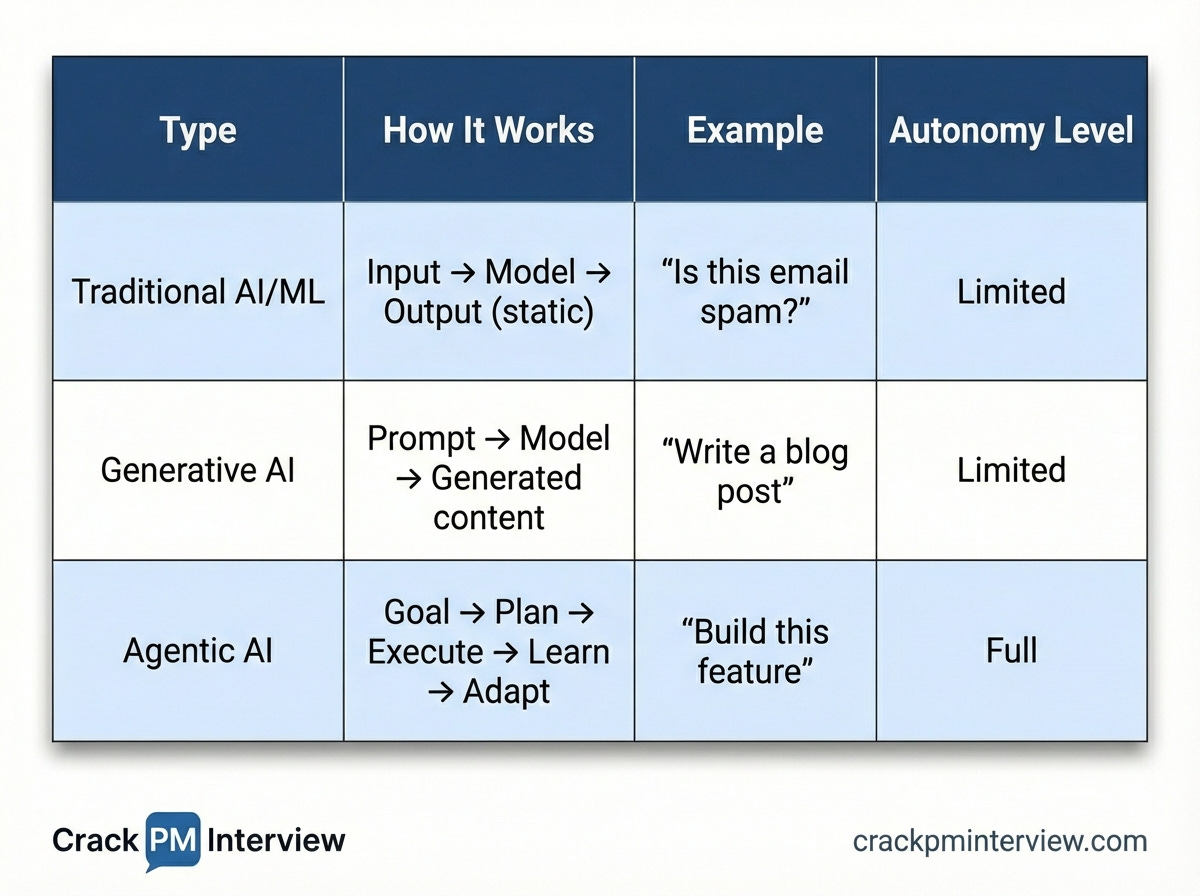
How is Agentic AI different from Tradition AI/ML and Generative AI?
The Five Key Characteristics of Agentic AI Systems:
Goal-Oriented - Works toward defined objectives, not just responding to prompts
Autonomous - Makes decisions without constant human input
Adaptive - Learns from experience and new situations
Action-Taking - Interacts with systems and environment
Self-Improving - Gets better through feedback loops
Real-World Examples:
1) GitHub Copilot Workspace:
Understands issue description from natural language
Plans implementation across multiple files
Writes code that fits existing patterns
Runs tests and validates functionality
Creates pull request with documentation
Adapts to your codebase style over time
2) Customer Service AI Agents (Intercom, Zendesk):
Understands customer query intent
Searches knowledge base for relevant articles
Takes actions (processes refunds, updates orders, schedules callbacks)
Escalates complex issues to humans
Learns from successful resolutions to improve
3) Research Agents (Perplexity, Claude with tools):
Takes research question as input
Browses web, reads papers, analyzes sources
Synthesizes findings into coherent narrative
Cites sources and acknowledges uncertainty
Adapts search strategy based on what it finds
4) Coding Agents (Devin, Cursor):
Receives feature request or bug report
Analyzes codebase to understand architecture
Plans and implements solution
Debugs issues autonomously
Learns team coding conventions over time
The Key Difference: Action + Learning
Traditional AI systems are reactive - they respond to inputs with outputs.
Agentic AI systems are proactive - they pursue goals, take actions, and improve from experience.
This shift requires fundamentally different design thinking. You’re not designing a tool that users operate. You’re designing an autonomous collaborator that operates alongside users.
Why Interviewers Will Ask This in AI PM Interviews:
✅ Tests understanding of AI paradigm
✅ Evaluates ability to design with uncertainty
✅ Checks safety and control thinking
✅ Assesses product sense for AI products
Common Mistakes Candidates Might Make:
❌ Treating it like traditional ML (”train → deploy → done”)
❌ Ignoring safety mechanisms
❌ Over-promising capabilities
❌ Missing the feedback/learning loop
❌ Forgetting human oversight for MVP
Join our WhatsApp channel for quick PM insights and latest Job updates
Now, let’s dive in and answer this question.
How to Answer Agentic AI System Design Questions?
Here’s a proven repeatable framework that works perfectly well for any system design questions and, in fact, for any technical question thrown at you.
Use the below S.P.E.C.T.S. Framework:
S - Scope - Clarify the problem and context.
P - Product Requirements - Identify and prioritize functional requirements.
E - Engineering Constraints - Define non-functional requirements.
C - Components - Design high-level system architecture.
T - Trade-offs - Discuss alternatives and evolution path.
S - Success Metrics - Define validation, guardrails and connect everything to measurable outcomes.
let’s breakdown each step
Step 1: Scope - Clarify the Problem and Context
Goal: Define what we’re building before diving into architecture.
I) Ask Clarifying Questions
Task Domain:
“What types of tasks should the AI handle? Narrow domain or general purpose?”
“Specific vertical (coding, customer service, research) or horizontal?”
Autonomy Level:
“How autonomous should it be? Fully autonomous or human-in-the-loop?”
“Can it take actions without approval, or suggest and wait?”
Adaptation Scope:
“Adapt to new tasks in same domain or completely new domains?”
“Few-shot learning (needs examples) or zero-shot (just instructions)?”
Scale & Users:
“How many users? Single-tenant or multi-tenant?”
“Enterprise or consumer use case?”
Interviewer’s likely response:
“Focus on building an AI agent for software development teams. It should handle coding tasks (write code, debug, review). Start with human oversight - AI suggests and executes after approval. Design for 10K developers initially, scale to 100K. The AI should adapt to new coding frameworks within days using a few examples. Safety is critical - cannot deploy to production without explicit approval.”
II) Now, Restate the Problem
“So we’re building an AI coding agent for software development teams that can:
Execute coding tasks (implement features, debug, code review)
Adapt to new frameworks and patterns with 3-5 examples
Operate with human oversight (propose → approve → execute workflow)
Start with 10K developers, plan for 100K
Safety-first: production deployments require explicit approval”
III) State Assumptions and Non-Goals
Assumptions:
✅ Access to code repositories (GitHub, GitLab)
✅ Integration with developer tools (IDEs, CI/CD)
✅ Access to foundation LLMs (GPT-4, Claude)
Non-Goals:
❌ NOT replacing human developers (augmentation only)
❌ NOT handling infrastructure/DevOps initially
❌ NOT autonomous production deployment
IV) Define Success
“Success means the AI agent can take a coding task description, generate working code that passes tests, learn new frameworks from <5 examples, and reduce developer time by 30%.”
Step 2: Product Requirements - Define What to Build
Goal: Identify core functionality and prioritize ruthlessly before thinking about implementation.
I) User Segments
Primary:
Software developers (individual contributors)
Engineering managers (assigning tasks to AI)
Secondary:
QA engineers (validating AI output)
Tech leads (training AI on team patterns)
II) Core Use Cases
Use Case 1: Autonomous Task Execution
Developer describes task: “Add rate limiting to the API”
AI analyzes codebase and understands context
AI creates execution plan (subtasks breakdown)
AI implements changes across multiple files
AI runs tests and validates
Developer reviews and approves
AI commits and creates pull request
Use Case 2: Learning New Patterns
AI encounters unfamiliar framework
Developer provides 3-5 example implementations
AI extracts pattern and stores in memory
AI applies pattern to current and future tasks
Use Case 3: Self-Correction
AI generates code implementation
Automated tests fail
AI analyzes failure and hypothesizes fix
AI iterates (up to 3 attempts)
If still failing, escalates to human
III) Functional Requirements - MVP
Core Capabilities (P0 - Must Have):
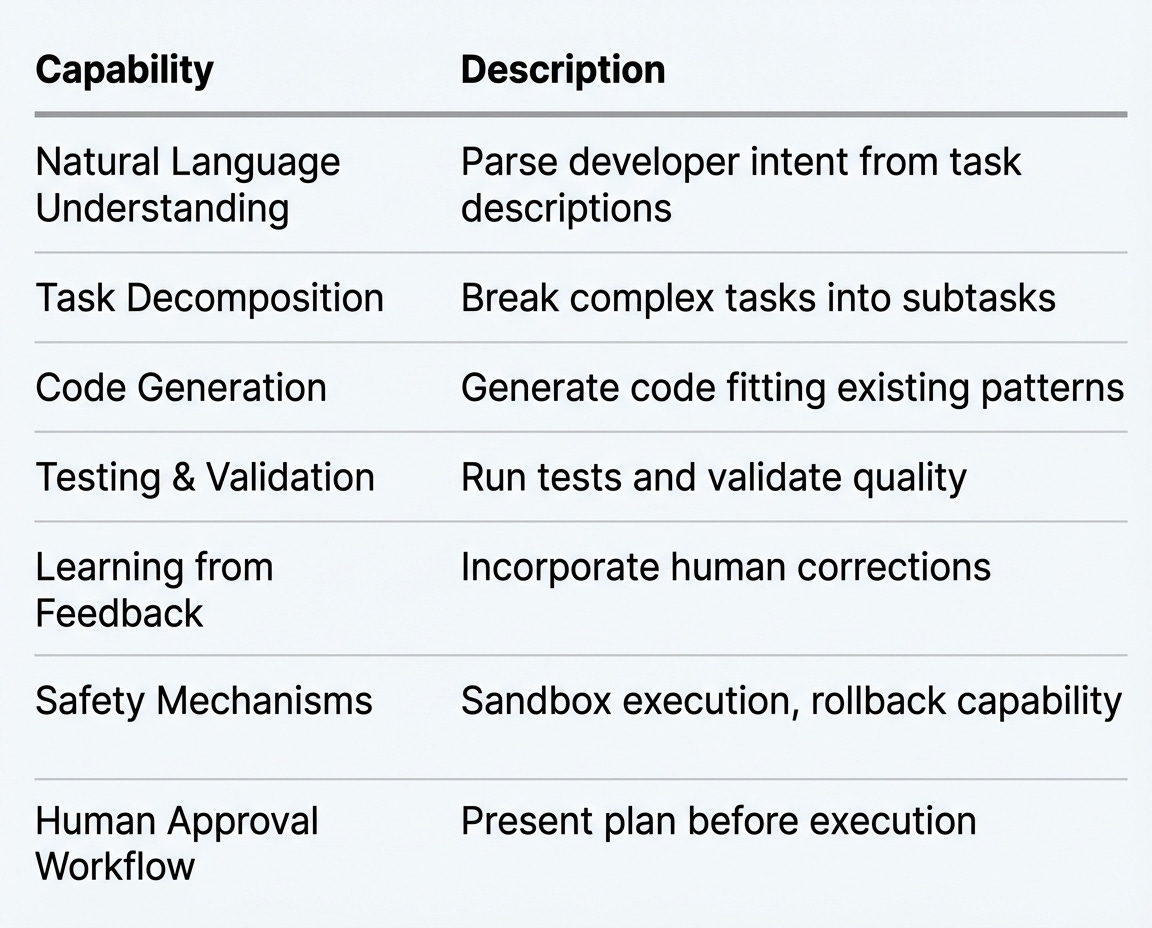
Adaptation Capabilities (P0 - Must Have):
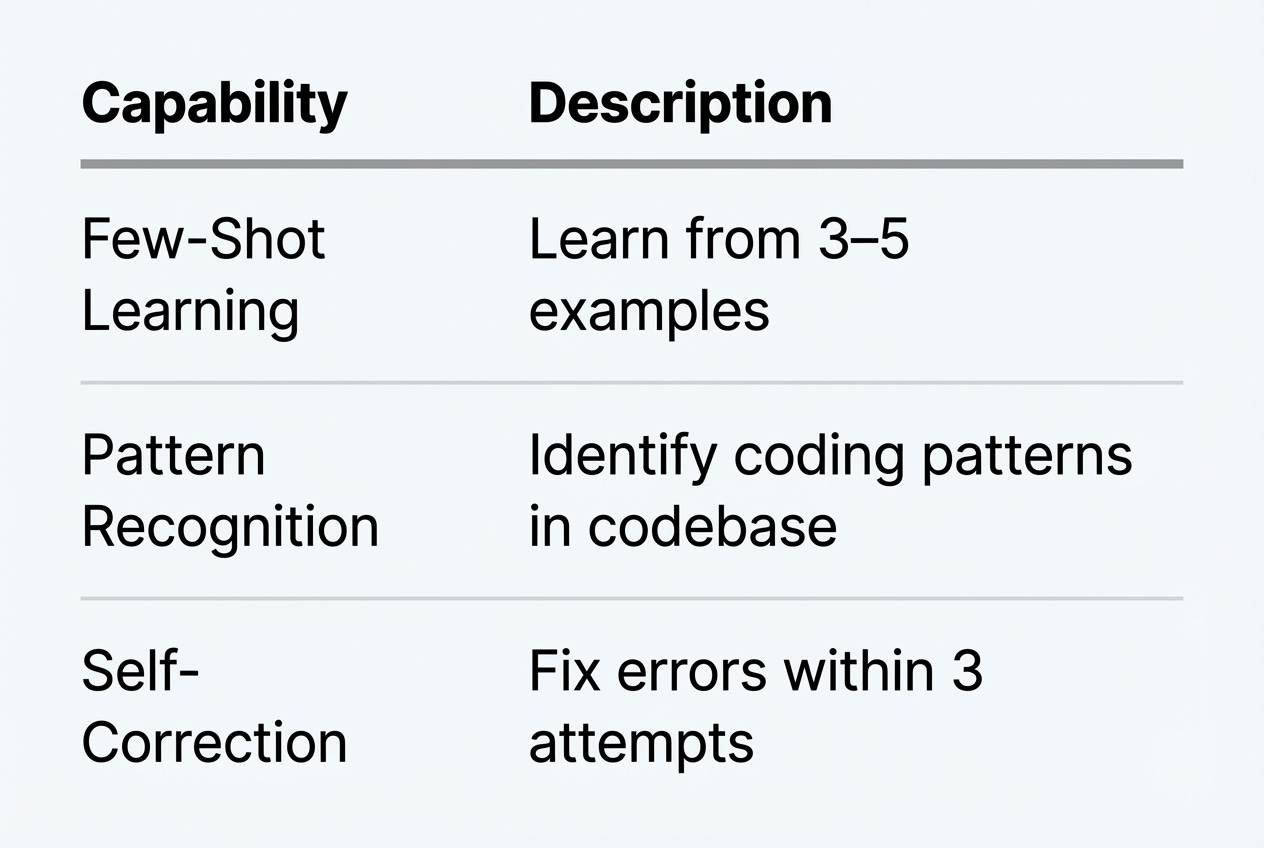
IV) MVP vs Nice-to-Have Prioritization
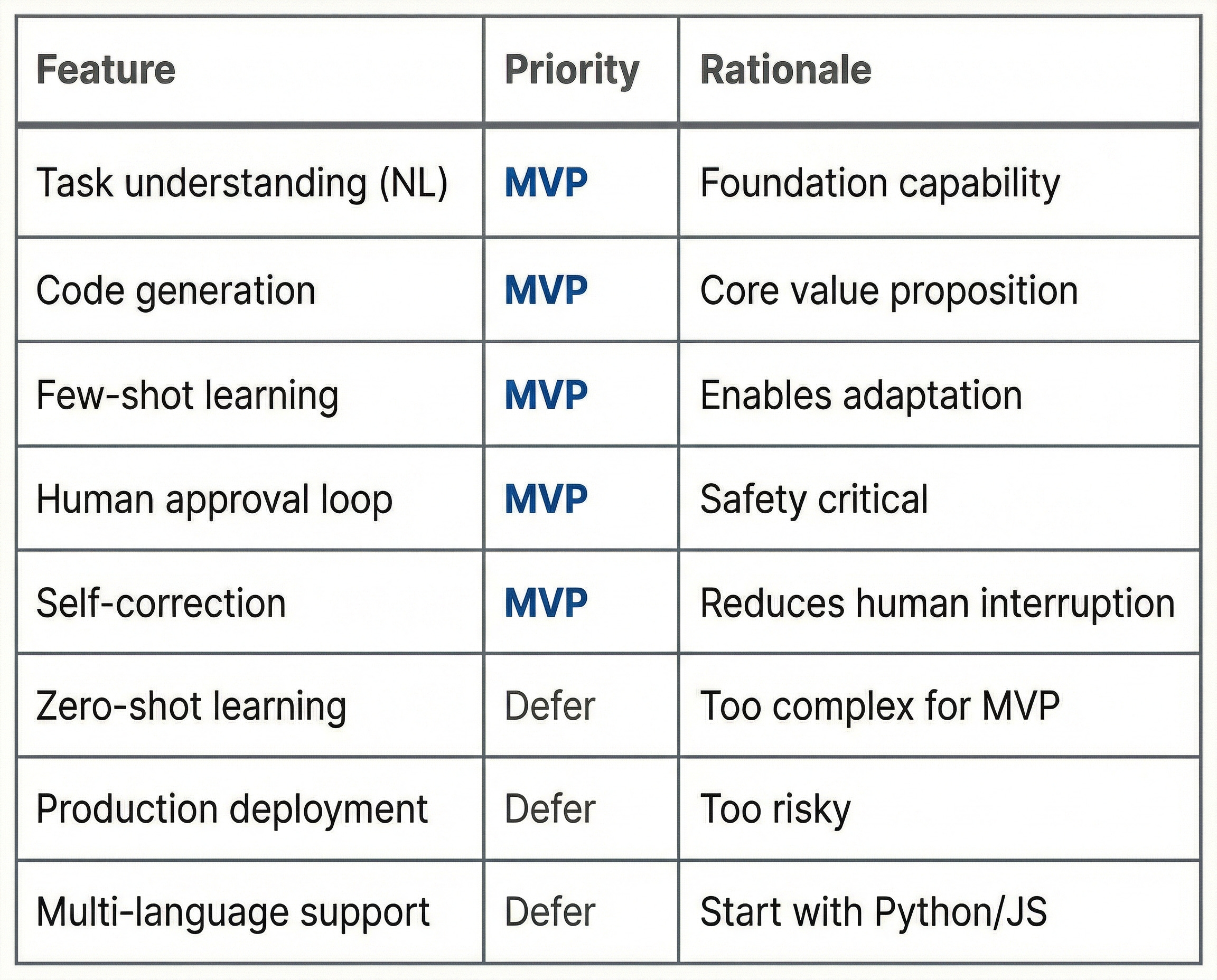
Why this prioritization: We’re focusing on supervised autonomy - human oversight builds trust, learning from corrections improves the AI, and starting narrow ensures quality.
Step 3: Engineering Constraints - Technical Boundaries
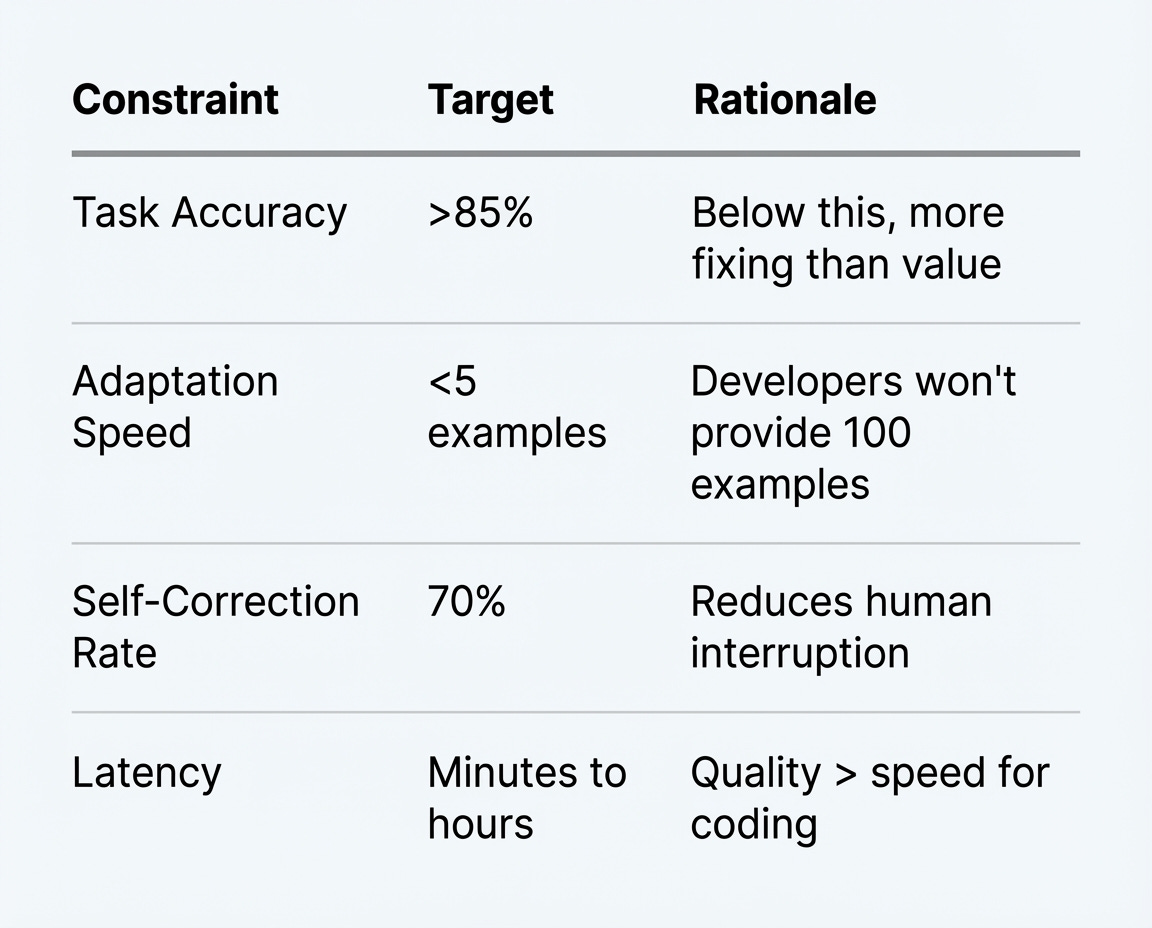
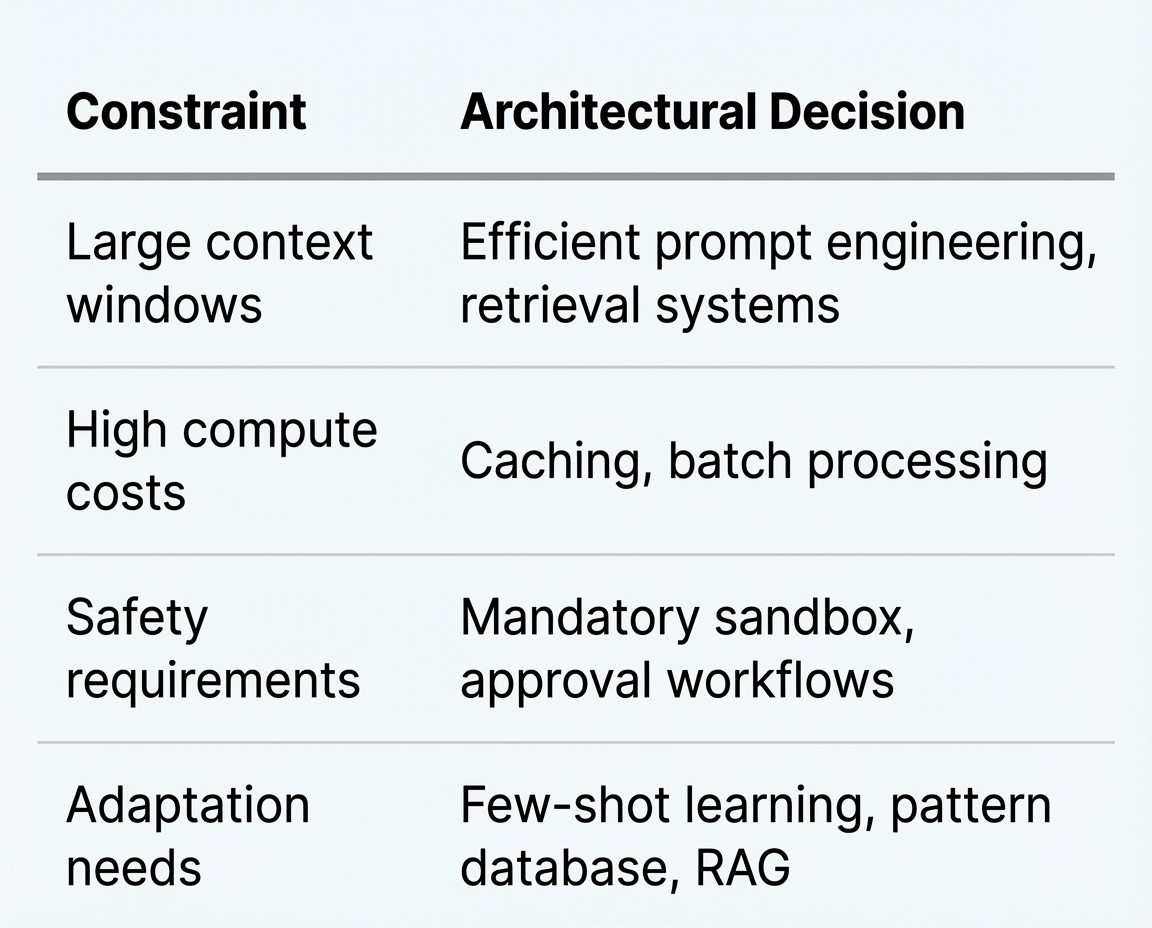
Model Performance Requirements
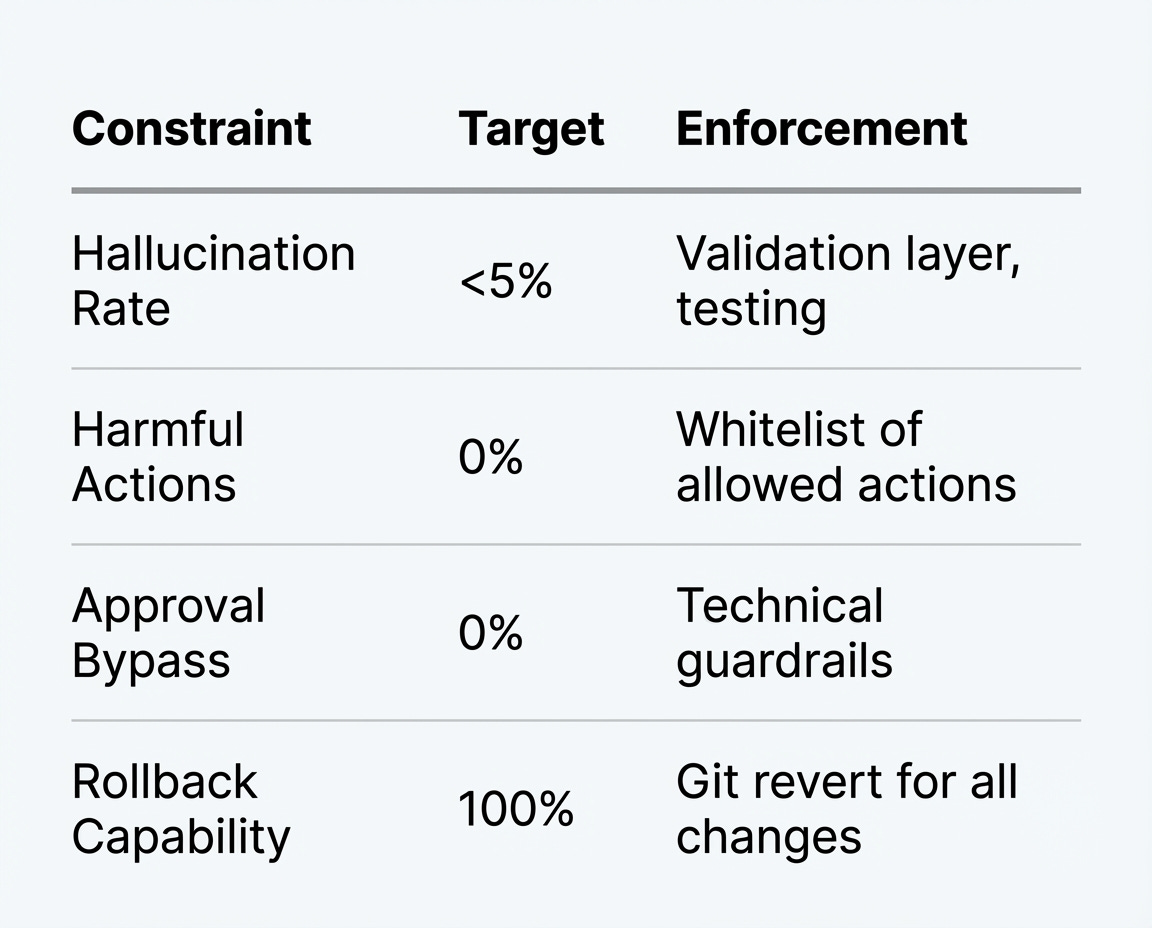
Safety & Reliability
Computational Resources
Model Inference: Large context windows (32K-128K tokens)
Cost: $0.10-$1.00 per task (LLM API costs)
Memory: Vector database for pattern storage
How These Constraints Shape Architecture:
Step 4: Components - High-Level Architecture
Goal: Map out major system components and how they interact without getting lost in implementation details.
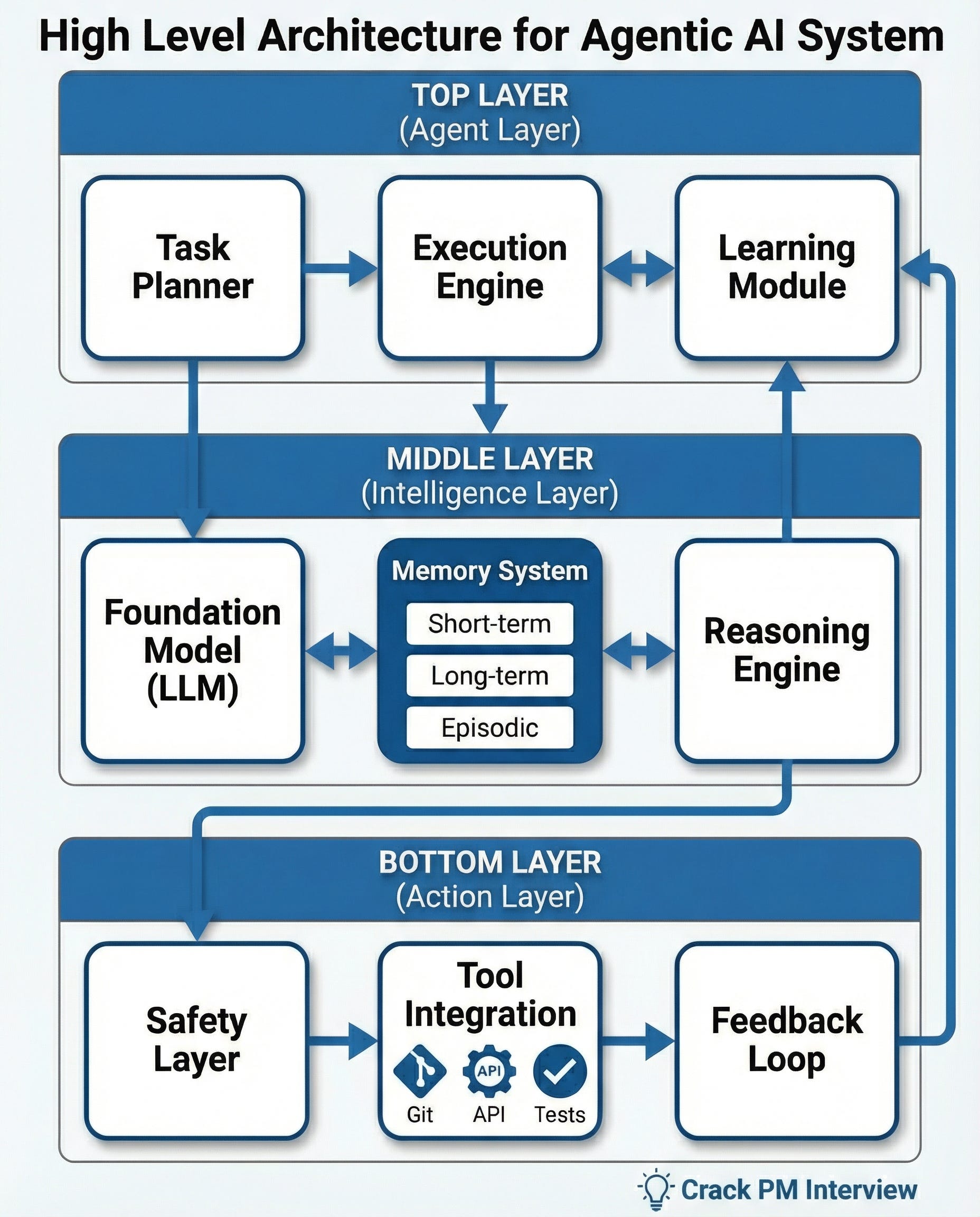
The 9 Core Components
I see nine main components organized into three layers:
Agent Layer (Decision & Orchestration):
Task Planner - Decomposes tasks, creates execution plans
Execution Engine - Orchestrates subtask execution
Learning Module - Adapts from feedback and examples
Intelligence Layer (Reasoning & Memory):
Foundation Model - Large language model (GPT-4, Claude)
Memory System - Stores context, patterns, history
Reasoning Engine - Decision-making, confidence scoring
Action Layer (Execution & Safety):
Tool Integration - Connects to Git, APIs, test runners
Safety Layer - Validates actions, prevents harm
Feedback Loop - Collects results, enables learning