


You’re sitting across from your interviewer at a top tech company. The behavioural questions went well. You nailed the product design question. Then they lean forward and ask:
“Can you explain how you would design the backend architecture for a real-time messaging system like Slack?”
Your mind races. You’re not an engineer. Should you dive into databases? Talk about websockets? Admit you don’t know?
This moment determines whether you move forward or get a polite rejection email.
Technical questions in PM interviews aren’t about testing if you can code. They’re about evaluating whether you can:
Work effectively with engineers
Make informed product decisions
Understand the technical feasibility of your ideas
The best PMs don’t need to write production code, but they do need to speak the language of technology fluently enough to earn their engineering team’s respect.
In this guide, I’ll walk you through exactly how to approach technical questions in PM interviews, share a framework that works for any technical scenario, and give you practice questions to prepare with.
Understanding the Types of Technical Questions
Before we dive into how to answer, let’s understand what you’re up against. Technical questions in PM interviews typically fall into five categories:
1. System Design Questions
These ask you to architect a system or product from scratch.
Examples:
“Design Instagram’s photo upload and feed system”
“How would you build a scalable search engine?”
What they’re testing: Your ability to think about scalability, data flow, and system components. Can you understand how different pieces of technology fit together and make reasonable architectural choices?
2. Technical Trade-off Questions
These present you with technical decisions and ask you to evaluate options.
Examples:
“Should we use SQL or NoSQL for our product catalog?”
“Native mobile app versus progressive web app—how do you decide?”
What they’re testing: Your judgment and whether you can weigh competing technical considerations against product and business needs. There’s rarely a single right answer, which is exactly the point.
3. Architecture and Infrastructure Questions (Computer Science 101)
These dive into how systems work under the hood.
Examples:
“Explain what happens when a user submits a payment form”
“How does a mobile app communicate with a backend server?”
What they’re testing: Do you understand the technical foundations well enough to have meaningful conversations with your engineering team about implementation approaches?
4. API and Integration Questions
These focus on how systems connect with each other.
Examples:
“How would you integrate a payment gateway into our checkout flow?”
“What should we consider when building an API for third-party developers?”
What they’re testing: As a PM, you’ll frequently need to work with external services and partner integrations, so understanding APIs is crucial.
5. Technical Troubleshooting Scenarios
These present a problem and ask how you’d investigate.
Examples:
“Our API response time jumped from 200ms to 2 seconds - how do you troubleshoot?”
“Users report images aren’t loading on mobile - what’s your approach?”
What they’re testing: Your problem-solving methodology and whether you can think systematically about technical issues.
What Each Question Type Reveals:
How to Answer Technical Questions?
You don’t need to memorize every database type or cloud service. What you need is a repeatable framework that works for any technical question thrown at you.
Use the below S.P.E.C.T.S. Framework:
S - Scope - Clarify the problem and context.
P - Product Requirements - Identify and prioritize functional requirements.
E - Engineering Constraints - Define non-functional requirements.
C - Components - Design high-level system architecture.
T - Trade-offs - Discuss alternatives and evolution path.
S - Success Metrics - Define validation, guardrails and connect everything to measurable outcomes.
Think of it like this: technical interviews aren’t about having all the answers pre-loaded in your brain.
They’re about demonstrating how you think through complex problems.
Now, let’s dive into each step in detail
Step 1: Scope - Clarify the Problem and Context
Goal: Ensure you’re solving the right problem before diving into solutions.
What to Cover
1. Ask Clarifying Questions
Never assume.
Always ask about:
Users: Who’s using this? What’s their context?
Scale: How many users? What’s the data volume?
Geography: Single region or global?
Platform: Web, mobile, or both?
Timeline: MVP in 3 months or enterprise-grade in a year?
2. Restate the Problem
“So if I understand correctly, we’re building a [X] for [Y users] to solve [Z problem], optimizing primarily for [metric/outcome]?”
3. Define Assumptions and Non-Goals
Assumptions:
“I’m assuming we have existing authentication infrastructure”
“Assuming we’re building for modern browsers”
Non-Goals (explicitly state what you’re NOT solving):
“We’re not building a full office suite, just document editing”
“Not focusing on offline mode in MVP”
4. Define Success at a High Level
“Success means users can collaboratively edit documents in real-time with minimal conflicts and excellent performance.”
Example Walkthrough for Step-1: Scope
Interview Question: “Design a URL Shortner.”
Clarifying questions:
Core functionality: Just shortening and redirecting, or also analytics?
Scale: Thousands or millions of URLs daily?
Users: B2C like Bitly or internal enterprise tool?
Geography: Single region or global CDN?
Restating:
“We’re building a URL shortening service that takes long URLs, generates short codes, and redirects users at scale.”
Assumptions:
Modern web browsers
HTTPS for all URLs
No offline requirements
Non-goals:
Not building custom URL analytics dashboard in MVP
Not supporting QR code generation initially
Success:
Users can shorten URLs instantly and redirects happen in under 100ms globally.
Step 2: Product Requirements - Identify and Prioritize Functional Requirements
Goal: Identify core functionality and prioritize ruthlessly before thinking about implementation.
What to Cover
1. User Segments
Who are we building for?
Primary users
Secondary users
Admin/power users
2. Core Use Cases
What are the essential user journeys?
Primary workflows
Edge cases that matter
Critical user interactions
3. Functional Requirements List
What must the system DO?
Create a clear list. For example, in case of URL shortener:
User can create short URL from long URL
User can access original URL via short link
System generates unique short codes
System validates URLs before shortening
4. MVP vs Nice-to-Have
Separate the features which you want in MVP and which are nice-to-have.
5. Prioritization Framework: Use a simple matrix to show impact vs effort
Explicit Separation: Requirements vs Non-Goals
Requirements (what we WILL build):
✅ Generate short URLs
✅ Redirect users reliably
✅ Track basic click metrics
✅ Validate URLs for security
Non-Goals (what we WON’T build in MVP):
❌ Advanced analytics dashboard
❌ Team collaboration features
❌ API for developers (post-MVP)
❌ Mobile apps (web-first)
Why this matters: Shows you can prioritize and make tough decisions - a very critical PM skill.
Step 3: Engineering Constraints - Define non-functional requirements
Goal: Establish non-functional requirements that shape architectural decisions.
What to Cover
1. Scale Assumptions
Be specific with numbers:
Users: “10,000 concurrent users”
Data: “10 million documents”
Traffic: “1,000 edits per second during peak”
Growth: “10x growth expected in 12 months”
2. Latency Targets
Define acceptable performance:
User-facing operations: “Under 100ms for sync”
Background operations: “Under 5 seconds for save”
Percentiles matter: “p95 latency under 200ms”
3. Availability Expectations
How much downtime is acceptable?
Critical path: “99.9% uptime for editing”
Less critical: “99% uptime for history”
Maintenance windows: “Can we have scheduled downtime?”
4. Data Consistency Needs
What consistency model?
Strong consistency: “Banking transactions”
Eventual consistency: “Social media feeds”
Conflict resolution: “How do we handle concurrent edits?”
5. Security and Compliance
What are the requirements?
Data encryption: “At rest and in transit”
Authentication: “OAuth, SSO?”
Authorization: “Role-based access control”
Compliance: “GDPR, HIPAA, SOC2?”
Data residency: “Must data stay in specific regions?”
How Non-Functional Requirements (NFRs) Shape Architecture Choices?
Show this thinking: “Given our 100ms latency requirement, we’ll need aggressive caching strategies and potentially a CDN for static assets...”
Step 4: Components - Design High-Level Architecture
Goal: Map out the major system components and how they interact—without getting lost in implementation details.

What to Cover
1. Component Diagram (Explained Verbally)
No tools needed. Just describe the boxes and arrows clearly:
“I see four main components:
Component A - responsible for X
Component B - handles Y
Component C - manages Z
Component D - coordinates W”
Use simple visual language:
“At the top, we have...”
“This connects to...”
“Data flows from X to Y...”
2. Responsibilities Per Component
Be explicit about what each component does:
API Gateway:
Routes requests
Handles authentication
Rate limiting
Request/response transformation
Application Server:
Business logic
Validation
Orchestration
Error handling
Database:
Data persistence
Query processing
Transaction management
Cache Layer:
Hot data storage
Session management
Response caching
3. Data Flow Walkthrough
Walk through a complete user action:
“When a user creates a short URL:
Request hits API Gateway → authenticates user
Flows to URL Service → validates and generates short code
Service writes to Database → stores mapping
Service updates Cache → for fast lookups
Response returns to user → with short URL”
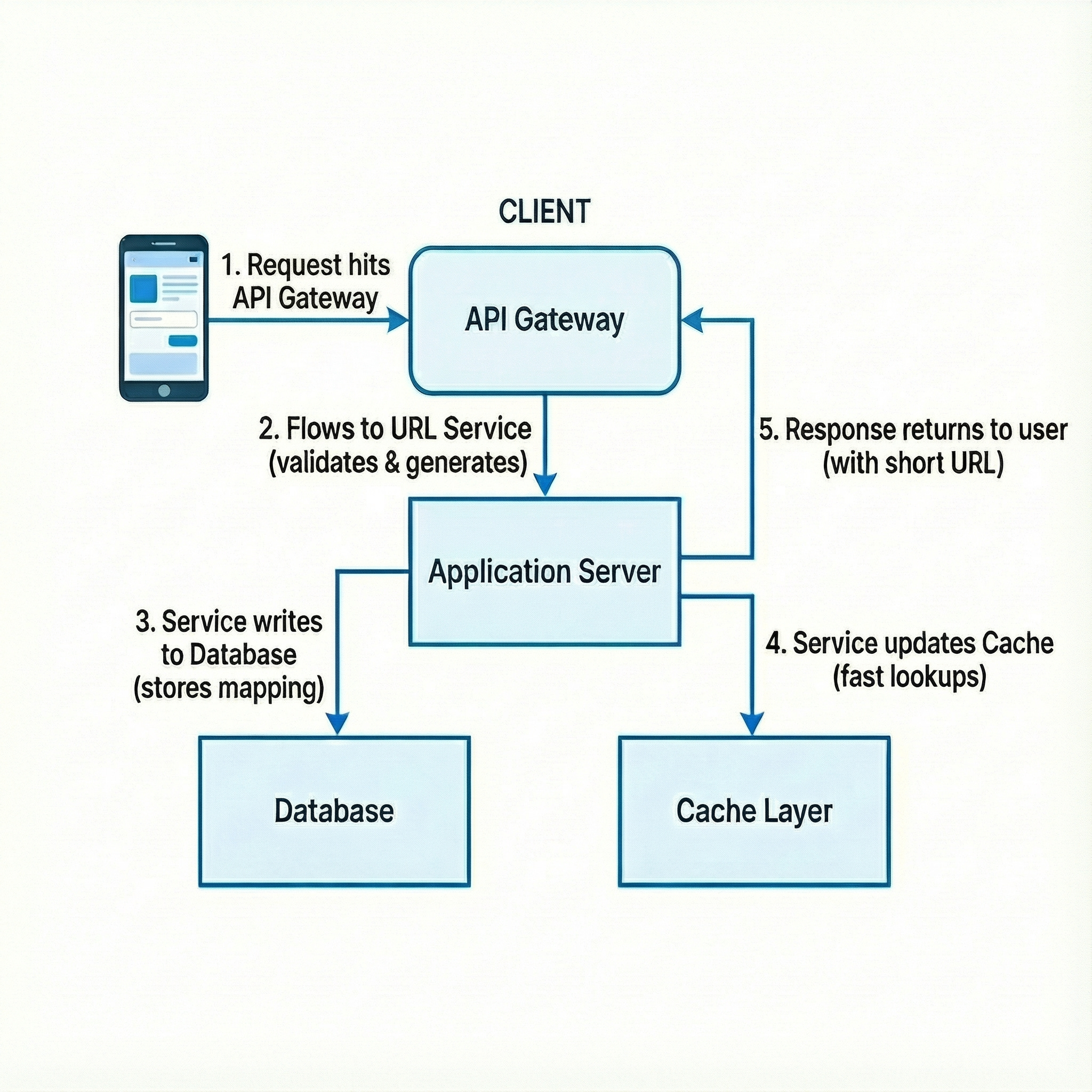
Do this for 2-3 key flows to show complete understanding.
No Tools OR Fixed Tech Stack Are Required.
❌ Don’t do this:
“We’ll use Node.js with Express, PostgreSQL 14.5, Redis 7.0, running on Kubernetes with Istio service mesh...”
✅ Do this instead:
“We need an API layer for request handling, a cache for performance, a database for persistence, and a queue for async processing.”
Why:
You’re a PM, not implementing the system. Stay at the conceptual level. Let engineers pick specific technologies.
When interviewer asks about tech stack:
“I’d defer to the engineering team’s expertise and our existing infrastructure. The key is [architectural principle], which could be implemented with [general technology category].”
Step 5: Trade-offs and Evolution - Show Technical Judgment
Goal: Demonstrate you understand there are multiple valid approaches, can evaluate them critically, and think about long-term evolution.
What to Cover
1. Present Key Architectural Decisions
Identify 2-3 critical technical decisions where alternatives exist:
Database choice (SQL vs NoSQL)
Architecture pattern (monolithic vs microservices)
Communication protocol (REST vs GraphQL vs WebSocket)
Consistency model (strong vs eventual)
Sync vs async processing
2. Compare Alternatives with Trade-off Tables
Use structured comparison:
3. Explicit Trade-off Discussion
Always frame as “We’re trading X for Y”:
“We’re trading flexibility for speed to market“
“We’re trading consistency for availability“
“We’re trading infrastructure cost for development velocity“
“We’re trading control for reduced maintenance“
4. Make Recommendation with Context
“Given [our stage/constraints/priorities], I recommend [option] because [reasoning]. We can revisit this decision when [trigger condition].”
5. Show Evolution Path: MVP → Scale
Critical to show growth thinking.
MVP Architecture:
Simple, monolithic
Optimized for learning and iteration
“Good enough” performance
Scaled Architecture:
Distributed, service-oriented
Optimized for reliability and scale
Production-grade performance
Migration triggers:
“We’d consider evolving the architecture when we hit [specific metric/pain point]”
Step 6: Success Metric - Define How to Measure Success
Goal: Connect everything back to measurable outcomes that validate your technical decisions.
What to Cover
1. Primary Metrics
The 2-3 metrics that directly measure core functionality:
“Message delivery success rate >99.9%”
“End-to-end latency <100ms (p95)”
“Sync conflict rate <0.1%”
2. Secondary Metrics
Important but not critical metrics:
“Daily active collaborators”
“Average document edits per session”
“Concurrent editors per document”
3. Guardrails
Metrics that protect against degradation:
“Error rate <0.5%”
“API timeout rate <1%”
“Data loss rate = 0%”
“Infrastructure cost per user <$X”
4. How Metrics Tie Back
Critical: Connect each metric to user experience or business outcome
Summary: Tying It All Together
After completing all six steps, provide a 5-6 sentence executive summary:
“To summarize: We’re building a [system] for [users] to [core value prop]. The MVP focuses on [P0 requirements] while deferring [nice-to-haves].
Technically, we’re using [high-level architecture] because it balances [trade-off]. This approach handles [scale requirements] while maintaining [key constraints].
We’re trading [X for Y] in the short term, with a clear evolution path to [scaled architecture] when we hit [trigger metrics].
Success is measured by [primary metric 1], [primary metric 2], and [primary metric 3], which directly connect to [business outcome].”
This is how a PM would summarize to leadership - showing you can zoom out after deep diving.
Common Pitfalls to Avoid ⚠️
Even with the S.P.E.C.T.S. framework, candidates often make predictable mistakes. Here are the most common pitfalls to avoid:
Jumping straight to components without clarifying scope.
Making assumptions without stating them.
Getting lost in unnecessary complexity.
Not communicating your thought process.
Being wedded to your first approach. Stay flexible. If the interviewer suggests alternatives, be willing to reconsider.
Apologizing or showing lack of confidence. Be honest about knowledge gaps without undermining yourself: “I’m not deeply familiar with X, but here’s my reasoning...”
Forgetting to sanity check. Always validate: “Does 10 billion notifications per second make sense? That’s 100 per user per second, which seems too high...”
Rushing through the process.
Skipping trade-offs discussion. Never present a solution as “obvious.” Always discuss alternatives and what you’re trading.
Weak or vague success metrics. Be specific: “p95 latency <100ms” not “good performance.”
Key Insight: Awareness of these mistakes is half the battle. When you catch yourself making one, acknowledge it and course-correct: “Actually, let me back up and clarify scope first...”
Pro Tips for Success ✅
Here are tips that will elevate your performance in technical PM interviews:
Think out loud throughout your answer.
Be structured but remain conversational.
Draw diagrams or use visual language.
Focus on the “why” behind decisions. Don’t just say “use NoSQL” - explain: “NoSQL because our read-to-write ratio is 100:1 and we need horizontal scaling.”
End strong with confidence. Summarize clearly: “We’re building X for Y users using Z architecture because [trade-off]. Success measured by [metrics].”
Study the Framework.
Practice with real questions.
Key Insight: Interviewers want to see how you think, structure problems, and communicate technical concepts.
Confidence + structured thinking + product mindset = winning formula.
Practice Questions for Technical PM Interviews
To build your confidence and master the S.P.E.C.T.S. framework, practice is essential.
Here are 25+ technical questions organized by category:
System Design Questions
Design a URL shortening service like Bitly that handles millions of URLs and billions of redirects daily.
Design a ride-sharing matching system like Uber that connects drivers with riders in real-time across a city.
Design a social media news feed like Facebook or Instagram that serves personalized content to millions of users.
Design a collaborative document editor like Google Docs with real-time sync and conflict resolution.
Design a video streaming platform like Netflix that handles uploads, transcoding, and adaptive bitrate streaming globally.
Technical Trade-off Questions
Should you use SQL or NoSQL for an e-commerce product catalog? Walk through the decision using S.P.E.C.T.S.
When would you choose a monolithic architecture versus microservices for a growing startup?
Should you build a payment system in-house or integrate with Stripe? Evaluate the trade-offs.
Where should you implement caching: client-side, CDN, server-side, or database? Discuss the trade-offs.
For image processing, when should you use synchronous versus asynchronous processing? What are the implications?
Architecture and Infrastructure Questions (Computer Science 101)
Explain what happens when a user clicks “Pay Now” on an e-commerce checkout page, from frontend to backend to payment processor.
How does a mobile app communicate with a backend server? Walk through the complete flow.
Describe how authentication works in a modern web application. Include OAuth, tokens, and session management.
Explain how DNS works and what happens when you type a URL into your browser.
How does HTTPS work? Explain the handshake process and why it matters for security.
API and Integration Questions
How would you integrate multiple third-party APIs (Stripe for payments, Twilio for SMS, SendGrid for email) while handling failures gracefully?
Design a webhook system that allows external developers to subscribe to events in your platform with delivery guarantees.
How would you design an API gateway for a microservices architecture that handles authentication, rate limiting, and routing?
What factors would you consider when choosing between REST and GraphQL APIs for your product?
Design a system to sync data between a mobile app and server with offline support and conflict resolution.
Technical Troubleshooting Scenarios
Your API response time suddenly increased from 200ms to 2 seconds. Walk through how you’d investigate and resolve this.
Users report that images aren’t loading on mobile devices but work fine on desktop. What’s your troubleshooting approach?
Your database is experiencing slow queries and impacting user experience. How do you diagnose and fix the issue?
Your service error rate jumped from 0.1% to 5% overnight. Walk through your investigation and resolution process.
You need to support 10x more users in 6 months. How would you identify bottlenecks and plan the technical evolution?