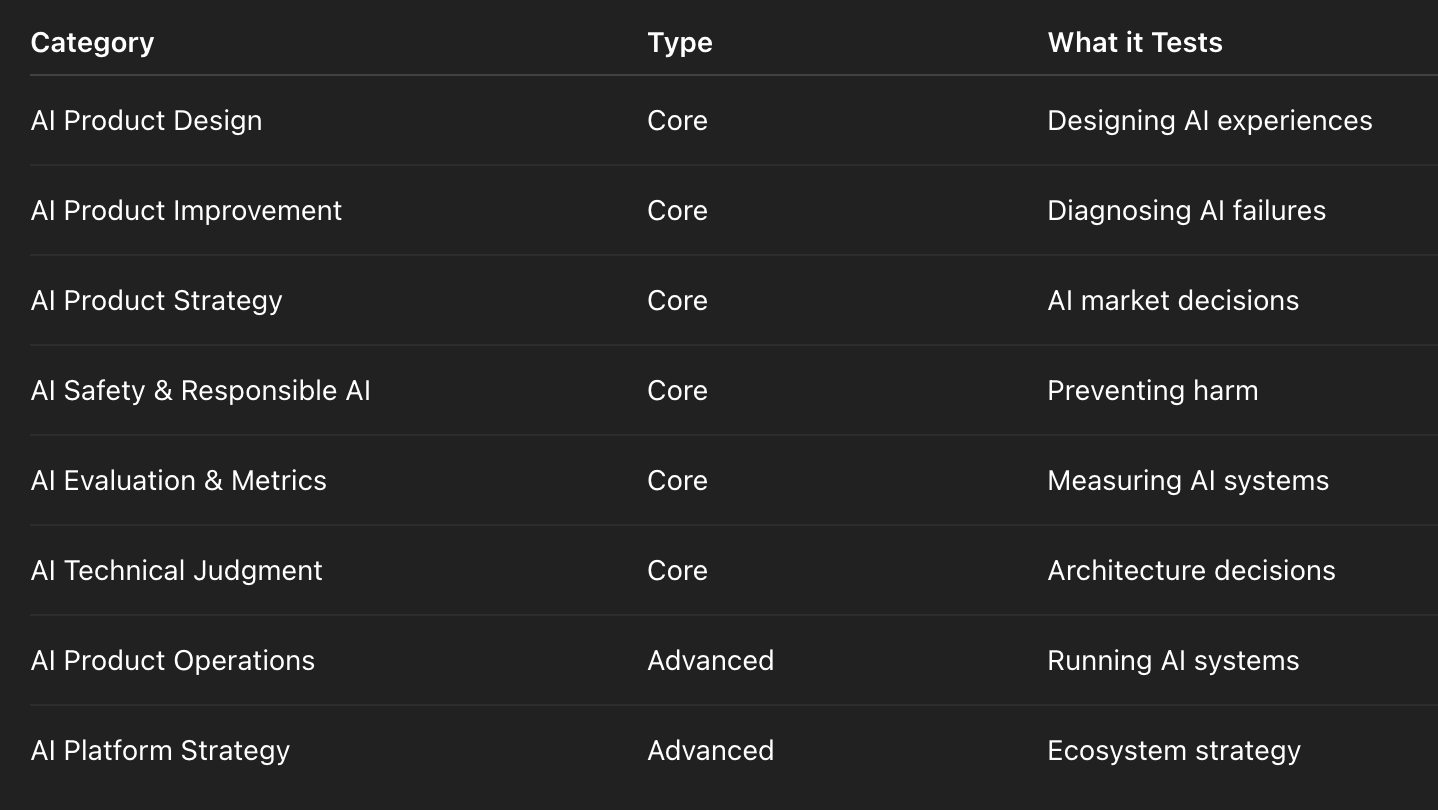
AI PM interviews are no longer just traditional PM interviews with “AI sprinkled on top.”
At companies like OpenAI, Anthropic, Perplexity, Google DeepMind, and Meta AI, interviewers explicitly test AI-specific thinking across safety, model limitations, evaluation, and strategy.
The easiest way to understand this is:
AI PM interviews = Traditional PM frameworks + AI system thinking
To master them, you don’t need multiple frameworks.
You need to master below 6 core question types:
🧠 CORE AI PM INTERVIEW QUESTION TYPES
These 6 categories cover ~90% of AI PM interview questions.
1. AI Product Design
What interviewers test
Your ability to design AI-powered experiences, considering:
probabilistic outputs
human-in-the-loop
trust & explainability
model limitations
Example questions
Design an AI tutor for learning coding
Design an AI assistant for Uber drivers
Design AI features for Notion
Build an AI tool for customer support agents
What great answers include
AI capability mapping
fallback mechanisms
failure handling
user trust design
Framework
Use CIRCLES (adapted for AI)
Add two extra steps:
AI capability assessment
human override design
We’re doing deep-dive on each question type for AI PM Interviews.
SUBSCRIBE NOW to stay in the loop.
2. AI Product Improvement
What interviewers test
Your ability to diagnose AI product issues and improve them.
Because AI products behave differently than deterministic software.
Example questions
AI coding assistant suggestions are inaccurate. Improve it.
Users don’t trust AI outputs. What would you change?
Skills tested
root cause analysis
prompt/data/system fixes
iteration loops
Framework
Use:
PQ-GUP-SEMS (our existing framework)
Add AI diagnostics:
training data
prompt layer
retrieval layer
evaluation pipeline
3. AI Product Strategy
What interviewers test?
Your ability to make strategic decisions in the AI ecosystem.
Example questions
Should Spotify build its own LLM?
Should a startup rely on OpenAI APIs or build models?
What is OpenAI’s moat?
Why did Meta abandon open model for closed model? Explain Llama to Muse Spark Shift.
Skills tested
AI economics thinking
build vs buy decisions
data moats
distribution advantage
Frameworks
BUS (Business → Users → Strategy)
SUBSCRIBE NOW to get full access, schedule 1:1 mock interviews and exclusive PM career community.
4. AI Safety & Responsible AI
What interviewers test:
Your ability to prevent harm and misuse of AI systems.
This is a major focus for companies like Anthropic and OpenAI.
Example questions:
How do you approach GenAI safety in consumer products?
Design Safeguards for an Agentic AI System That Can Take Actions on Behalf of a User.
How would you prevent harmful outputs from a chatbot?
How would you detect bias in AI systems?
How would you red-team an AI feature?
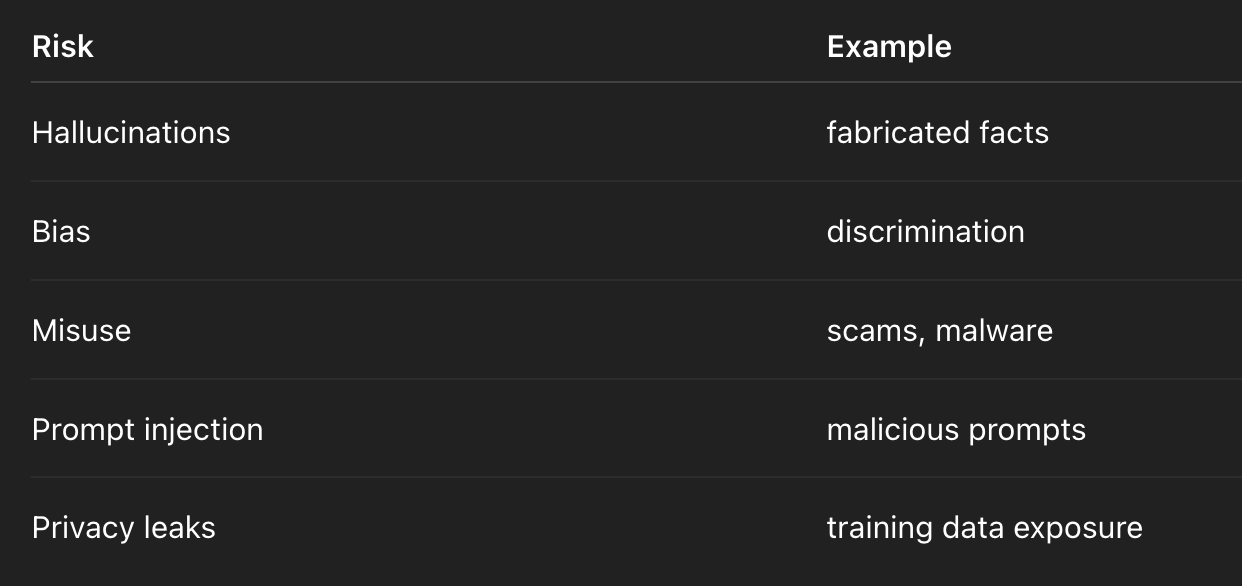
Risks you must consider:
Common AI risks include:
Framework:
P-PRIME
P - Product Context
P - Potential Risks
R - Risk Mitigation
I - Implementation Guardrails
M - Monitoring & Metrics
E - Evolution & Iteration
5. AI Evaluation & Metrics
This is a huge category in AI PM interviews.
What interviewers test:
Your ability to measure AI systems correctly.
Your understanding that AI products require different metrics than traditional software.
AI metrics are different because:
outputs are probabilistic
quality is subjective
accuracy ≠ user satisfaction
Example questions:
How would you measure success of ChatGPT?
What metrics should an AI writing assistant track?
How would you evaluate hallucination rate?
Metrics categories:

AI interviews often probe trade-offs between accuracy vs satisfaction.
Framework
EVAL-AI
6. AI Technical Judgment (Architectural Decisions)
This category is increasingly common.
You are not expected to code, but you must understand AI architecture.
Example questions:
When should you use RAG vs fine-tuning?
When should you use embeddings?
When should you build an AI agent vs workflow?
Design an Agentic AI System That Autonomously Adapts to New Tasks.
Skills tested:
ML system understanding
engineering collaboration
feasibility assessment
Framework:
STACK-AI
🚀 ADVANCED MODULES
These are important in real-world PM work, but appear less frequently in interviews, especially for junior roles.
7. AI Product Operations
This category tests whether you can run AI systems in production.
AI products require constant monitoring.
Example questions:
How would you monitor model drift?
What should an AI incident response look like?
How do you handle harmful outputs after launch?
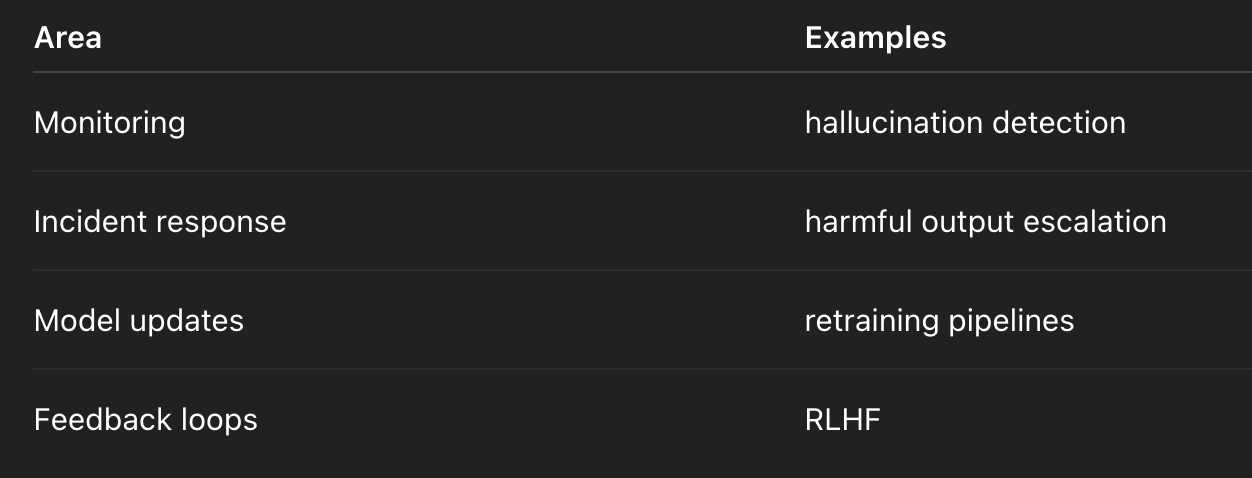
Operational areas:
Where it shows up:
embedded in metrics questions
embedded in safety questions
senior PM interviews
8. AI Platform & Ecosystem Strategy
This category appears frequently in senior AI PM interviews.
Example questions:
Should OpenAI create an app ecosystem?
How should Anthropic monetize Claude APIs?
Should Google open-source its models?
Skills tested:
platform effects
developer ecosystem strategy
pricing models
Summary for The Complete AI PM Interview Guide