



A developer opens Claude Code and asks it to build a new onboarding flow.
Claude explores the repo, touches twelve files, writes tests, fixes a failing one, and opens a pull request. It looks impressive. Dozens of tool calls, hundreds of lines of code, almost no hand-holding.
Three days later, the PR gets substantially rewritten in review.
Now picture a second developer. Claude touches four files, writes a fraction of the code, and the change passes the test suite, matches the repo’s conventions, clears review with a couple of minor comments, and ships two days ahead of schedule.
Which session represents greater product success?
This is the core challenge in measuring an AI coding agent: visible activity is not the same as delivered value.
Lines of code can rise while maintainability worsens. Users can accept incorrect output. A task can finish quickly but create security issues or rework later. An agent can also take 20 minutes to work autonomously and still save the developer an hour of active effort.
Traditional product metrics such as weekly active users, sessions, or feature clicks cannot answer this question alone. Claude Code must be evaluated simultaneously for AI quality, user trust, agent reliability, developer outcomes, business sustainability, and long-term learning.
I would structure the answer using EVAL-AI framework.
The question we will answer in this article is:
“You are the Product Manager for Claude Code. How would you measure whether the product is successful?”
Table of Contents
How to measure success of Claude Code? - Using EVAL-AI Framework
Step 2: V - Value Metrics - Is the Output Correct, and Is It Actually Good?
Step 3: A - Adoption Metrics - Do Developers Trust and Keep the Output?
Step 4: L - Latency and System Health - Is It Fast, Reliable, and Affordable Enough to Use?
Step 5: A - Alignment Metrics - Does This Actually Matter to the Business and the Developer’s Goals?
Step 6: I - Iteration Metrics - Is It Getting Better, and Is It Safe?
Why This Question Is Different
Most AI PM metrics questions are hard because AI outputs are probabilistic and quality is subjective. Claude Code stacks three more layers of difficulty on top of that, and naming them out loud, unprompted, is one of the fastest ways to signal depth in the room.
1. It’s agentic, not conversational.
2. It has partially verifiable ground truth, and that’s a gift most AI products don’t get.
3. It can take irreversible actions.
4. The user is a developer, not a general consumer.
Developers have high technical standards and low tolerance for confidently wrong output. A developer who gets a plausible-looking diff that quietly doesn’t work loses more trust, faster, than a general user who gets a mediocre chatbot response, because the failure often doesn’t surface until later, in review, in CI, or in production.
Now, let’s answer this question.
How to measure success of Claude Code?
Using EVAL-AI framework that I introduced in the previous article.
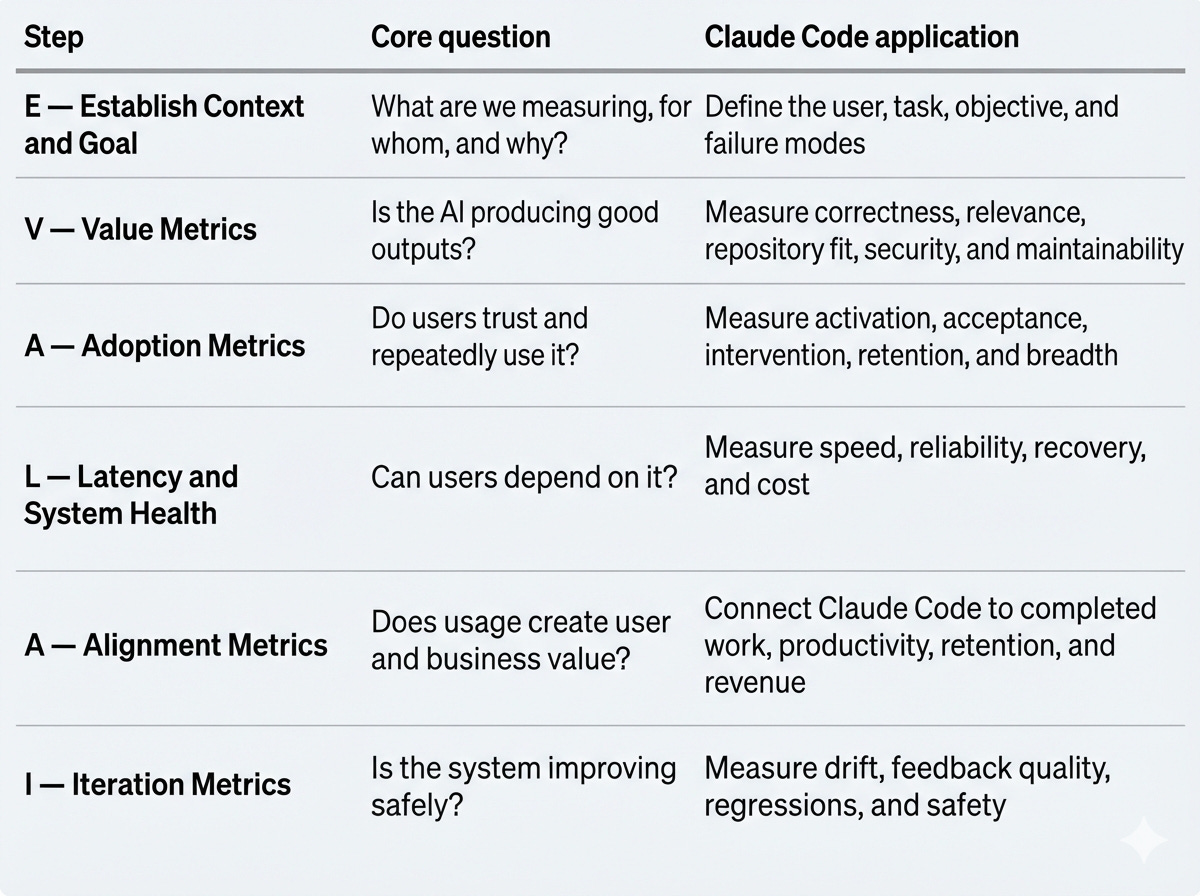
The sequence matters. Strong AI quality can still produce weak adoption, while high adoption can hide poor output. Short-term speed can also create downstream rework, risk, or future regressions.
Let’s dive deeper into each step.
Step 1: E - Establish Context and Goal
Before naming a single metric, walk through five steps that define what you’re actually measuring. Skipping straight to metrics is the single most common way this layer falls apart in an interview, because a metric with no anchor to a user, a segment, and a defined failure mode isn’t diagnostic. It’s decoration.
1. Clarify the Product and Scope
Claude Code is Anthropic’s agentic coding tool. It runs in the terminal, in IDEs, and in the desktop app, and it can read a codebase, write and edit files, run tests, execute commands, and manage version control on a developer’s behalf.
It isn’t autocomplete. It’s closer to handing a task to a capable junior engineer and letting them work through it with some autonomy, inside the permission boundaries the user sets.
That framing matters because it changes the unit of analysis. For an autocomplete product, the useful unit is a single suggestion: was it shown, was it accepted, did it save keystrokes.
For Claude Code, the unit is a goal-oriented task:
did the user ask Claude to fix the failing tests,
did Claude understand the failure,
did it touch the right files,
did the tests pass afterward,
did the developer keep the change.
Naming this distinction out loud in the interview is a fast way to signal you understand the product before you’ve said a single metric.
2. Ask Clarifying Questions
A small number of questions can materially change your measurement strategy, and asking them shows the interviewer you’re not reciting a memorized framework.
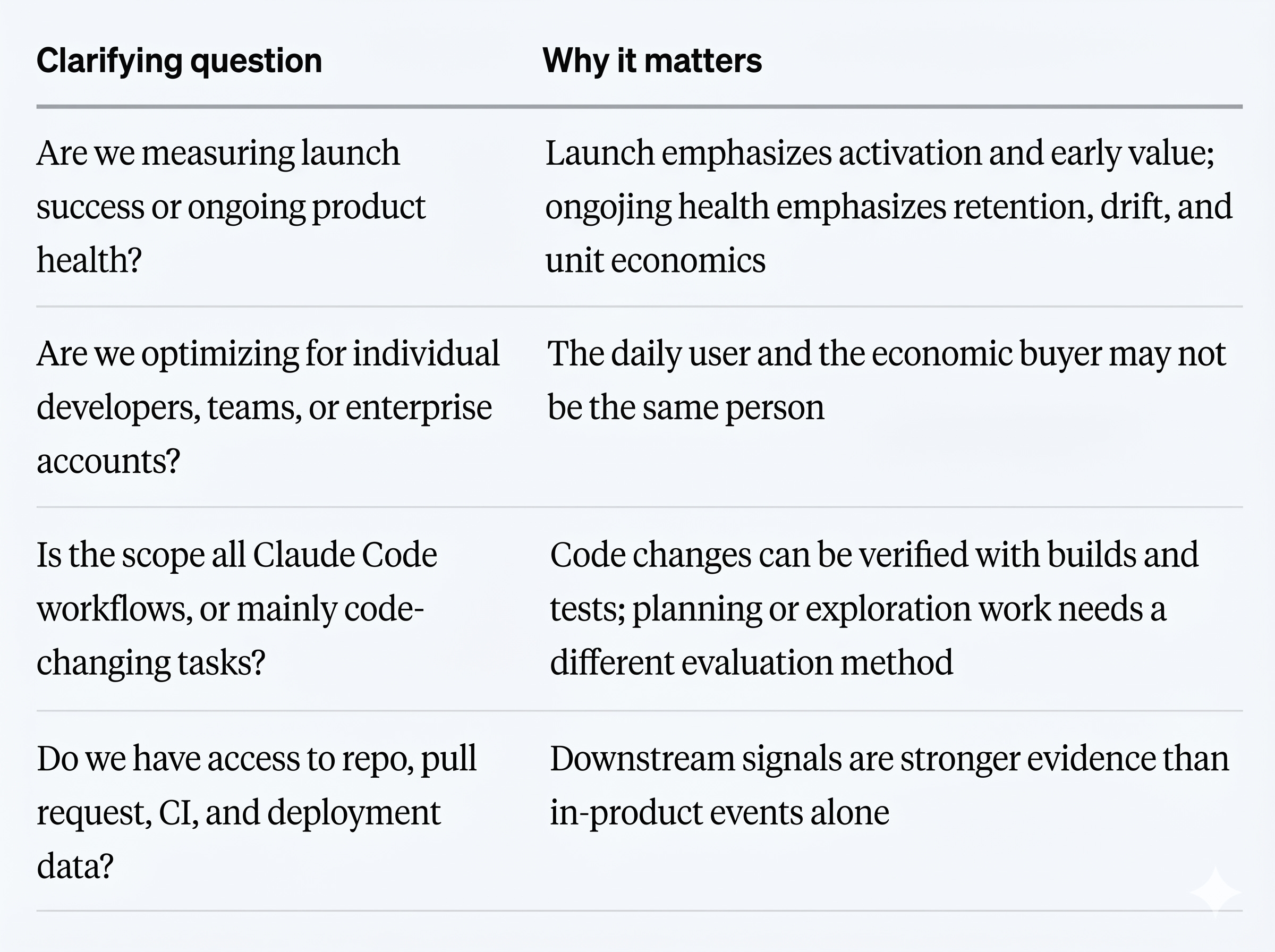
For this walkthrough, assume we’re measuring ongoing product health for teams doing code-changing work, with telemetry that can be joined to Git, CI, and deployment data. Stating that assumption out loud, instead of silently picking one, is what a senior candidate does.
3. Prioritize the User Segment
Segment and then prioritize the users:
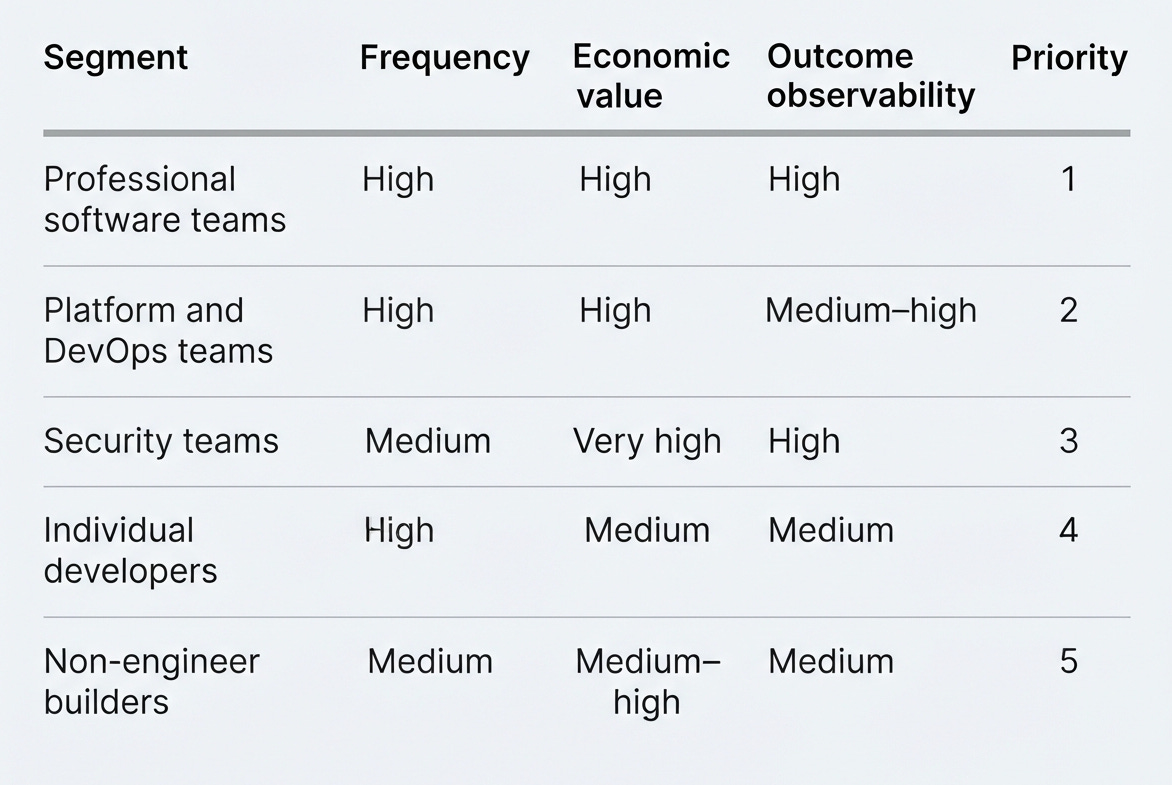
I’d prioritize:
Professional software-development teams using Claude Code for feature work, bug fixes, testing, and refactoring.
Why?
This segment has frequent, recurring tasks, results that can often be verified objectively through tests and builds, and a natural expansion path from individual use to team-wide adoption, which makes it the strongest anchor for the rest of the metric stack.
4. Define the Product Goal
The goal should name both the value you’re going after and the constraints you’re not willing to trade away for it:
Help software development teams complete valuable development tasks faster and with less human effort, while maintaining or improving code quality, security, and maintainability.
Pay attention to the goal defined with constraints above.
“Faster” without “quality” rewards a tool that ships code but not the outcomes.
“Less human effort” without “maintaining quality” rewards a tool that looks autonomous while quietly pushing cleanup work downstream to code review.
Naming the goal this precisely is what lets you monitor an agent that’s technically up but also reflects success.
5. Define Failure Modes
Metrics become more useful when you first define how the product can fail.
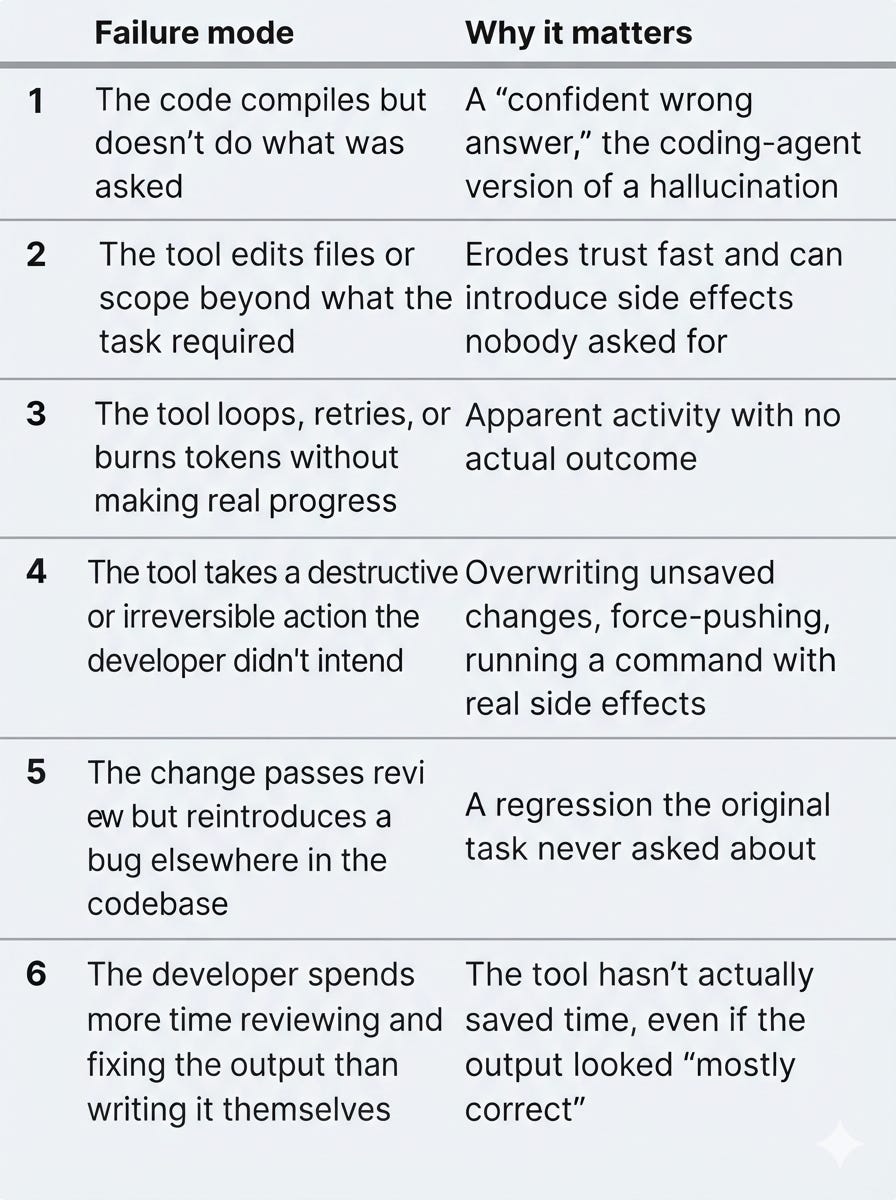
These failure modes shape the remaining layers.
Step 2: V - Value Metrics - Is the Output Correct, and Is It Actually Good?
Value metrics answer one question:
Is Claude Code producing good work?
This has to be measured independently of whether users are engaging with the product. High usage doesn’t prove correctness, and high acceptance doesn’t prove the user actually noticed an error.
This is also where Claude Code’s verifiable ground truth becomes a real strategic advantage, and where you should say so out loud in the interview:
code compiles or it doesn’t,
tests pass or they don’t,
which gives you an evaluation option most AI products never get for free.
1. Define “Good” Output
For a code-changing task, quality has six dimensions, and a strong answer names all six rather than stopping at “does it work.”
Functional correctness. Does the code compile, run, and satisfy the expected behavior?
Intent adherence. Did Claude solve the problem the user actually described?.
Repository fit. Does the change follow architecture, conventions, dependencies, and testing patterns?
Maintainability. Is the solution clear, appropriately scoped, and easy to change?
Security. Does it avoid vulnerabilities, secrets exposure, and unsafe dependencies?
Agent competence. Can Claude gather context, make sensible plan, use tools, recover from errors, and stop appropriately?
2. Define Primary Value Metric
My primary Value metric would be:
Verified Task Success Rate
→ Verified Task Success Rate = Eligible tasks meeting all success criteria / Total eligible task attempts
A code-changing task counts as successful only when:
The user’s acceptance criteria are satisfied
The project builds or compiles
Relevant tests pass
No critical security issue is introduced
Repository-specific requirements are followed
The task doesn’t require material human rewriting before it works
This bar is deliberately stricter than “Claude produced code” or “the user accepted the change.” Both of those are easy to hit and neither one proves the work was actually good.
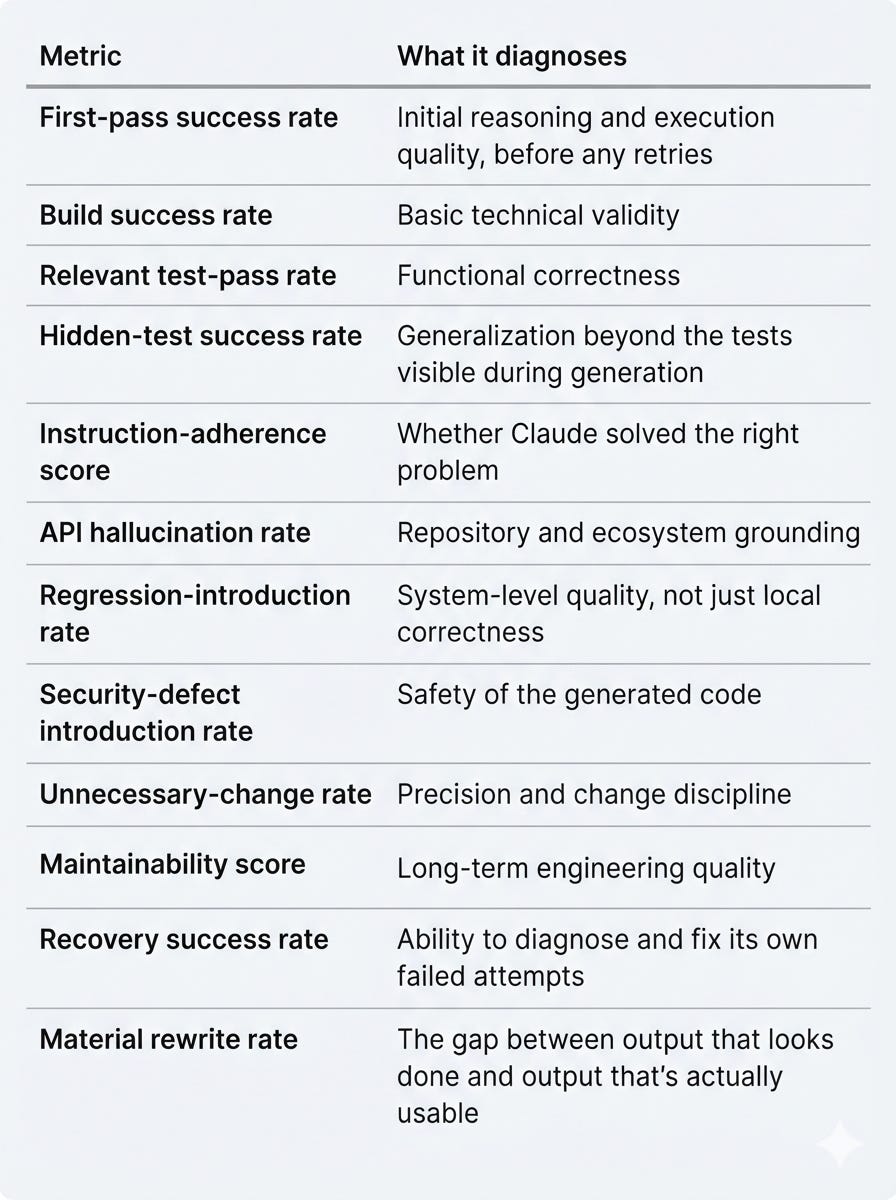
3. Supporting Value Metrics
4. Choose the Evaluation Method
A strong candidate explains not just what to measure, but how, and is honest about what each method misses.
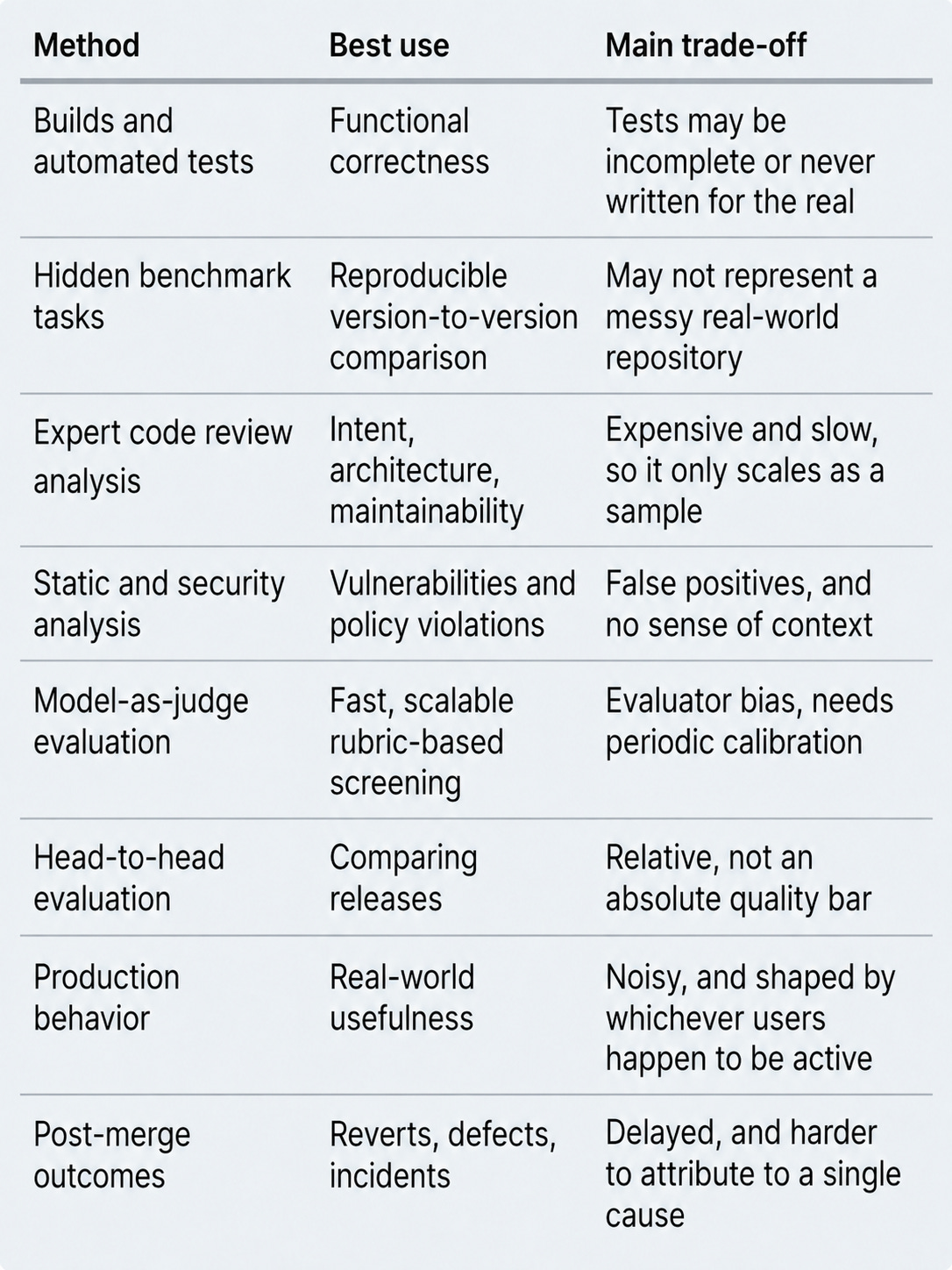
I would use a hybrid system:
Deterministic checks for builds, tests, linting, and security policies
Expert review for intent, architecture, and maintainability
Head-to-head testing for release comparisons
Production outcomes to validate offline results
💡 Interview Tip: Keep correctness in Value and acceptance in Adoption. A user can accept incorrect code, so acceptance can never be your quality metric. Conflating the two is one of the fastest ways to lose points on this layer.