The interview is going well. You nailed the product design question. Your metrics answer was tight.
Then the interviewer at Anthropic - or OpenAI, or Google DeepMind - asks:
→ “You’re launching a general-purpose AI assistant for consumers. Walk me through your safety approach.”
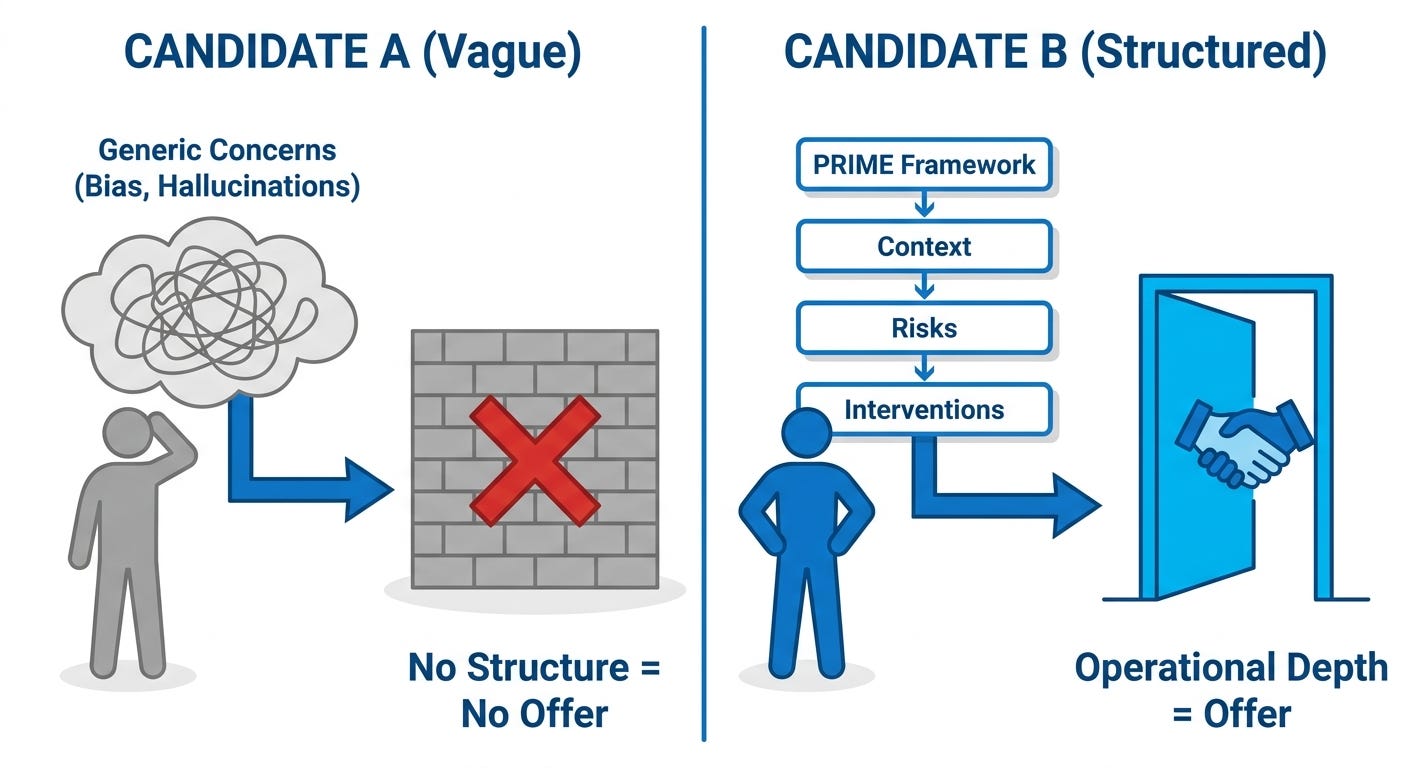
Candidate A (the one who doesn’t get the offer) says: "AI can be biased and can hallucinate, so we'd need to add content filters plus monitor with evaluations to make sure we're being responsible."
The interviewer nods. Politely. The silence after feels like a verdict.
Candidate B (the one who does get the offer) says: "Before I name any risks, let me establish context. This is a general-purpose consumer assistant - millions of users, including minors and people in crisis. The blast radius of a single harmful output is amplified by scale and the absence of any intermediary review..."
Candidate B continues for five more minutes detailing - specific risks with affected groups, concrete interventions mapped to guardrail layers, safety metrics to track and a post-launch red-team cadence.
The difference between these two candidates is not knowledge. It is structure and operational depth.
This guide gives you exactly that. By the end, you will have:
A five-step framework called PRIME, taught and applied to a real interview question
Two complete worked examples, a safety metric stack, and twelve practice questions
The ability to answer any AI safety question the way the best AI PMs at the world’s most safety-focused companies actually think about it
Before diving deeper into the framework, let’s first understand why and how AI safety questions are different.
Why AI Safety Questions Are Different
At companies like Anthropic, OpenAI, and Google DeepMind, AI safety questions are not ethics pop quizzes. They are not testing whether you care about responsible AI. Everyone says they care. They are testing a specific, three-part skill set.
1. Specificity of harm identification. Can you name the mechanism, the affected group, the context, and the severity - not just the category?
"It could be biased" is not a harm identification.
"A hiring screener built on this model may systematically rank women lower for senior engineering roles because training data over-represents historical hiring outcomes from companies that filtered heavily on Ivy League credentials" is a harm identification.
2. Safety and product quality as complements, not trade-offs. Do you see safety as a constraint on the product, or as a design input that makes the product better?
A well-calibrated safety system builds user trust, reduces regulatory exposure, and creates a long-term competitive moat that pure feature velocity cannot replicate.
Anthropic's Constitutional AI was designed with exactly this insight: a product that is simultaneously more helpful and more harmless.
3. Operational depth. Can you go from identifying a risk to defining an intervention, specifying which guardrail layer it operates at, choosing a monitoring metric, and describing an escalation path?
Identifying that hallucinations are a risk is table stakes.
Explaining that you would implement a domain classifier as an input guardrail, require citation grounding as an output guardrail, and track hallucination rate disaggregated by domain weekly - that is operational depth.
Crack PM Interview prepares PMs for AI-first roles at companies like Anthropic, OpenAI, Google DeepMind, Meta AI and other AI-first companies.
Introducing The PRIME Framework To Answer AI Safety Questions
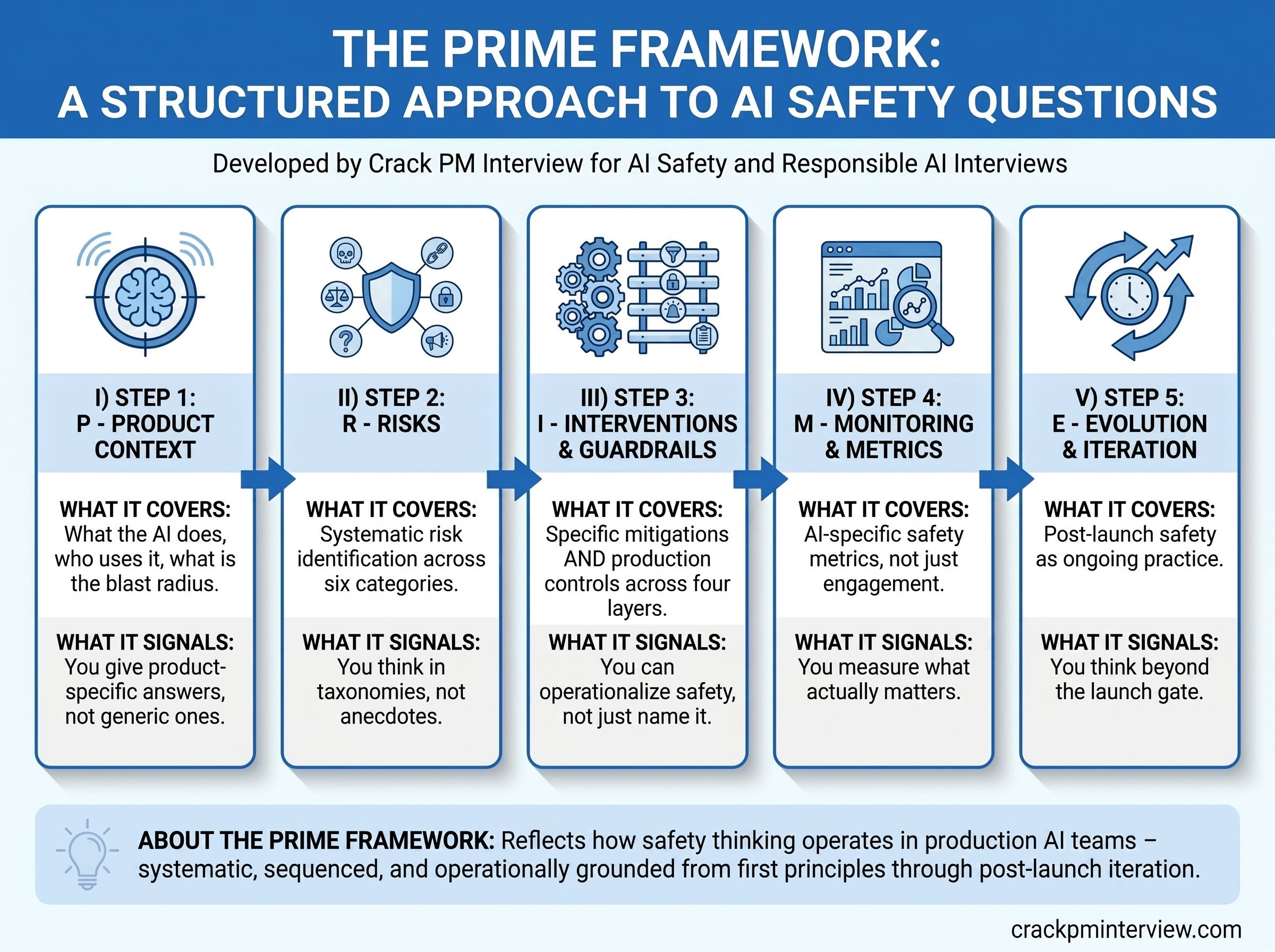
The PRIME framework is your structured answer system for any AI safety question. It mirrors how the best AI safety teams actually operate: systematically, with clear sequencing from context to risk to mitigation to monitoring to iteration.
Now let’s go deep on each step, using the anchor question that appears most frequently in AI PM interviews: “You’re launching a general-purpose AI assistant for consumers. Walk me through your safety approach.”
Step 1: P - Product Context
What this step covers:
Before you name a single risk, establish context.
What is the product?
Who uses it, and in what situations?
What does the AI model actually do?
What decisions does it make or influence?
And critically: what is the blast radius if something goes wrong?
Apply this step to the anchor question (Safety in general-purpose AI assistant)
“A general-purpose consumer AI assistant - think ChatGPT, Claude, Gemini - serves millions of users with open-domain queries.
Users include students, professionals, non-English speakers, people experiencing mental health crises, children who may bypass age restrictions, and professionals seeking information in high-stakes domains like medicine, law, and finance.
The AI generates text, code, and potentially images. It influences real-world decisions. The blast radius is wide and deep: a single harmful output can reach a vulnerable user with no intermediary, no human reviewer, and no delay.”
This context changes everything downstream. A product serving enterprise HR professionals and a product serving general consumers face different risk profiles, different mitigation priorities, and different acceptable error rates. Establishing context before listing risks is not a warm-up. It is the analytical foundation that makes your entire answer credible.
💡 Interview Tip:
Spend 30-45 seconds explicitly establishing product context before naming risks. Interviewers notice when candidates rush straight to harm lists - it signals pattern-matching over genuine analysis. The candidate who slows down to establish context first consistently appears more sophisticated, not less efficient.
Systematically identify risks across all six AI risk categories.
The goal is not to list every possible harm - it is to demonstrate that you think in taxonomies and can connect each risk to a specific affected group, a specific mechanism, and a specific context.
What changes in AI vs. traditional products for risks:
Traditional product risks are mostly predictable and bounded - a broken checkout flow, a crashed app, a misrouted notification.
AI product risks are emergent and context-dependent. The same model can be safe in one query and dangerous in the next.
Risks compound through feedback loops (biased outputs generating biased training data).
This is why a systematic risk taxonomy matters: without one, you will miss entire categories of harm.
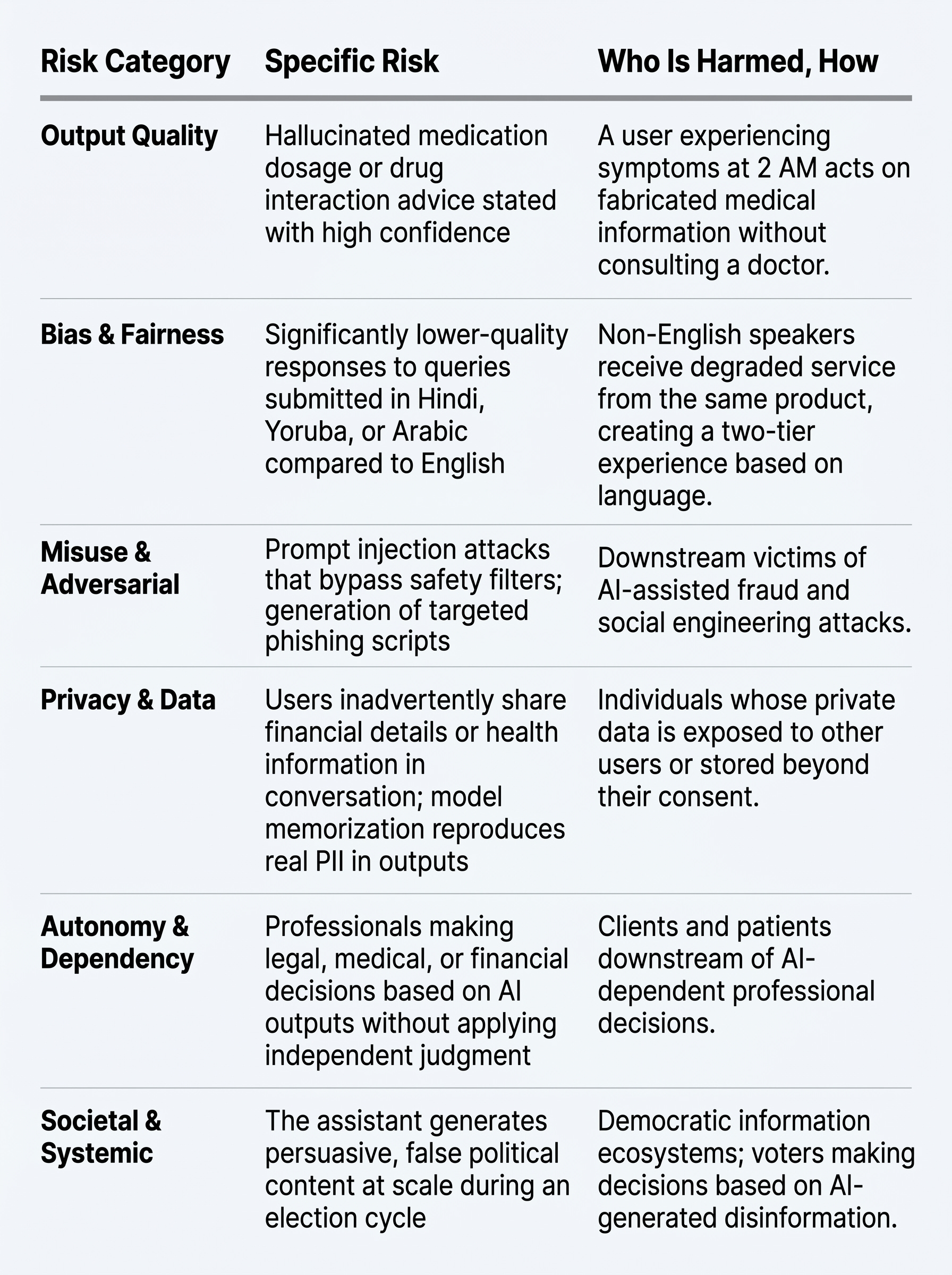
The six AI risk categories every PM must know:
1. Output Quality Risks: Hallucinations, factual errors, confident wrongness, outdated information. In low-stakes contexts, these are embarrassing quality failures. In high-stakes contexts, they are safety risks with potential for real harm.
2. Bias and Fairness Risks: Training data bias, demographic disparities, feedback loop amplification. The risk is not just that the model treats groups differently - it is that those differential outcomes become data that trains future models, compounding the disparity over time.
3. Misuse and Adversarial Risks: Prompt injection, jailbreaking, social engineering assistance, generating harmful content. These are risks not from the product failing, but from bad actors deliberately exploiting it.
4. Privacy and Data Risks: PII exposure, training data memorization, inference attacks. Users often share sensitive information without realizing it. The model may reproduce memorized personal data in outputs.
5. Autonomy and Dependency Risks: Over-reliance, deskilling, automation of high-stakes decisions without adequate oversight. A student who uses AI for every assignment may not develop critical thinking skills. A clinician who defers to AI output without independent judgment may catch fewer errors.
6. Societal and Systemic Risks: Misinformation at scale, concentration of information power, environmental impact, labor displacement effects.
Applied to the anchor question (consumer AI assistant):
The specificity standard:
“The model may hallucinate” is a C-grade observation in an AI PM interview.
“In a consumer assistant, the model may generate plausible-sounding but entirely fabricated medication dosage information, and because the ECRI ranked AI chatbot misuse in healthcare as the number one health technology hazard of 2026, a user acting on that output without consulting a clinician faces real safety risk” is an A-grade observation. The mechanism, the affected person, the context, the stakes - all visible.
💡 Interview Tip:
You do not need to cover all six categories at equal depth in every interview. Identify the two or three most critical risks for the specific product, go deep on those, and briefly acknowledge the others. “I’d also want to flag privacy and systemic risks, though for this product I think the output quality and misuse risks are the highest priority” is a strong prioritization move that signals PM judgment.
For every risk you identified, propose specific, implementable interventions (risk mitigations) and specify which guardrail layer each one operates at.
This step tests whether you can operationalize safety - not just name risks, but define what you would do about them, where in the system you would do it, and how the control actually works in production.
It is the step that separates PM candidates from everyone else.