


When most candidates hear this question, they recite the news head headlines.
“Meta got greedy.”
“Zuckerberg changed his mind.”
“Chinese labs stole the playbook.”
“The open-source era is over.”
Every one of those answers is a data point dressed up as a conclusion. They tell the interviewer what you read. They do not tell the interviewer how you think. And in an AI PM interview, how you think is the only thing being evaluated.
Here is what makes this question genuinely hard:
You need to explain why open-source was the right call from 2022 to 2025
AND why closed-source is the right call in 2026
You need both halves. A candidate who only explains the pivot misses the strategic logic that made Llama correct in its era. A candidate who only defends Llama misses the market shift that made Muse Spark necessary.
The through-line that holds both halves together is this:
The decision changed because the battleground changed. Open source wins ecosystem battles. Closed source wins consumer product battles. Meta moved from one to the other.
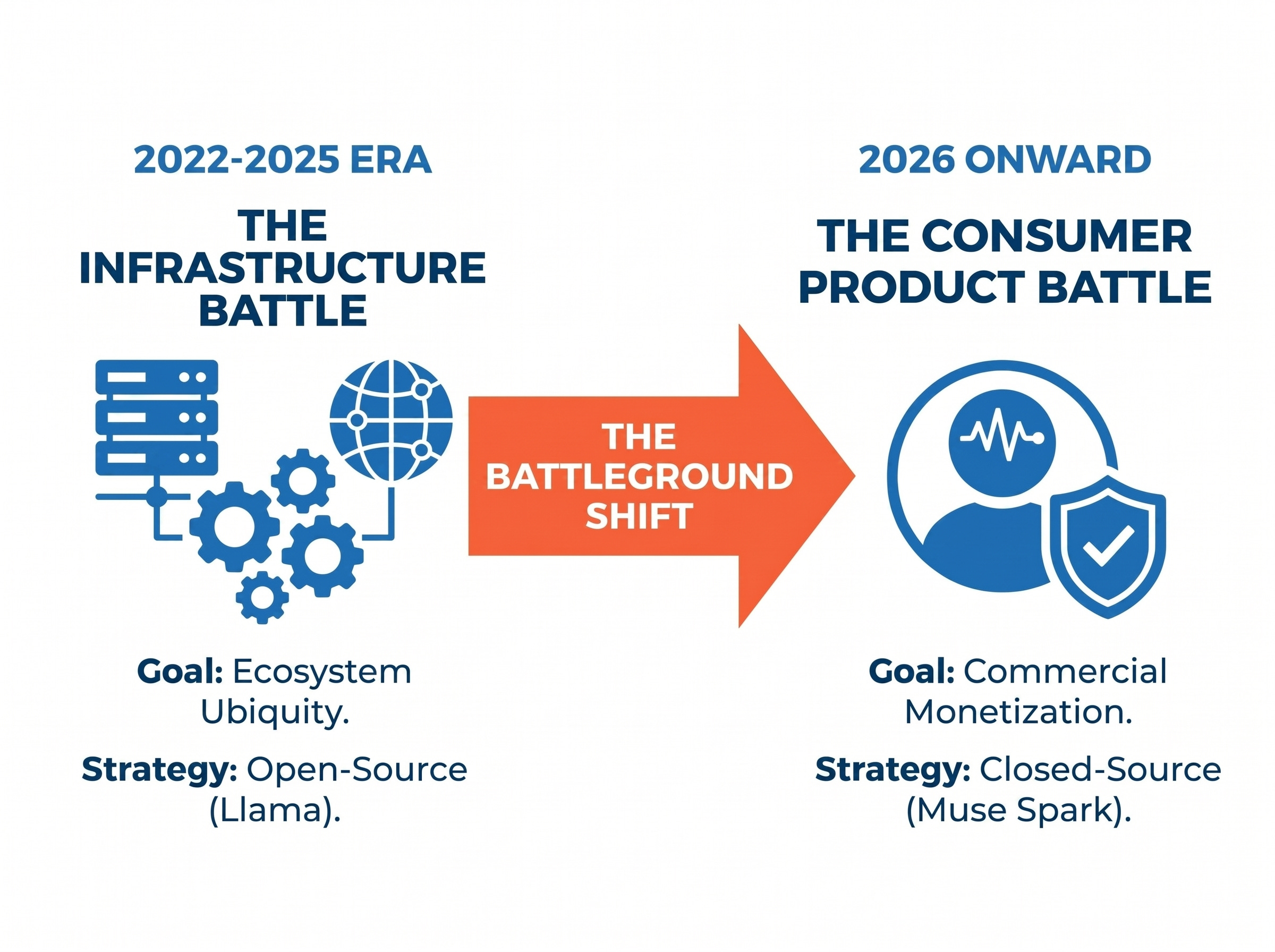
That is the complete answer in one sentence. The rest of this article is how you build it, layer by layer, in an interview room.
Find the 6 essential question types in AI PM interview here.
Previous Article: How to answer AI Product Strategy Questions?
Here is what we’d cover in this article:
The BUS Framework applied to the AI Strategy Shift - step by step
Step 1: (B) Business Objectives - What Changed for Meta Between 2022 and 2026?
Step 2: (U) User and Customer Needs - Who Is the Primary Customer, and Did That Change?
Step 3: (S) Solutions and Strategy - What Were the Options, and Why Did Closed-Source Win?
AI Strategy Concepts You Must Know Before Answering
Before diving deeper, it is worth spending some time know about concepts which everyone should know before structuring the answer.
These are the four building blocks of the answer. Without them, you are assembling the BUS Framework with missing parts.
Concept 1: The Open-Source AI Economics Model
Open-source AI economics follows the same logic as Red Hat’s Linux business and Google’s Android play: give away the model, charge for everything that runs on top of it.
Why it works:
Training cost is fixed - you pay it once
Ecosystem value compounds over time
Developers adopt the free model, build products, generate momentum, and eventually want managed deployment, enterprise support, and platform integrations
You monetize the blades, not the razor
Why it breaks - in two conditions:
Training costs escalate faster than ecosystem monetization can recover
The model stops being infrastructure and becomes the product itself
The cost ceiling concept is critical here: there is a training cost threshold above which giving away the trained model is indefensible to investors. Meta crossed that threshold somewhere between Llama 3 and the decision to build Muse Spark.
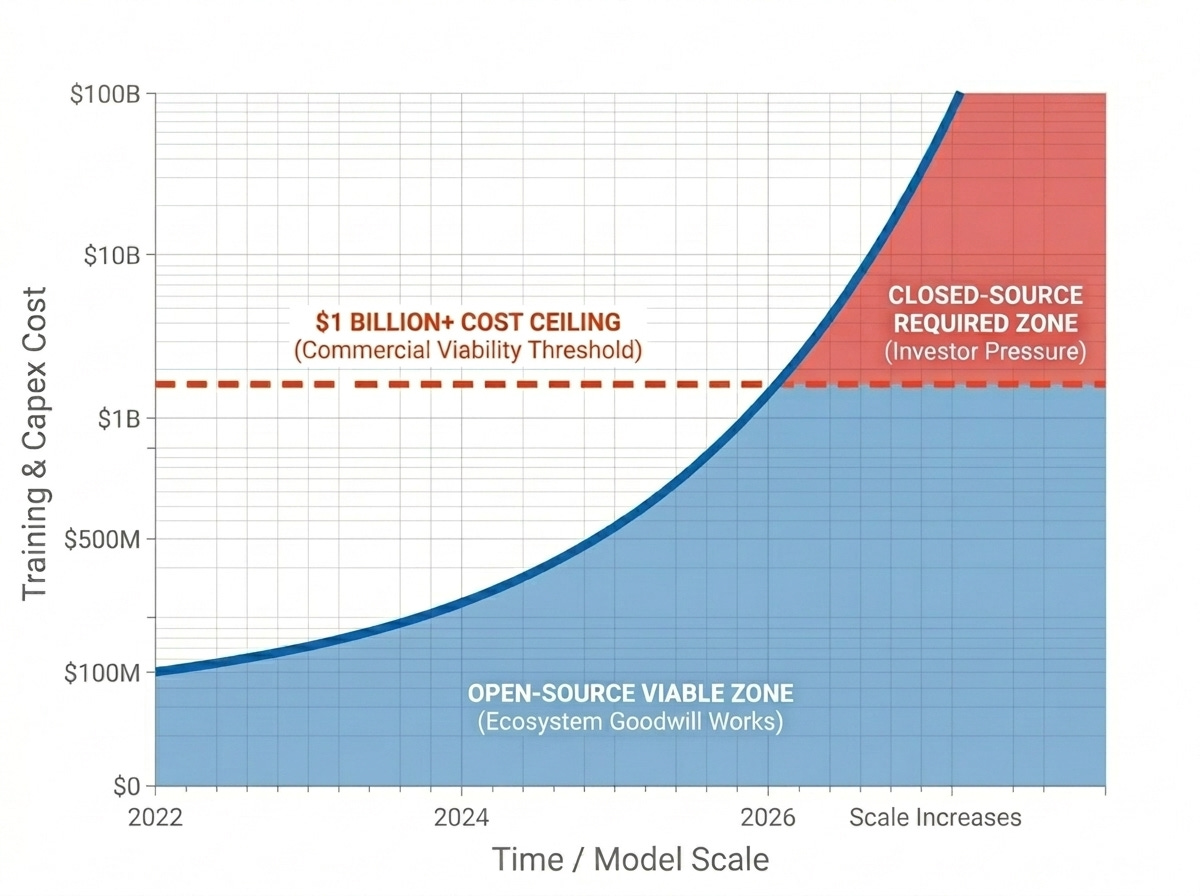
When a single training run costs over a billion dollars and annual capex is $125-145 billion, “ecosystem goodwill” is not a sufficient return.
Concept 2: AI Battleground Theory - Infrastructure vs. Consumer
The AI ecosystem has two distinct competitive battlegrounds, each with different winning conditions.
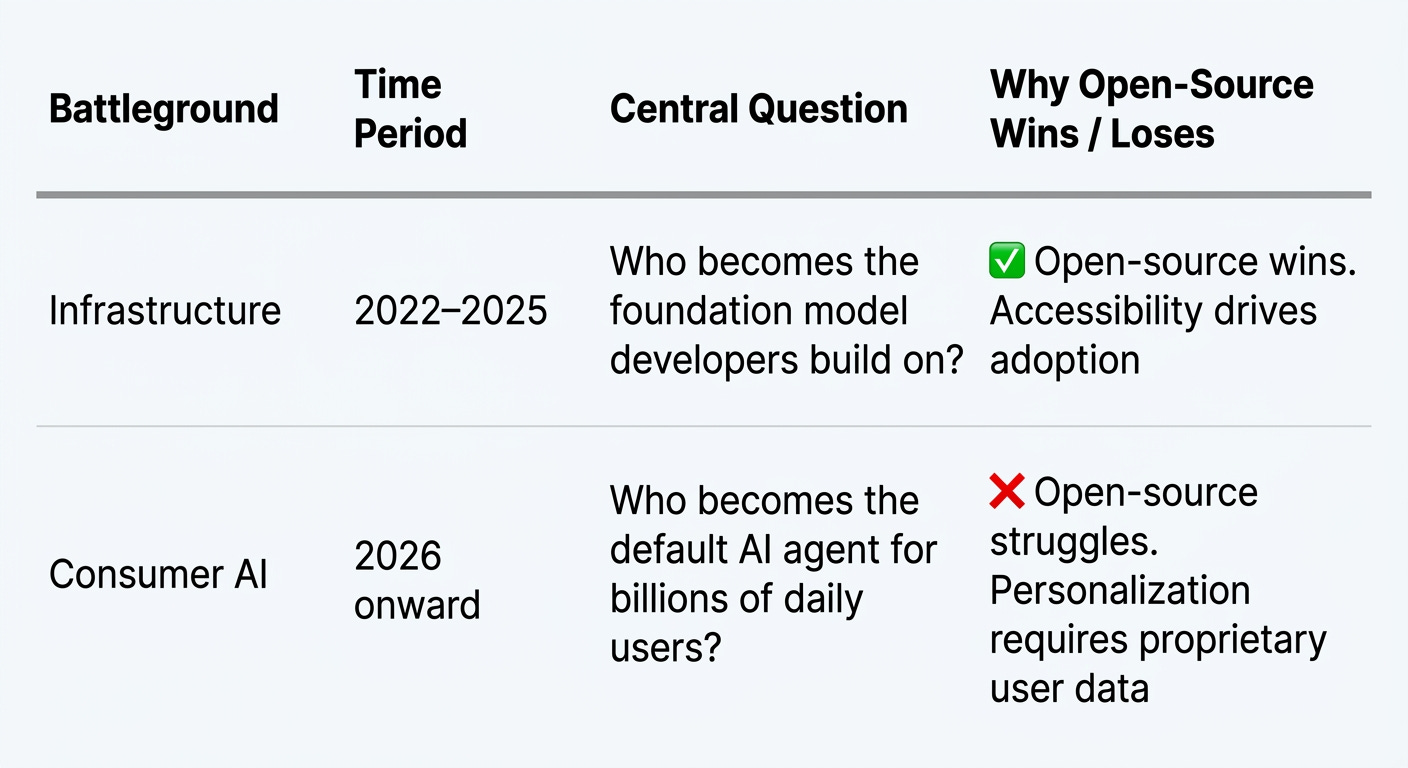
The core principle: when a company shifts from competing on infrastructure to competing on consumer products, its open-source posture should shift with it. That is not inconsistency. That is strategic discipline.
Concept 3: AI Moats and How They Shift
Different strategies build different types of moats - and when the strategy changes, the moat profile changes.
Open-source builds developer ecosystem moats:
Adoption momentum and community dependency
Tooling built around the model (hard to rebuild on a competitor)
Switching costs from years of fine-tuning investment
Primarily relevant in the infrastructure battleground
Closed-source with proprietary data builds consumer data moats:
Personalization depth from behavioral signals unique to your platform
Model improvement from usage patterns no competitor can replicate
Switching costs rooted in how well the AI knows the individual user
Primarily relevant in the consumer AI battleground
Meta traded the first type of moat for the second. Understanding what was gained, what was lost, and whether the trade was worth it is the moat analysis the interviewer wants to see.
Concept 4: The Open vs. Close Decision Criteria for AI
Open-source when:
You need ecosystem adoption more than margin
Your model is infrastructure others build on
Training costs are recoverable through ecosystem monetization
You need to commoditize a competitor’s pricing power
Your primary customer is a developer who needs customization
Close when:
Your model is the product, not the platform
It integrates proprietary user data that cannot be externalized
You need direct API revenue
Your capex commitment requires commercial returns that ecosystem monetization cannot deliver
You are competing on consumer experience, not developer tooling
💡 Interview Tip:
These four concepts are the analytical vocabulary you need to answer this question without relying on news recall. An interviewer at a top AI company wants to hear these frameworks applied - not a recap of what the tech press wrote about Muse Spark. If you can define the cost ceiling concept and the battleground theory in your own words, you are already ahead of most candidates in the room.
How to Answer AI Strategy Shift Question? The Complete Interview Answer
This is the core of the article. What follows is the full answer to “Why did Meta shift AI strategy from open-source AI to a closed model?” - built step by step, the way you would build it in an interview room using the BUS framework.
Step 1: (B) Business Objectives - What Changed for Meta Between 2022 and 2026?
Step 2: (U) User and Customer Needs - Who Is the Primary Customer, and Did That Change?
Step 3: (S) Solutions and Strategy - What Were the Options, and Why Did Closed-Source Win?
Step 1: (B) Business Objectives - What Changed for Meta Between 2022 and 2026?
How to frame the B step for this question
Usually, this step is used to describe the company - its mission, revenue model, current position.
But, for a strategy-reversal question, B needs to do something harder: explain how the business context shifted in ways that made the old strategy correct then and the new strategy correct now.
Meta’s Business Objective in 2022: Establish AI Ecosystem Position
The problem Meta faced in 2022:
No developer mindshare and no AI infrastructure position
OpenAI and Microsoft locking in enterprise with GPT-4
Google embedding Gemini into Android and Workspace
Meta: three billion daily users, world-class FAIR research team, zero relevance as an AI infrastructure provider
The existential risk: If AI became the infrastructure layer of the internet and Meta had no position in that layer, Meta’s competitive advantage in advertising would erode. The companies controlling the AI stack would control ad context, content engagement, and personalization systems. A Meta reliant on someone else’s AI stack was a structurally weaker Meta.
The business objective in 2022 was therefore specific: Establish ecosystem position in AI before the infrastructure layer calcified around OpenAI and Google.
Why open-source served this objective:
Infrastructure adoption requires zero friction
The fastest path to becoming the default is making the model free
Price is the most important adoption barrier - remove it and adoption follows
Every developer who builds on Llama is a vote against OpenAI’s pricing power
Meta’s Business Objective in 2026: Monetize AI at Consumer Scale
What changed in the context by 2026:
Llama had 1.2 billion downloads - averaging one million per day
The ecosystem position objective was substantially achieved
Meta was the #1 open-source model family globally by downloads
But achieving the first objective created a new problem. Investors expected a commercial return.
The financial pressure:
Meta guided $125-145 billion in capex for 2026 alone - nearly double 2025
“One million downloads per day” is not a sufficient return on that investment
Investors need a commercial model, not ecosystem goodwill
The battleground shift:
The infrastructure race had a clear open-source leader: Llama
The new race was for consumer AI: who becomes the default AI agent for billions of daily users?
Meta had an extraordinary advantage here: 3 billion daily active users across Facebook, Instagram, WhatsApp, Threads, and Messenger
Why closed-source serves this objective:
Leveraging the consumer advantage requires personalizing with behavioral data Meta holds
A model trained on private user data cannot be open-sourced
Consumer products require margin control, data integration, and API monetization
None of those work when you give the model away
The B-level insight to land in an interview: “Meta’s business objective did not randomly flip. The open-source objective - establish ecosystem position - was achieved. 1.2 billion downloads, #1 open-source model globally. That success unlocked the next objective: convert ecosystem position into consumer AI dominance with a commercial model. The strategy changed because the first objective was accomplished, not because it failed.”
Step 2: (U) User and Customer Needs - Who Is the Primary Customer, and Did That Change?
How to frame the U step for this question
The most important insight in the entire answer lives here. Llama and Muse Spark have different primary customers. When the primary customer changes, the strategy that serves them must change too. Name that shift early and precisely.
Llama’s Primary Customer: The Developer Ecosystem
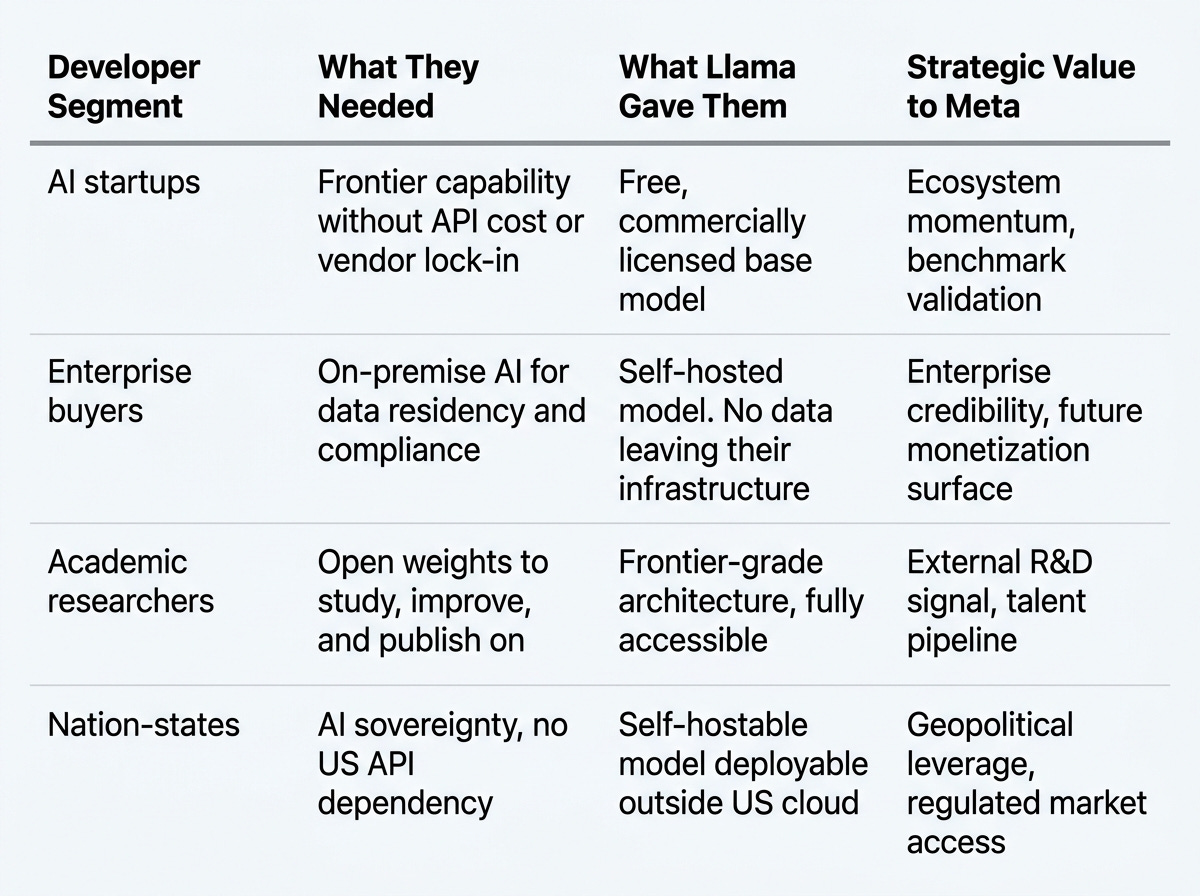
What united all these segments: a single need - access.
Open weights
Customizability
No license friction
No per-token pricing at scale
No risk of a vendor changing API terms and breaking your production system
These customers were not looking for personalization. They were looking for control. Open-source gave them exactly that.