


Picture this. You’re 20 minutes into a PM interview at an AI-first company. The interviewer leans forward and says:
“Design an AI product for elderly people.”
You’ve prepped for product design questions. You know CIRCLES. You start talking about users, pain points, prioritization.
It feels smooth. But something is off.
The interviewer keeps probing:
“What happens when the AI gives a wrong explanation?”
“How does the user know whether to trust the feedback?”
“What if the model is down?”
You stumble. You hadn’t thought about any of that.
This is the trap most PM candidates fall into with AI Product Design questions. They answer them like traditional product design questions with an AI feature tacked on.
But interviewers at companies like OpenAI, Anthropic, Google DeepMind, and Meta are testing for something fundamentally different. They want to see that you understand the unique design challenges that come with building on top of AI systems.
Here’s what they’re actually evaluating, whether they say it explicitly or not:
Probabilistic outputs: AI doesn’t always give the same answer. How do you design for that uncertainty?
Human-in-the-loop: When should the AI decide, and when should a human intervene?
Trust and explainability: How do users develop (or lose) trust in AI-generated outputs?
Model limitations: What happens when the AI is wrong, slow, or unavailable?
Fallback mechanisms: What is the non-AI experience when the model fails?
Failure handling: How do you design graceful degradation instead of a broken experience?
If your answer doesn’t address all six, you’re leaving points on the table.
In this guide, I’ll walk you through the AI-CIRCLES framework, a modified version of the classic CIRCLES method built specifically for AI product design.
BONUS: Infographic Cheatsheet for AI Product Design Questions
Then, I'll walk you through those adaptations step by step, with example responses within each step for a real interview question: "Design an AI product for elderly people."
Table of Contents
Let’s first understand why and how AI Product questions are different.
Why AI Product Design Questions Are Different?
Let’s start with the core difference.
Traditional Question: “Design a product for elderly people”
AI Question: “Design an AI product for elderly people”
That one word - “AI” - changes everything about what you need to demonstrate.
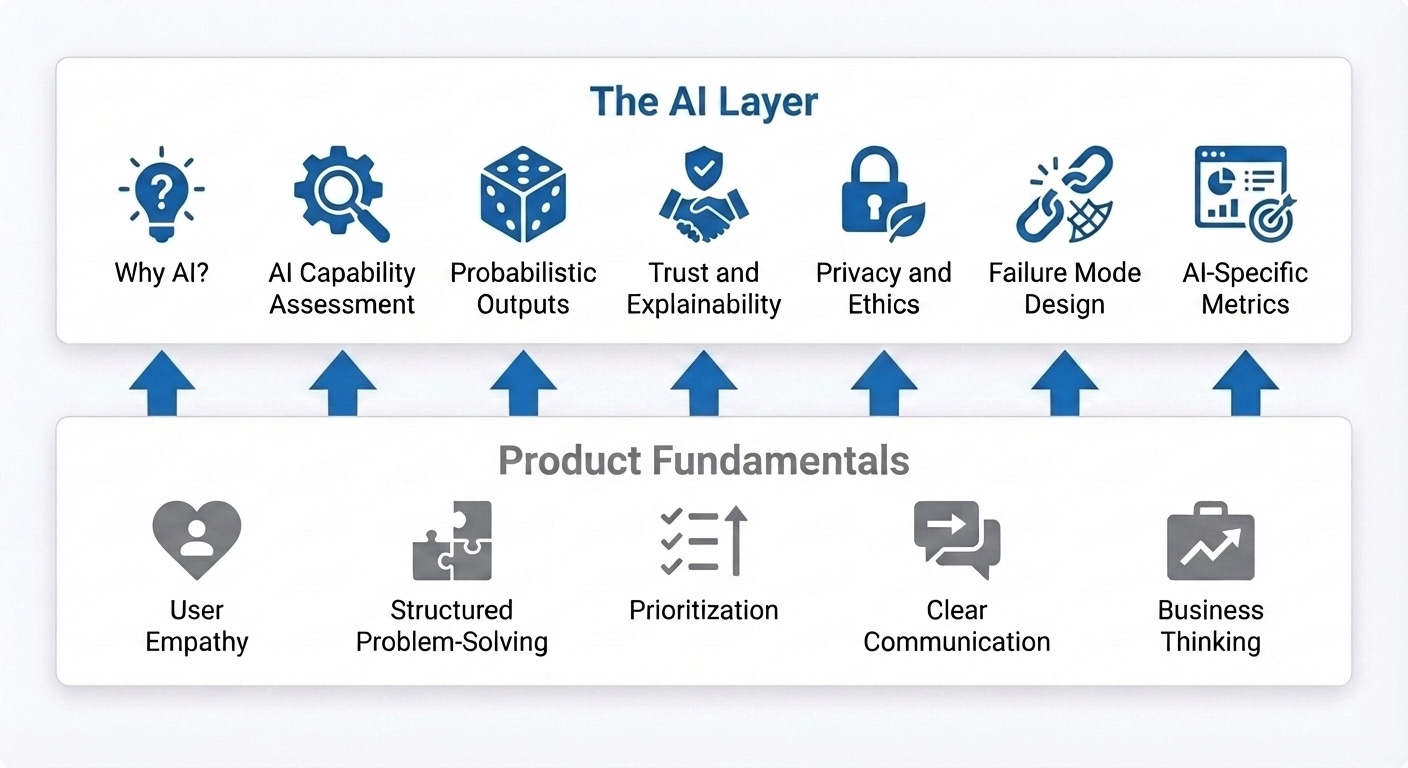
What You Still Need (Product Fundamentals)
Don’t panic. The foundation doesn’t change:
User empathy - Understanding your users deeply
Structured problem-solving - Breaking down complex problems
Prioritization and trade-offs - Choosing what matters most
Clear communication - Explaining your reasoning
Business thinking - Balancing user value with business goals
These fundamentals remain essential.
What’s New (The AI Layer)
On top of your product foundation, you must add seven new dimensions:
1. The “Why AI?” Question
This is the single most important AI-specific question, and most candidates never ask it.
For every AI feature you propose, you must justify:
Where does AI create value humans or simpler systems can’t deliver?
Could rules, heuristics, or basic algorithms work instead?
Is AI solving a real problem or just impressive technology looking for a use case?
Great PMs use AI when it’s the right tool, not because it’s trendy.
2. AI Capability Assessment
You need realistic understanding of:
What can current AI actually do for this use case?
Which AI technologies fit this problem? (ML, LLMs, computer vision, NLP?)
What are the hard technical limitations today?
You can’t design an AI product if you don’t know what AI can and can’t do.
3. Designing for Probabilistic Outputs
This is the dimension most candidates miss entirely.
AI is fundamentally different from traditional software:
AI doesn’t always give the same answer to the same input
AI can be confidently wrong (hallucinations, false confidence)
The same model can perform differently for different users
AI outputs are probabilistic, not deterministic
The interface must communicate uncertainty honestly. You can’t design AI products like you design calculators.
4. Trust, Explainability, and Human Override
How do users develop trust in AI outputs?
When should the AI decide vs. when should a human intervene?
The override spectrum: Inform → Assist → Co-pilot → Automate
Trust design patterns: confidence indicators, source attribution, explanation snippets, correction loops
Each feature needs an explicit override level based on decision stakes.
5. Privacy, Ethics, and Bias
AI products collect and process data differently:
What sensitive data are we handling?
How do we prevent and audit for bias?
Privacy by design: data minimization, transparency, user control
These aren’t optional add-ons - they’re core product requirements.
6. Failure Mode Design
Every AI feature needs designed fallback states:
What happens when the AI is down?
What happens when the AI is uncertain?
What happens when the AI is confidently wrong?
What happens when users are edge cases the model wasn’t trained on?
Not just “plan for failures” as a principle, but specific fallback UX for each scenario.
7. AI-Specific Metrics
Beyond traditional metrics, you need:
Model performance: accuracy, precision, recall, latency
Trust metrics: override rate, AI suggestion acceptance rate, user-reported trust
Fallback metrics: fallback trigger frequency, degraded-experience satisfaction
Combined with business metrics (engagement, retention, revenue)
The Mindset Shift
Traditional PM: Build the right product
AI PM: Build the right product + ensure AI is the right solution + design for uncertainty + design for failure + earn trust progressively
You’re not replacing your product skills - you’re expanding them to handle AI’s unique challenges.
How to Answer AI Product Design Questions?
Use the AI-CIRCLES framework.
AI-CIRCLES is a 7-step framework built for AI product design questions. It follows the same structure as CIRCLES (so it’s easy to remember if you already know the original), but every step has been adapted to account for the unique challenges of AI systems.
Here’s the overview, then we’ll go deep on each step.
AI-Specific Focus: AI capability boundaries, type of AI, what “design” means
AI-Specific Focus: AI comfort level, trust baseline, AI-specific anxieties
AI-Specific Focus: Probabilistic decision points, human vs. AI judgment moments
C - Cut Through Prioritization
AI-Specific Focus: AI capability mapping, trust-first prioritization
AI-Specific Focus: Core features + fallbacks + human overrides + trust elements
AI-Specific Focus: Accuracy vs. speed, autonomy vs. control, privacy vs. personalization
S - Summarize with AI Safety Layer
AI-Specific Focus: Capability assessment + override design + failure mode handling
The framework still works for AI product questions. But each step needs AI-specific thinking layered in.
Join our WhatsApp channel for quick PM insights and latest Job updates
Let’s walk through every step, with AI adaptations and example responses for the question: “Design an AI product for elderly people.”
Step 1: Comprehend the Situation
Before you design anything, you need to understand the boundaries of the problem. For AI product design, this means going beyond the usual “who, what, why” and also clarifying the AI dimension.
What you'd do traditionally?
Ask clarifying questions about the problem using the 5W's and 1H (Who, What, Where, When, Why, How).
Understand the context and constraints.
Confirm the goal.
Is this a new product or an improvement? Are there budget limitations, geographic considerations, or time constraints?
State your assumptions explicitly so the interviewer can redirect you if needed.
For full list of clarifying questions to be asked during this step, read traditional Product Design guide.
What changes with AI?
Clarify three additional things to understand AI dimension of the problem before you start designing.
1) What type of AI is involved?
Generative AI (producing new content like ChatGPT),
predictive AI (forecasting or classifying),
recommendation AI (suggesting from existing options like Spotify),
or computer vision (understanding images and video, like self-driving cars)
The type of AI shapes every design decision you'll make. Ask the interviewer, or state your assumption.
2) What data is available?
AI systems learn from data. If there's no data to train on, many AI approaches won't work.
You don't need to get deep into data engineering, but asking "What data might we have access to?" shows you understand that AI doesn't work by magic. It needs inputs.
3) Are there AI-specific constraints?
Privacy regulations like HIPAA (for health data) or COPPA (for children's data) add constraints that don't exist for traditional products.
Ask about these early so you don't design a solution that's legally impossible.
💡 Interview Tip
State your AI assumptions explicitly, just like you'd state traditional assumptions. "I'm going to assume this uses sensor-based ML for pattern detection, not generative AI" sets clear boundaries that the interviewer can correct if you're heading in the wrong direction.
Example in action for step 1 (comprehend the situation):
Interviewer: “Design an AI product for elderly people.”
You: “Great question! Before I start designing, I’d like to ask a few clarifying questions to make sure I understand the problem correctly.
First, the standard ones: When you say ‘elderly,’ are we talking about a specific age range, perhaps 65 and older? Are there particular problems or areas of life we should focus on, or is this completely open-ended? Should I assume this is a digital product, a physical product, or am I free to explore any format? And are there geographic constraints, or should I think about the US market first?
Now the AI-specific ones: What AI capabilities should I consider? Are we looking at machine learning for pattern detection, generative AI for conversation, computer vision, or am I free to choose what fits best? Are we building custom AI models from scratch, or can we leverage existing AI services and APIs? What data might we realistically have access to? And given we’re dealing with an elderly demographic that likely involves health data, are there specific privacy regulations like HIPAA that I should factor in from the start?
Based on what I know, I’m going to make the following assumptions: We can use any AI technology that fits the problem. We’re designing for the US market initially. This is a digital product that could include hardware components like wearables or home sensors. And we need to prioritize privacy very heavily, given this demographic and the likelihood of handling sensitive health and behavioral data.”
Step 2: Identify the Customer
Once you comprehend the situation, the next step is identifying who you’re designing for. Not all users are created equal, and trying to design for everyone often means you delight no one.
What you’d do traditionally to identify the right customer?
Define potential user segments using criteria like demographics, behavior, needs, and context.
List 3-5 distinct user personas with brief descriptions.
Choose ONE primary customer segment to focus on, and explain your rationale for selecting that segment.
Consider factors like market size, underserved needs, alignment with business goals.
For full guide on identifying customers for traditional product, read traditional Product Design guide.
What changes with AI while identifying the right customer?
You now need to add an AI-specific lens to your segmentation and selection. This means considering four additional dimensions.