


“Design an AI product for a ride sharing app.”
This is the new breed of PM interview questions and it’s intentionally testing two critical skills at once: your product thinking AND your understanding of AI/ML capabilities.
The interviewer wants to see:
Can you identify problems where AI adds unique value?
Do you understand AI capabilities and limitations?
Can you design responsible AI that respects privacy and ethics?
Do you balance technical feasibility with user needs?
Can you measure AI performance and business impact?
This isn’t just about slapping “AI” onto an existing feature. It’s about understanding where AI creates genuine value and where it’s just hype.
For a deep-dive on “How to answer Product Design questions in PM Interview?” - read here
In this post, I’ll walk you through exactly how to answer this question using the CIRCLES framework.
You’ll see how to think about AI products differently from traditional features, how to address privacy concerns, and how to design AI that users actually trust.
Now, let’s dive in.
How to Answer AI Product Design Questions?
Here’s a proven repeatable framework that works perfectly well for any AI Product Design questions and, in fact, for any product design question thrown at you.
Use the CIRCLES Framework:
C - Comprehend the Situation
I - Identify the Customer
E - Evaluate Trade-offs
S - Summarize Recommendations
let’s breakdown each step
Step 1: Comprehend the Situation
Before jumping to “let’s use ChatGPT for something,” we need to understand what we’re really being asked to solve.
AI product questions require even more clarification than regular product questions.
The Clarifying Questions I’d Ask
Me: “Great question! Let me ask some clarifying questions to make sure I’m designing the right AI solution.”
Question 1: AI Scope and Capabilities
“When you say ‘AI product,’ what types of AI capabilities should I consider? Are we talking about machine learning models, generative AI like LLMs, computer vision, natural language processing, or am I free to explore any AI technology?”
Why this matters: Different AI technologies solve different problems. ML models excel at pattern recognition and prediction. LLMs are great for conversation and content generation. Computer vision works for visual verification. Choosing the right AI for the right problem is critical.
Question 2: Existing vs. New AI
“Should I assume we’re building new AI models from scratch, or can we leverage existing AI capabilities and APIs?”
Why this matters: Building custom models requires data, time, and ML expertise. Using existing AI (like OpenAI API, Google Cloud Vision) is faster but less differentiated. This affects our timeline and feasibility.
Question 3: Product Context
“Are we designing for a specific ride sharing platform like Uber or Lyft, or a generic ride sharing app? And should I focus on a particular geography?”
Why this matters: Different markets have different needs. Safety concerns in India differ from the US. Ola’s users have different behaviors than Uber’s. Geography affects data availability, regulations, and user expectations.
Question 4: Target User
“Should I focus on riders, drivers, or could this AI product serve both? Or even internal teams like operations or support?”
Why this matters: Riders want convenience and safety. Drivers want earnings optimization. Internal teams want operational efficiency. Each stakeholder has different AI product opportunities.
Question 5: Business Objective
“What’s the primary goal? Are we trying to improve safety, increase efficiency, enhance user experience, create new revenue, or something else?”
Why this matters: AI can do many things, but we need to focus on what drives business value. Safety AI looks different from efficiency AI.
Question 6: Constraints
“Are there any constraints I should know about—data privacy regulations, budget limitations, timeline, existing tech stack, or specific technologies to avoid?”
Why this matters: AI products often handle sensitive data. GDPR, user privacy, and ethical AI aren’t optional considerations—they’re constraints we must design within.
Example Interviewer Response
Interviewer: “Good questions. You can use any AI technology that makes sense for the problem. Assume you can build custom models or use existing AI APIs—whichever is more appropriate. Think of this as a major ride sharing platform like Uber operating globally, but feel free to focus on a specific market if it helps. The product can serve riders, drivers, or both—you decide based on where you see the biggest opportunity. Primary goal is to create differentiated value that increases user trust and retention. Be mindful of data privacy and responsible AI, but assume reasonable resources for development.”
Understanding the Ride Sharing Context
Before moving forward, let me establish what we know about ride sharing:
Current Pain Points:
Riders: Safety concerns (especially women, night rides), unpredictable pricing, driver reliability, route anxiety
Drivers: Inconsistent earnings, difficult passengers, platform dependency, navigation challenges
Platform: Trust and safety incidents, competitive pressure, regulatory challenges
Where AI Already Exists:
Dynamic pricing algorithms
Route optimization and ETA prediction
Rider-driver matching
Fraud detection
Customer support chatbots
Opportunities for New AI:
Areas where pattern detection at scale adds value
Real-time decision making that humans can’t do
Predictive capabilities for prevention vs. reaction
Personalization at scale
Safety and trust enhancement
State Assumptions
Me: “Based on your input, here are my assumptions:
We’re designing for a global ride sharing platform similar to Uber
We can use any appropriate AI technology (ML, LLM, computer vision, etc.)
Primary focus is on increasing user trust and retention through differentiated value
Must design with privacy and responsible AI principles from day one
Assume 12-18 month development timeline with adequate ML engineering resources
I’ll focus on the most impactful opportunity I identify through the framework
Does that sound right?”
💡 AI Product Tip: When designing AI products, always clarify what AI capabilities are available and what constraints (privacy, ethics, data) you’re working within. AI products have unique considerations that traditional features don’t.
Step 2: Identify the Customer
Ride sharing platforms serve multiple user types. For an AI product, I need to choose who benefits most from AI’s unique capabilities.
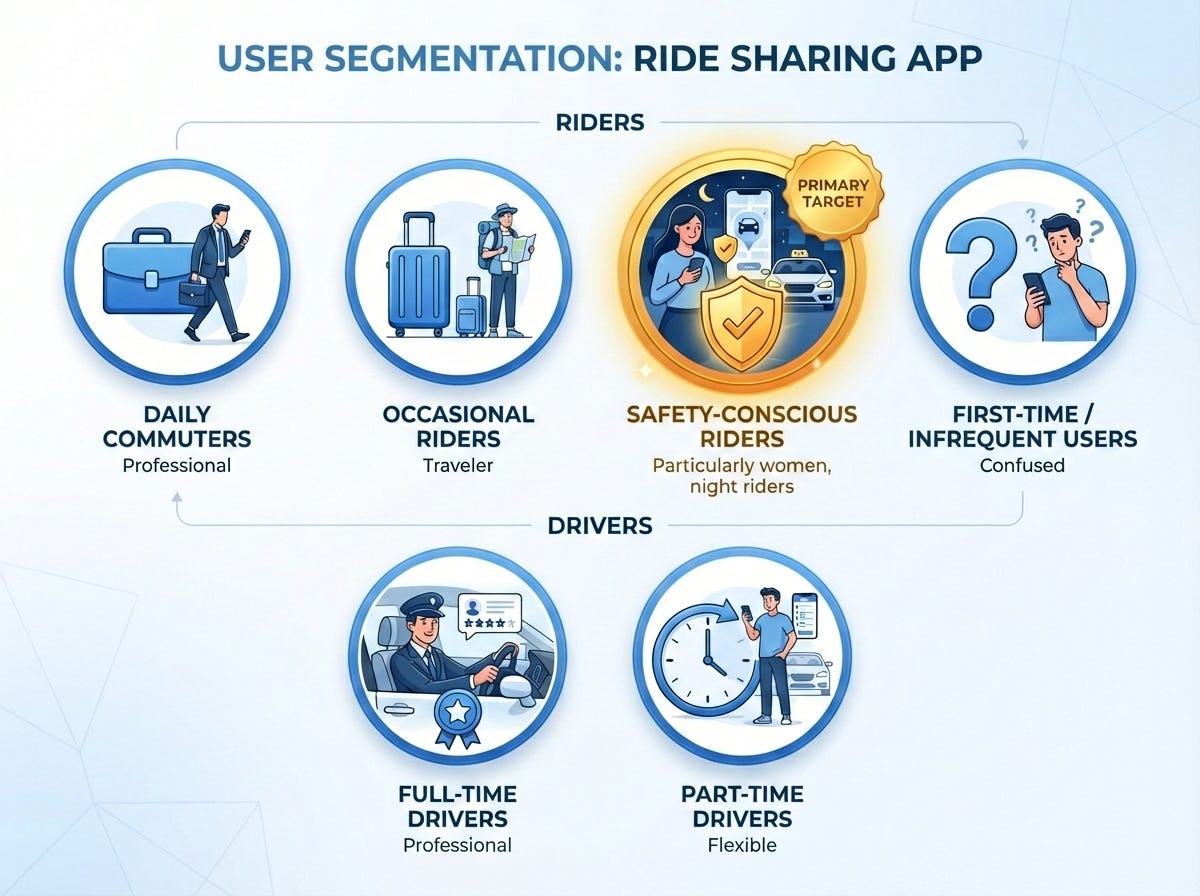
Potential User Segments
Rider Segments:
Segment 1: Daily Commuters
Regular office-goers using rides predictably
Price-sensitive, route-familiar
Want reliability and consistency
Value: Time optimization, cost predictability
Segment 2: Occasional/Airport Riders
Infrequent users for specific trips
Less price-sensitive, higher stakes trips
Want reliability and comfort
Value: Peace of mind, quality experience
Segment 3: Safety-Conscious Riders
Particularly women and night-time riders
Highly concerned about personal safety
Want trust and verification
Value: Security, real-time safety, emergency response
Often avoid ride sharing due to safety fears
Segment 4: First-Time/Infrequent Users
New to ride sharing or use rarely
Confused by app complexity
Want guidance and simplicity
Value: Hand-holding, education, confidence
Driver Segments:
Segment 5: Full-Time Professional Drivers
Ride sharing is primary income
Want earnings optimization
Sophisticated platform users
Value: Income maximization, efficiency
Segment 6: Part-Time/Gig Drivers
Supplemental income, flexible hours
Less platform-savvy
Want simplicity and quick earnings
Value: Easy onboarding, simple interfaces
Choosing the Primary Segment
Me: “I’m going to focus on Segment 3: Safety-Conscious Riders—particularly women and people taking rides during evening/night hours or in unfamiliar areas.
Here’s my reasoning:
1. Highest-Stakes Problem with Clear AI Fit
Safety is literally a life-or-death concern. This is where AI can provide unique value that humans can’t match:
Humans can’t monitor thousands of rides simultaneously in real-time
AI can detect anomalous patterns that individual riders might miss
AI can process multiple data signals instantly to identify risks
AI enables proactive intervention before incidents occur
This is a perfect match between problem severity and AI capabilities.
2. Massive Underserved Market
Current solutions are inadequate:
SOS buttons are reactive (incident already happening)
Trip sharing is passive (friends can’t actually help in real-time)
Driver ratings are historical (doesn’t help during current ride)
Women and safety-conscious users often avoid ride sharing entirely
This represents lost market opportunity. If we can make ride sharing feel safe, we unlock users currently choosing taxis or not traveling.
3. Clear Business Value
Trust directly impacts core metrics:
User retention (safer experience = more repeat usage)
Market expansion (capture safety-conscious non-users)
Brand differentiation (first platform to truly solve safety)
Premium pricing potential (users pay for safety features)
Regulatory advantage (governments want safer platforms)
4. Data Availability
We have rich data to train AI:
Millions of historical rides (mostly safe, some incidents)
GPS and route data
Driver behavior patterns
Time, location, and contextual data
Incident reports and safety flags
This data enables sophisticated AI models.
5. Competitive Differentiation
No ride sharing platform has truly solved safety with AI. Current approaches are basic:
Manual SOS buttons
Basic trip sharing
Post-incident support
An AI-powered proactive safety system would be a genuine innovation, not incremental improvement.
6. Responsible AI Opportunity
Safety AI done right demonstrates responsible AI principles:
Clear user value (not AI for AI’s sake)
Transparent operation (users understand what AI does)
User control (opt-in, configurable)
Privacy-respecting (purpose-limited data use)
This lets us showcase thoughtful AI product design, not just technology deployment.”
💡 AI Product Tip: Choose problems where AI’s unique capabilities (pattern detection at scale, real-time analysis, predictive modeling) provide value that’s impossible or impractical for humans to deliver. Don’t use AI just because it’s trendy.
Step 3: Report Customer Needs
Now let’s deeply understand what safety-conscious riders need—and where AI can help.
Safety & Trust Needs (Primary Focus)
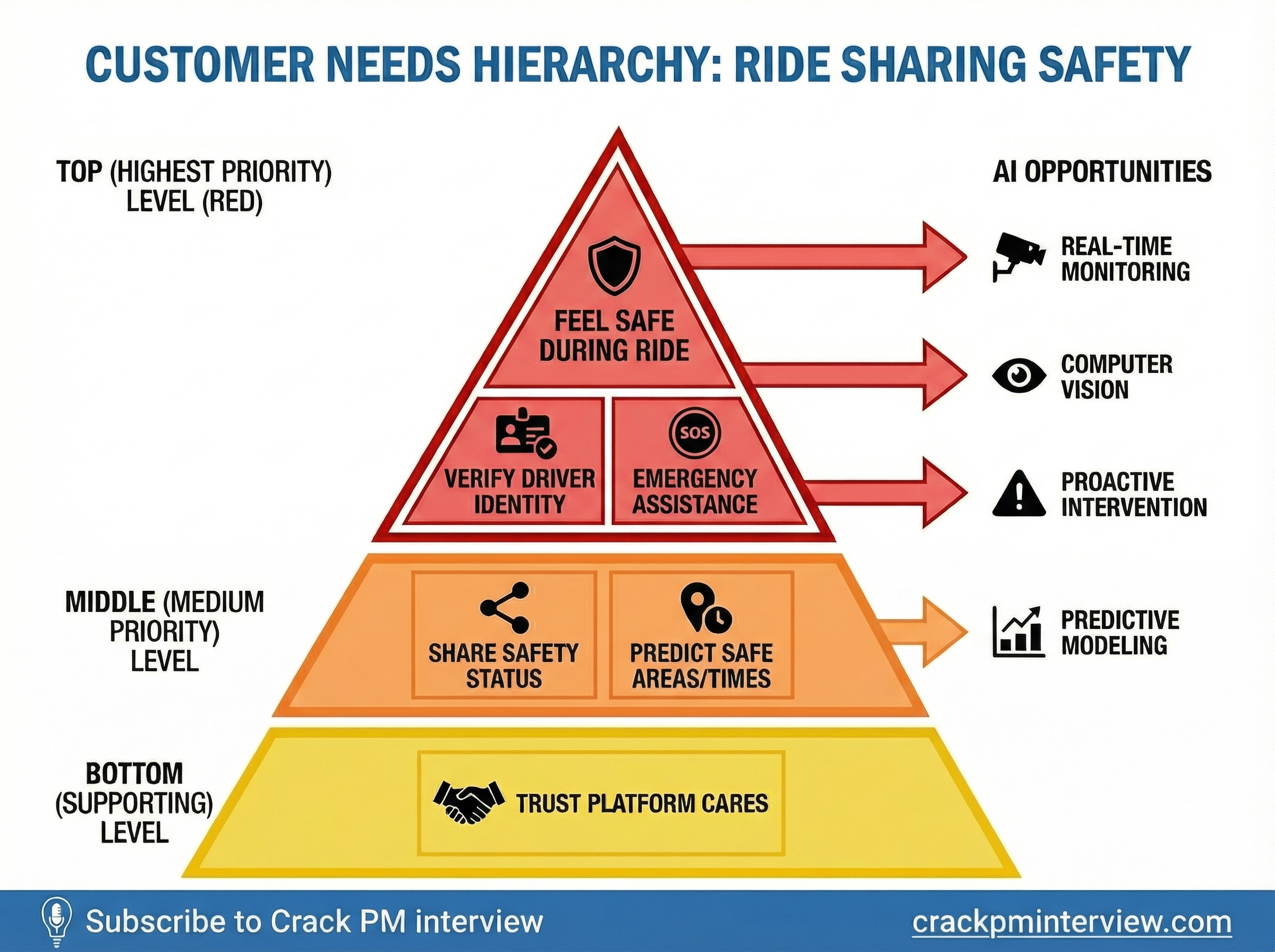
Need 1: Feel Safe During the Ride
This is the core need. Riders want to know they’re safe throughout the journey, not just hope for the best.
Pain Point: “I’m alone in a car with a stranger. If the driver takes a weird route or acts strangely, I get anxious but don’t know if I’m overreacting. By the time I know something is really wrong, it might be too late.”
Current Gap: Users can only report incidents AFTER they happen. There’s no real-time monitoring or intervention. The SOS button requires the rider to recognize danger and take action—but in many situations, riders hesitate to “make a scene” or aren’t sure if their concern is valid.
AI Opportunity: AI can monitor rides continuously and detect anomalies in real-time—route deviations, unusual stops, speed patterns, duration anomalies. It can flag potential issues before the rider even realizes something’s wrong.
Need 2: Verify Driver Identity and Vehicle Match
Riders want to know they’re getting into the right car with the right driver.
Pain Point: “I check the license plate and driver photo, but sometimes the person looks different from their photo, or the car doesn’t quite match. Is this the right driver? Am I getting into a stranger’s car? I’ve heard stories of fake drivers.”
Current Gap: Photo verification is manual and static. Photos can be old, lighting differs, people change appearance. License plates can be faked or swapped. There’s no continuous verification that the person driving is who they claimed to be.
AI Opportunity: Computer vision and facial recognition can verify driver identity in real-time. AI can match live driver photos against verified profiles, detect if someone else is driving, and flag mismatches immediately.
Need 3: Emergency Assistance When Something Feels Wrong
If something goes wrong, riders need help immediately—but often don’t know when to call for help.
Pain Point: “The driver is making me uncomfortable with comments or driving erratically. I don’t want to overreact, but I’m getting scared. Should I press the SOS button? What if I’m wrong and I get the driver in trouble? What if pressing it makes things worse?”
Current Gap: SOS buttons require user-initiated action. Many riders hesitate to use them due to:
Fear of overreacting
Social discomfort confronting driver
Uncertainty about when situation is “serious enough”
Fear of escalating the situation
AI Opportunity: AI can detect distress signals from multiple sources (unusual route, rider messages, silence patterns if audio monitoring is enabled) and proactively check in: “I noticed we’re taking an unusual route. Is everything okay?” This gives riders an easy way to signal without confrontation.
Need 4: Share Real-Time Safety Status with Trusted Contacts
Riders want family and friends to know they’re safe—and be alerted if they’re not.
Pain Point: “I share my trip with my mom, but she has no idea if everything is actually okay. She just sees a moving dot on a map. If something went wrong, she wouldn’t know until I don’t arrive—and by then it’s too late.”
Current Gap: Trip sharing is passive. Contacts can see location but have no way to know if the rider is safe or in distress. There’s no automated alerting system that notifies contacts when intervention might be needed.
AI Opportunity: AI can provide continuous safety status updates to trusted contacts. Green status when everything is normal, yellow when minor anomaly detected (route change), red when significant concern identified. Contacts get automatic alerts if AI detects problems.
Supporting Needs
Need 5: Predict Safe vs. Unsafe Times and Areas
Riders want to make informed decisions about when and where to ride.
Pain Point: “I need to take a ride home at 11 PM. Is this area safe at this time? Should I wait and leave earlier? I have no way to know.”
Current Gap: Platforms don’t provide safety predictions or recommendations. Riders make decisions blind.
AI Opportunity: Predictive modeling using historical incident data, time patterns, location data, and contextual information to provide safety scores and recommendations: “This route typically has high safety scores at this time” or “Consider booking 30 minutes earlier when this area has 25% fewer reported incidents.”
Need 6: Trust That the Platform Cares About Safety
This is an emotional need. Riders want to feel the platform prioritizes their wellbeing, not just efficiency.
Pain Point: “I feel like just a transaction. The platform wants to move me from A to B efficiently, but do they actually care if I feel safe? Are they watching out for me?”
Current Gap: Safety features feel like afterthoughts—basic, reactive, minimal. There’s no sense that the platform is actively protecting users.
AI Opportunity: Proactive AI safety that demonstrates care: “We’re monitoring your ride in real-time to ensure your safety” or “Based on this route and time, we’ve assigned a highly-rated driver with excellent safety history.” Actions speak louder than words.
Organizing by AI Opportunity
Looking at these needs, here’s where AI creates unique value:
High AI Impact:
Real-time safety monitoring (Need 1) → Pattern detection, anomaly detection
Predictive safety insights (Need 5) → Predictive modeling, risk assessment
Identity verification (Need 2) → Computer vision, facial recognition
Medium AI Impact:
Emergency assistance (Need 3) → Natural language processing, intent detection
Safety status sharing (Need 4) → Automated alerting based on AI analysis
Lower AI Impact:
Platform trust (Need 6) → This is about execution and communication of other features
AI excels at analyzing patterns in large datasets, detecting anomalies in real-time, and making predictions. Our top needs align perfectly with these capabilities.
Step 4: Cut Through Prioritization
We’ve identified six needs. Now let’s prioritize based on where AI creates maximum value and business impact.
Business Goals for Ride Sharing Platform
From the platform perspective, what matters?
Increase rider trust and retention - Safety concerns cause churn
Reduce safety incidents - Incidents are costly (legal, PR, operations)
Expand market - Safety-conscious non-users represent growth opportunity
Differentiate from competitors - True innovation, not feature parity
Improve brand reputation - Being “the safe ride sharing platform”
Prioritization Framework: Impact × AI Suitability × Feasibility
For each need, I’ll evaluate:
User Impact: How much does solving this improve the rider’s experience?
AI Suitability: How uniquely suited is AI to solve this vs. traditional approaches?
Technical Feasibility: Can we actually build this with current AI capabilities?
Business Value: How directly does this drive our business goals?
Top Priority Needs
Priority 1: Real-Time Safety Monitoring (Need 1)
User Impact: ⭐⭐⭐⭐⭐ (Addresses core safety anxiety throughout entire ride)
AI Suitability: ⭐⭐⭐⭐⭐ (Perfect fit - humans can’t monitor at scale, AI excels at real-time pattern detection)
Technical Feasibility: ⭐⭐⭐⭐ (Route and behavior analytics are proven; audio is more complex but doable)
Business Value: ⭐⭐⭐⭐⭐ (Directly reduces incidents, increases trust, major differentiator)
Why #1: This is where AI provides value impossible for humans to deliver. No human team can monitor millions of rides simultaneously, detect subtle anomalies, and intervene in real-time. This is AI’s sweet spot.
Example: AI detects driver took a 10-minute detour from optimal route, combined with unusual slowdown in low-traffic area. Confidence score triggers automatic check-in: “I notice we’re taking a different route than usual. Is everything okay?” Rider can respond “Yes, avoiding construction” or “No, I’m concerned” with one tap.
Priority 2: Predictive Safety Intelligence (Need 5)
User Impact: ⭐⭐⭐⭐ (Helps users make informed decisions, prevents situations before they occur)
AI Suitability: ⭐⭐⭐⭐⭐ (AI excels at predictive modeling and pattern recognition across huge datasets)
Technical Feasibility: ⭐⭐⭐⭐ (Well-established ML techniques, data is available)
Business Value: ⭐⭐⭐⭐ (Reduces incidents proactively, builds trust, demonstrates care)
Why #2: Prevention is better than reaction. If AI can help users avoid risky situations entirely, we’ve solved the problem before it starts. This is where machine learning shines—finding patterns humans would never spot.
Example: AI analyzes millions of rides and identifies that this specific route at 11 PM on weekends has 3× higher incident rate than same route at 9 PM. User booking at 10:45 PM gets suggestion: “Rides departing before 9:30 PM on this route have 40% higher safety scores. Would you like to adjust your departure time?”
Priority 3: Identity Verification (Need 2)
User Impact: ⭐⭐⭐⭐ (Critical first touchpoint, reduces fraud-related anxiety)
AI Suitability: ⭐⭐⭐⭐ (Computer vision is mature and accurate for this use case)
Technical Feasibility: ⭐⭐⭐ (Facial recognition works well, but requires camera access and careful privacy handling)
Business Value: ⭐⭐⭐ (Reduces fraud, prevents incidents, but more of a table-stakes feature than differentiator)
Why #3: This addresses a real concern (driver impersonation, vehicle mismatch) and computer vision makes it feasible. However, it’s a one-time verification at ride start, not continuous protection throughout the journey like Priority 1 and 2.
Why These Three Priorities
Me: “I’m prioritizing real-time safety monitoring, predictive safety intelligence, and identity verification because:
1. They Address Highest-Impact Needs Safety during the ride (#1) and preventing unsafe situations (#2) are where riders feel most vulnerable. Identity verification (#3) is the critical entry point—if trust breaks here, nothing else matters.
2. They Leverage AI’s Unique Strengths
Pattern detection across millions of rides
Real-time anomaly detection at scale
Predictive modeling with complex variables
Computer vision for identity matching
These are things AI does better than any human team could.
3. They Work Together as a System
Identity verification ensures right person from the start
Predictive intelligence helps users avoid risky situations
Real-time monitoring protects users during the ride
Together they create comprehensive safety coverage: before, during, and proactive prevention.
4. Clear Path to Measurement We can measure:
Incident reduction (real-time monitoring)
User behavior changes (predictive intelligence adoption)
Fraud prevention (identity verification success rate)
User sentiment (trust scores, safety ratings)
5. Responsible AI Alignment All three can be designed with:
User control (opt-in features)
Transparency (clear about what AI does)
Privacy protection (purpose-limited data use)
Explainability (users understand AI decisions)
I’m deprioritizing emergency assistance (#3) and safety status sharing (#4) not because they’re unimportant, but because they’re better as features within the real-time monitoring system rather than standalone solutions.”
Step 5: List Solutions
Now let’s generate different AI product concepts that address our priority needs. I’ll brainstorm four diverse approaches.
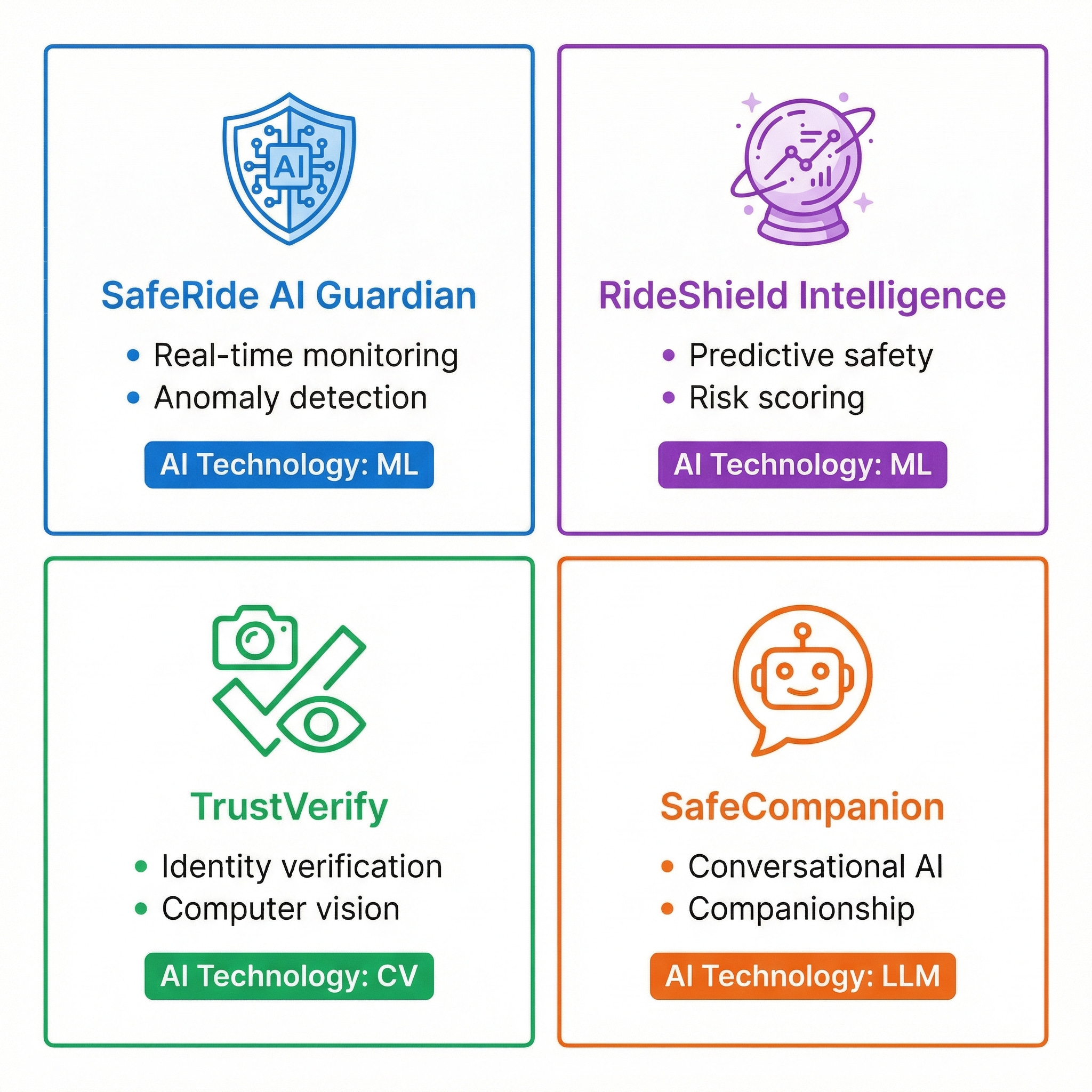
Solution 1: SafeRide AI Guardian (Real-Time Monitoring System)
Concept: An AI system that continuously monitors every ride in real-time, detecting anomalies and intervening proactively to ensure rider safety.
Key Features: