

Checkout our deep-dive on How to answer any GTM question in a PM Interview
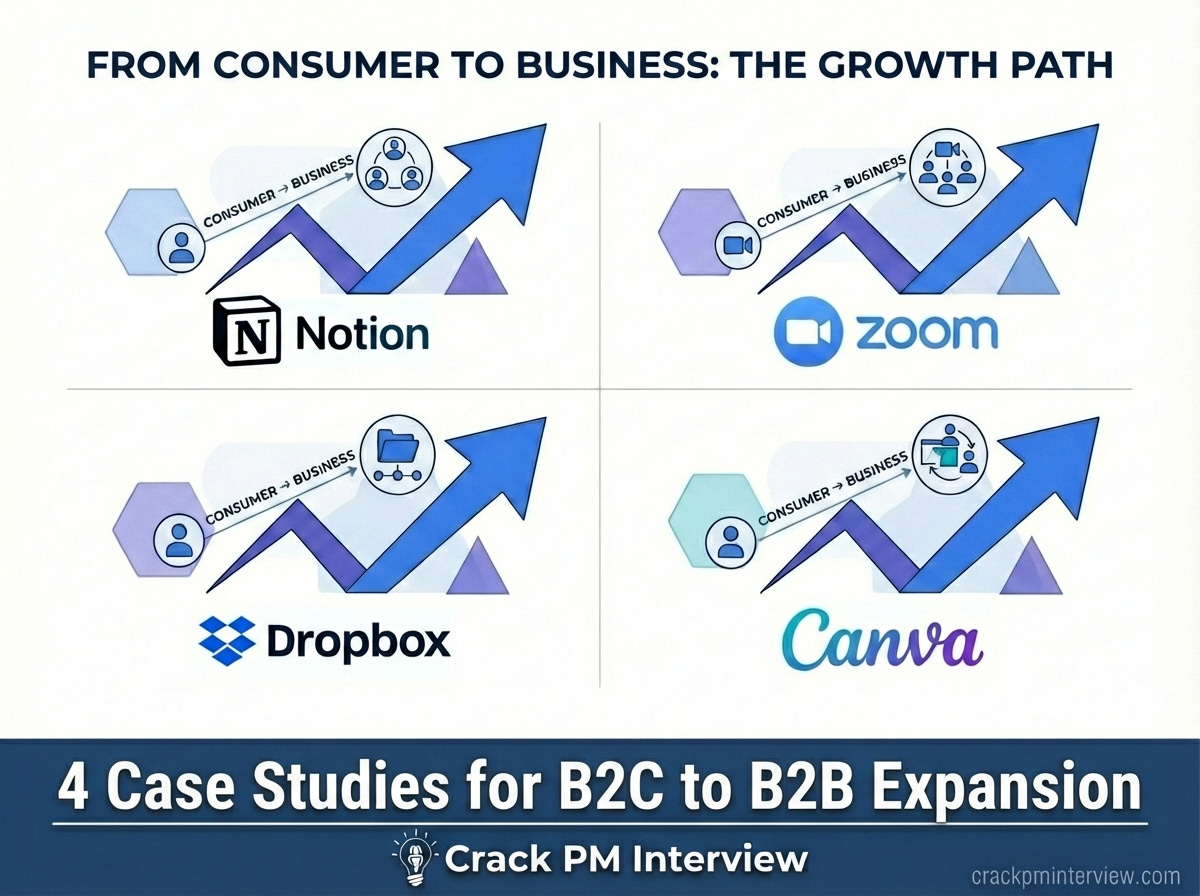
Less than 10% of consumer companies successfully expand into B2B.
But those who do unlock extraordinary value. B2B customers generate 10-50x more revenue, have 3-5x better retention, and provide predictable annual contracts instead of volatile monthly subscriptions.
Notion, Zoom, Dropbox, and Canva are among the 10% who got it right. Combined, they’ve created over $60 billion in value by following remarkably similar playbooks.
Here’s what they did, and what you can learn from their success.
Join our WhatsApp channel for quick PM insights and latest Job updates
Let’s examine how each company executed B2C to B2B transition.
Table of Contents
Case Study 1: Notion - Personal Productivity to Team Workspace
Background:
Launched 2016 as personal note-taking and productivity tool
Initially marketed to students and individual knowledge workers
Strong organic adoption through word-of-mouth and social media
By 2018, noticed teams using Notion for project management and wikis
Opportunity: Teams were hacking together multiple tools (Confluence, Trello, Google Docs)
The B2B Strategy:
Target: Started with small tech teams and startups (5-20 people), expanded to mid-market and enterprise
Position:
Consumer: “All-in-one workspace for your notes, tasks, wikis, and databases”
B2B (Notion for Teams): “Connected workspace for teams to plan, organize, and collaborate. Replace 10+ tools with one.”
Price:
Free: Unlimited blocks for individuals
Plus: $8/user/month (for small teams)
Business: $15/user/month (advanced features)
Enterprise: Custom pricing (starts ~$25-30/user/month)
Distribute:
Bottom-up PLG motion (individuals invited teammates)
Viral templates and public pages drove discovery
Community-led growth (Notion ambassadors, Reddit, Twitter)
Added sales team in 2020 for mid-market and enterprise
Partnerships with educational institutions for adoption
Results:
1M users by 2018
4M users by 2020
20M users by 2021
$10B valuation (2021)
Over 1M team workspaces
What worked:
Maintained generous free tier (didn’t limit core functionality)
Templates made it easy for teams to get started
Flexibility allowed teams to replace multiple tools
Public pages created viral discovery loops
Clear team value (collaboration, wikis, project tracking)
Community-driven growth reduced CAC
Challenges:
Performance issues at scale required significant technical investment
Had to build enterprise features (SSO, SAML, admin controls) later
Competition from Microsoft, Google, Atlassian with bundled products
Key takeaway: Product flexibility + community-driven growth + generous free tier = organic B2B adoption
Very common scenario for a PM when working at a B2C company. There will always be talks of expanding and launching a product for B2B space.
Read this to know - how to expand and launch a B2C product into the B2B market?
Case Study 2: Zoom - Consumer Freemium to Enterprise Standard
Background:
Launched 2013 with generous free tier (40-minute limit for 3+ participants)
Better video quality than competitors
Easy to use, no download required (later)
Initially targeted SMB and mid-market
The B2B Transition:
Target: SMB initially, expanded to enterprise (Fortune 500)
Position:
Consumer: “Video conferencing that just works”
B2B: “Enterprise video communications, 99.99% uptime, deploy in minutes not months”
Price:
Basic: Free (40-minute limit)
Pro: $14.99/host/month
Business: $19.99/host/month (10+ hosts)
Enterprise: Custom pricing
Distribute:
Freemium PLG for acquisition
Free users hit limits, upgraded naturally
Inside sales for Business tier
Field sales for Enterprise ($100K+ deals)
Zoom Phone added for expansion revenue
Success Measurement:
$60M revenue (2017)
$330M revenue (2018)
$622M revenue (2019)
$2.6B revenue (2020, pandemic boost)
$4B+ revenue (2023)
What worked:
Product experience 10x better than competitors
Free tier had real utility (not crippled)
Natural upgrade trigger (time limits)
Added enterprise features (SSO, admin, Zoom Phone) methodically
Key takeaway: Superior product experience + frictionless free tier + natural upgrade triggers = massive B2B success
Case Study 3: Dropbox - Consumer Storage to Business Collaboration
Background:
Launched 2008 as simple consumer file sync
Viral referral program (get space for inviting friends)
By 2011, noticed teams using shared folders for work
50M+ users by 2013, mostly consumer
The B2B Transition:
Target: Started with creative teams and SMBs, expanded to enterprise
Position:
Consumer: “Your stuff, anywhere”
B2B (Dropbox Business): “Content collaboration platform for teams, 3x faster project completion”
Price:
Basic: Free (2GB)
Plus: $9.99/month (2TB individual)
Business: $15/user/month (minimum 3 users)
Enterprise: Custom
Distribute:
Identified teams using personal accounts
Created separate Business product
Sales team for Business tier
Consumer product remained growth engine
Success Measurement:
Launched Business tier in 2013
200K business customers by 2015
500K business customers by 2017
$2B+ revenue by 2020
600K+ business customers
What worked:
Didn’t force migration (kept consumer healthy)
Clear differentiation (Business had admin, sharing controls, more storage)
Leveraged existing user base
Added Paper (collaboration) and HelloSign (signatures) for expansion
Challenges:
Competition from Google Drive, OneDrive (free with other products)
Had to continuously add features to justify pricing
Key takeaway: Existing user base is your best B2B pipeline, but maintain consumer product health
SUBSCRIBE to get full access to in-depth breakdown of interview questions and schedule 1:1 mock interviews.
Case Study 4: Canva - Individual Designers to Marketing Teams
Background:
Launched 2013 as simple design tool for non-designers
Strong consumer adoption, 10M+ users by 2017
Noticed marketing teams, small businesses using it
Opportunity: marketing teams spending $50K+ annually on design tools and agencies
The B2B Transition:
Target: Marketing teams at SMBs and mid-market companies (10-500 employees)
Position:
Consumer: “Design anything, publish anywhere”
B2B (Canva for Teams): “Empower your team to design together, maintain brand consistency, 60% cost reduction vs. agencies”
Price:
Free: Limited templates and features
Pro: $12.99/month (individual)
Teams: $14.99/user/month for first 5, then $7.50/user/month
Enterprise: Custom (starts ~$30/user/month)
Distribute:
Freemium PLG for acquisition
Teams naturally formed (sharing designs)
Added “Invite Team” flows
Inside sales for larger team deals
Enterprise sales for 100+ seat deals
Results:
15M users by 2019
60M users by 2021
Valued at $40B (2021)
Millions of teams using Canva for Teams
What worked:
Brand Kit feature (huge B2B value, brand consistency)
Template governance (control while empowering)
Maintained free tier (top of funnel)
Clear ROI story (vs. agency costs, vs. Adobe)
Key takeaway: Find the B2B “killer feature” (Brand Kit) that justifies premium pricing
What next case study would you like to read? Tell us in the comments.
The Playbook: What We Should Learn
Here’s what these four companies teach us about B2C to B2B expansion:
1. Start with SMB, Not Enterprise
All four targeted small teams (5-100 people) first. Why?
Faster learning: 2-4 week sales cycles vs. 6-12 months
Lower complexity: Fewer stakeholders, simpler decisions
Faster revenue: Close 10-20 SMB deals while negotiating one enterprise deal
Build proof: Case studies and testimonials to move upmarket later
2. Hybrid GTM Beats Pure PLG or Pure Sales
None went 100% self-serve or 100% sales-led. The winning formula:
Product-led for acquisition (free tier, viral loops)
Sales-assist for conversion ($5K+ deals need human touch)
Field sales for enterprise ($50K+ deals need dedicated AEs)
3. Pricing: It’s About Business Value, Not Consumer Price
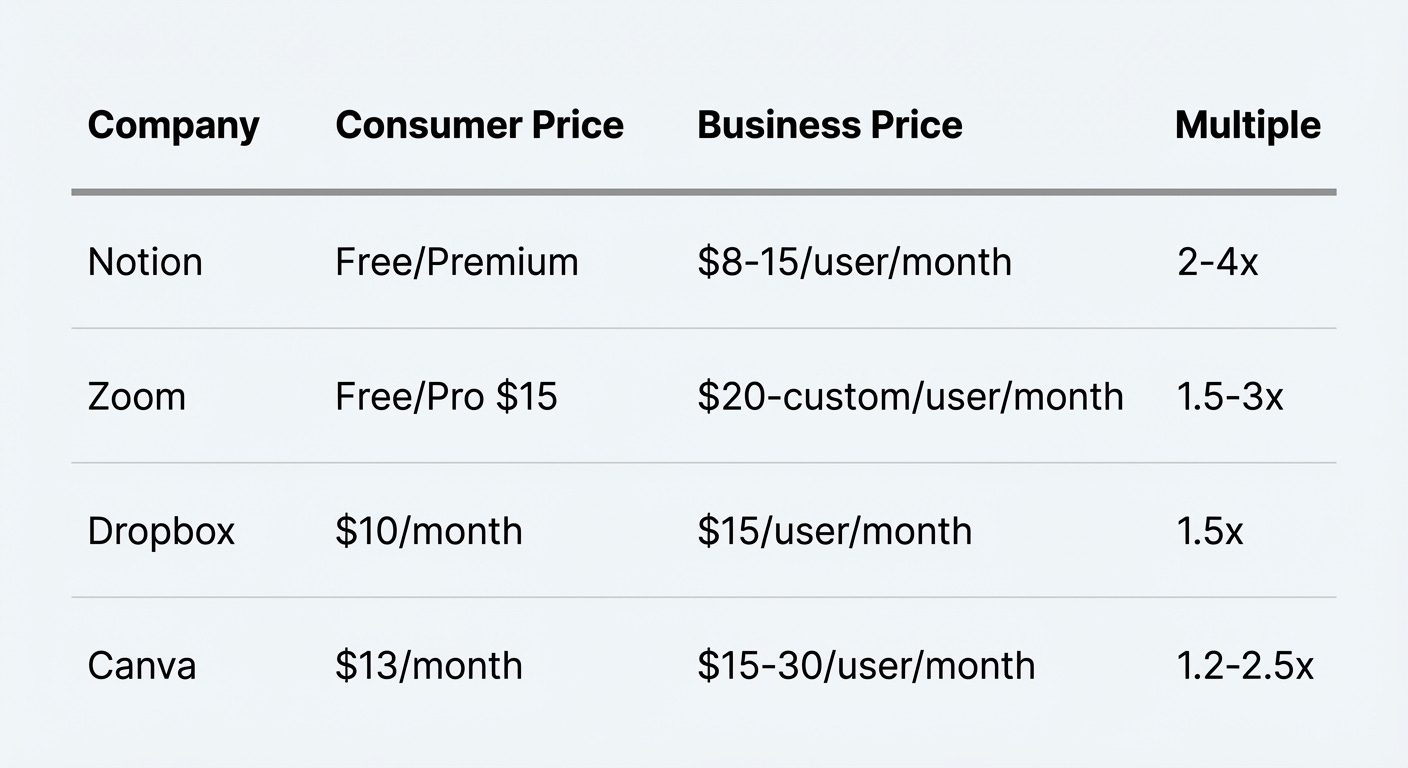
The pricing isn’t about multiplying consumer price. It’s about the value delivered:
Notion: Replace 10 tools ($100/month) with one ($15/month)
Zoom: Reliable video vs. lost productivity from failed meetings
Dropbox: Faster collaboration, reduced email chaos
Canva: 60% reduction in agency costs ($50K/year saved)
4. Keep Consumer Product Healthy
None abandoned their consumer roots. Why?
Consumer drives awareness (free marketing)
Individuals become team champions (bottom-up adoption)
Free tier is the top-of-funnel for B2B
Network effects start with individuals
5. Phase Enterprise Features
None built SOC 2, SSO, and SAML on day one. The sequence:
Phase 1 (MVB2B): Admin controls, team billing, basic analytics
Phase 2 (Scale): SSO, advanced permissions, API access
Phase 3 (Enterprise): SOC 2, HIPAA, SCIM, custom SLAs
Ship MVB2B in 3 months, not perfect enterprise in 12 months.
6. Measure Differently
B2B success metrics aren’t B2C metrics:
Don’t measure:
Daily Active Users (DAU)
Individual engagement
Viral coefficient alone
Do measure:
Net Revenue Retention (target >110%)
CAC payback period (target <12 months)
Expansion revenue (upsells, seat growth)
Gross retention (target >90%)
LTV:CAC ratio (target >3:1)
How to Use This in PM Interviews
When answering B2C to B2B expansion questions:
Reference specific examples: “Like Notion, I’d start with small teams (10-50 people) because they have 2-4 week sales cycles vs. enterprise’s 6-12 months. This lets us learn faster and build case studies.”
Use actual numbers: “Canva priced their Teams tier at $15/user/month, roughly 1.2x their Pro tier, but justified it with Brand Kit delivering 60% agency cost reduction. I’d similarly price based on business ROI, not consumer price.”
Show you understand tradeoffs: “Dropbox kept consumer healthy as their B2B funnel, but faced bundled competition from Google and Microsoft. We’d need a clear differentiation strategy beyond just ‘storage.’”
Apply patterns, don’t copy: Don’t say “do what Zoom did.” Say “Like Zoom’s approach of natural upgrade triggers, we’d build limits that encourage team upgrades when they hit real collaboration needs.”
Final Thoughts
B2C to B2B expansion isn’t luck. It’s a repeatable playbook:
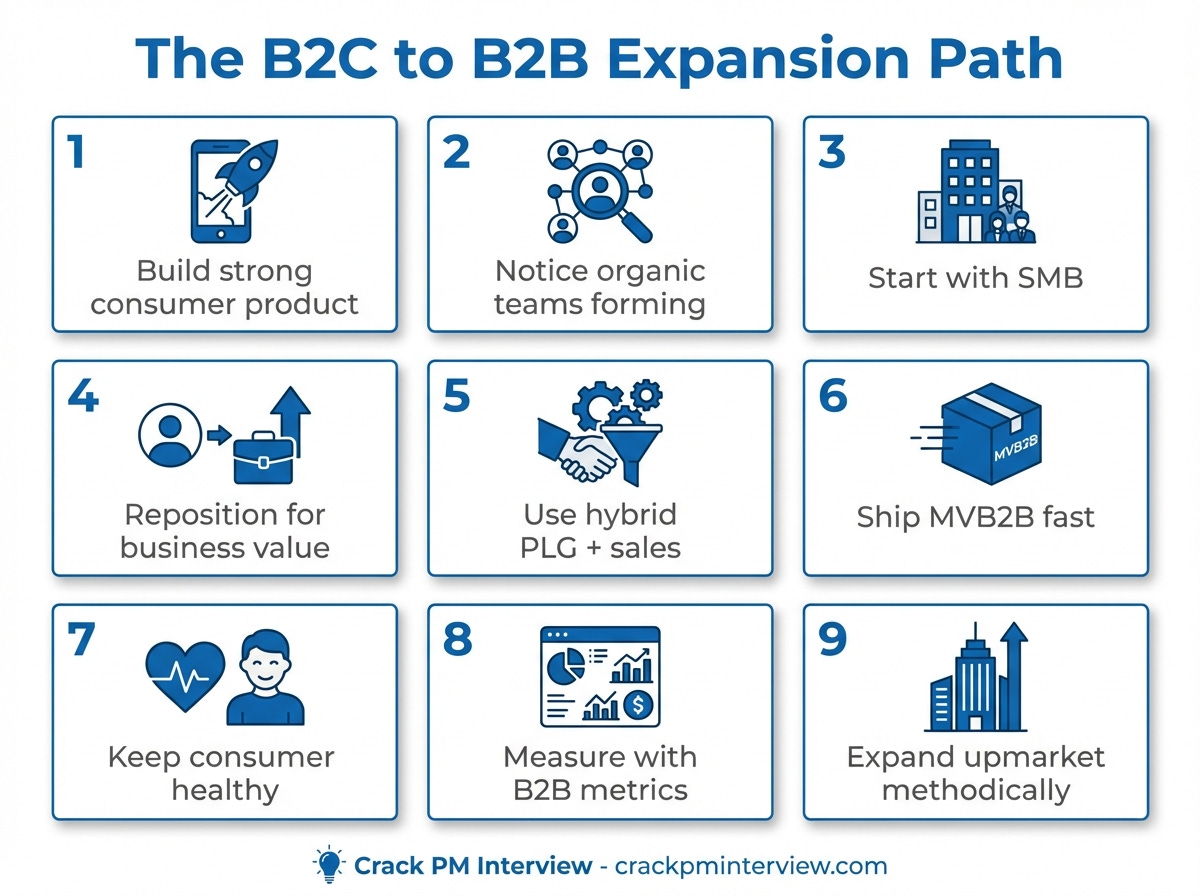
Notion, Zoom, Dropbox, and Canva collectively created $60B+ in value following this exact path.
The opportunity is massive. The playbook is proven. The question is execution.
Want the complete framework for answering B2C to B2B expansion questions in interviews? Read the full guide with strategic analysis, pricing frameworks, and 20 practice questions.
Checkout our deep-dive on How to answer any GTM question in a PM Interview