Why Has Meta Acquired Manus AI? - A Product Strategy Interview Guide for PMs
Step-by-step approach to tackle acquisition / strategy questions in a product management interview.
You’re in the final round of interviews at your dream company. The interviewer leans back and asks:
“Meta just acquired Manus AI, an 8-month-old autonomous AI agent startup, for $2-3 billion. In your view, why did Meta make this acquisition?”
Your palms get a little sweaty. You’ve seen the headlines about Manus, maybe even tried it. But now you need to deliver a structured, strategic answer that shows you think like a product leader, not just recite what you read on TechCrunch.
For a deep-dive on “How to answer Product Strategy questions in PM Interview?” - read here to tackle any product strategy question.
Join our WhatsApp channel for quick PM insights and latest Job updates
Here’s the thing: this type of question isn’t about knowing every detail. It’s about demonstrating:
strategic thinking,
structuring your analysis,
connect business strategy to user value,
evaluate alternatives and articulate why one path was chosen over others
and, balancing multiple perspectives.
The interviewer wants to see HOW you think, not whether you memorized acquisition announcements.
In this guide, you’ll learn:
How to think through Business Objectives, User Needs, and Solutions
Pro tips for success
By the end, you’ll have a replicable approach for any “Why did Company X acquire Company Y?” question in PM interviews.
Let’s break it down.
How to answer acquisition questions in a PM interview?
For acquisition questions, the BUS framework (Business Objectives, User Needs, Solutions & Strategy) works perfectly. Here’s how to apply it:
What business problems was Meta trying to solve?
What strategic goals does this acquisition serve?
Why was this urgent (timing)?
What user problems does Manus solve?
How does this improve Meta’s value proposition to users?
Which user segments benefit?
Why acquire vs. build in-house or partner?
What alternatives did Meta likely consider?
Was this the right strategic choice?
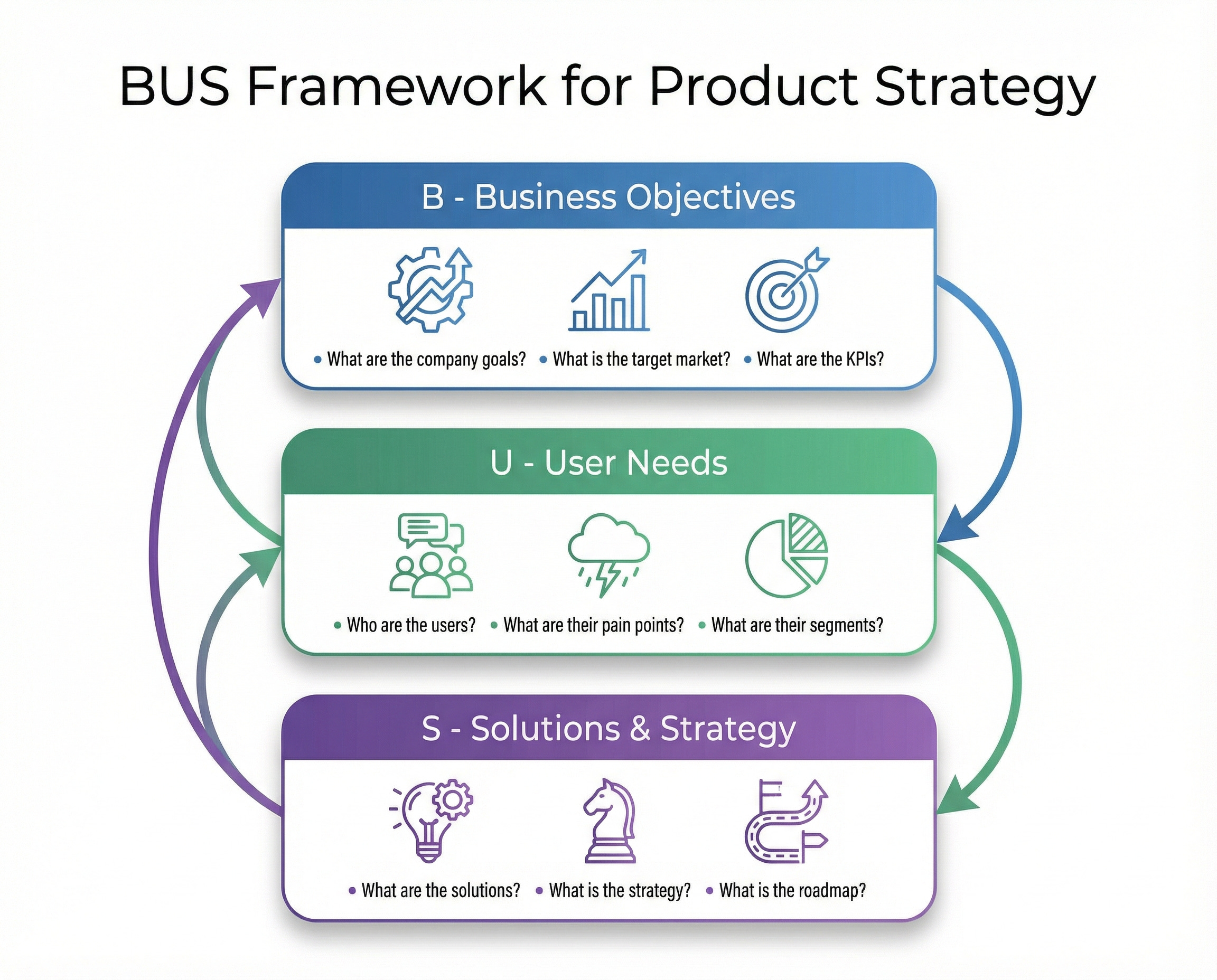
Your interview structure should look like:
Clarifying questions
Business Objectives analysis
User Needs analysis
Solutions & Strategy analysis
Summary and assessment
Now let’s walk through each step with sample responses.
Step 1: Clarifying Questions (30-60 seconds)
Never jump straight into analysis. Start with 2-3 clarifying questions to show thoughtfulness and buy yourself time to organize.
Sample Opening
“Great question. Before I dive in, let me clarify a few things to make sure I’m addressing what you’re looking for.”
Clarifying Questions
About scope:
“Should I focus specifically on the strategic rationale for this acquisition, or would you also like me to assess whether it was a good decision?”
“Are you interested in the immediate rationale or the longer-term strategic implications?”
About Meta’s position:
“Should I consider this in the context of Meta’s broader AI strategy, or analyze it in isolation?”
“Is it relevant that Meta has been making multiple AI acquisitions recently, like Scale AI?”
About Manus:
“Just to confirm my understanding, Manus is the autonomous AI agent platform that launched earlier this year, correct?”
“Should I address the geopolitical angle, Manus’s Chinese origins and the regulatory investigation?”
Setting context and expectations:
“Let me quickly set the context before my analysis.
Manus is an autonomous AI agent that launched in March 2025. The key difference from chatbots is autonomy, you assign a complex task and it completes it without constant prompting. It can do market research, write code, analyze data, all autonomously.
They achieved $100 million in annual recurring revenue just 8 months after launch, the fastest any startup has hit that milestone. Meta acquired them in December 2025 for $2-3 billion, negotiating the deal in just 10 days.
There’s a geopolitical element, Manus was founded in Beijing, relocated to Singapore, and China is now investigating the technology transfer.
With that context, let me walk through the strategic rationale.
I’d like to structure my thinking using the BUS framework, looking at Business Objectives, User Needs, and then the Strategic rationale for why they acquired versus other options.“
Why This Works
Shows maturity: You’re not impulsive
Demonstrates judgment: You know context matters
Buys thinking time: Those 30 seconds help you organize
Sets structure: Interviewer knows what to expect
Shows collaboration: You’re working with them, not performing at them
Step 2: Business Objectives (B) - Why Meta Needed This
Now dive into the core analysis. Start with what Meta was trying to achieve from a business perspective.
Cover these dimensions:
Meta’s strategic position (where they were before acquisition)
Business challenges (what problems they faced)
Strategic goals (what this acquisition helps achieve)
Timing and urgency (why now)
1) Meta’s Strategic Position in AI
Meta has strong foundation models with Llama, the open-source LLM family that’s been downloaded over 650 million times. They also have Meta AI, their assistant with 600 million monthly users across WhatsApp, Instagram, and Facebook.
But here’s the gap:
while Meta has great models and massive distribution, they lack autonomous agent capabilities.
Their AI is conversational, it responds to prompts. It doesn’t autonomously execute complex tasks.
Meanwhile, OpenAI announced ‘Operator,’ their autonomous agent. Google has ‘Project Mariner.’ The industry is shifting from chatbots to agents, from AI that talks to AI that acts. Meta risked being left behind in this next frontier.
2) Business Challenges and Strategic Goals this acquisition addresses:
i) Win the Agentic AI Race
The AI industry is in a paradigm shift. Autonomous agents, AI that can independently complete complex tasks, are the next battleground. Meta needed agent capabilities to stay competitive.
Without this, Meta would be stuck in the ‘chatbot’ era while competitors move to autonomous agents. This is similar to how mobile was a platform shift, you can’t ignore it without becoming irrelevant.
ii) Accelerate Time-to-Market
Building autonomous agent technology in-house would take 18-24 months minimum. In AI, that’s an eternity. OpenAI and Google are moving fast, and user habits form quickly.
By acquiring Manus, Meta bought themselves 18 months of development time. The 10-day negotiation shows they understood that every week of delay increased the risk of a competitor acquiring Manus or capturing the market first.
iii) Acquire Proven Technology and Talent
Manus isn’t a research project, it’s a proven product with $100 million in ARR and millions of users. This dramatically reduces technical risk compared to building from scratch.
More importantly, Meta acquired the team. The CEO Xiao Hong and his engineers demonstrated world-class execution, zero to $100 million ARR in 8 months. In AI, talent matters more than technology because technology can be replicated but exceptional teams cannot.
iv) New Revenue Opportunities
Meta’s core business is advertising, but Manus opens new monetization paths:
Direct subscriptions for agent features
Enterprise automation tools for businesses
Premium features in Meta AI
At current growth trajectory, Manus could reach $500 million to $1 billion in annual revenue within 2-3 years, making the $2-3 billion acquisition very justifiable from an ROI perspective.
v) Competitive Defense
Sometimes the best offense is denying competitors access. If Meta hadn’t acquired Manus, Google, Microsoft, or Apple likely would have. Or Manus could have become a competitor itself.
Benchmark Capital led Manus’s Series B just months before, signaling strong Silicon Valley interest. Meta needed to move decisively to prevent competitors from getting this capability.
3) Why the timing was critical:
The urgency is evident in the 10-day negotiation for a $2+ billion deal. This is unprecedented speed multi-billion dollar deal. For context, Meta’s WhatsApp acquisition took about a month.
Why so fast? Because in AI, timing is everything. Every week of delay:
Increased risk of competitor acquisition
Gave rivals more time to capture market share
Pushed back Meta’s entry into agentic AI
The autonomous agent market is forming now. Being 6-12 months late could mean permanent second-place status. Meta couldn’t afford deliberate, cautious strategy here.
Key Points to Hit for Business Objectives
When discussing Business Objectives, make sure you cover:
✅ Strategic positioning (Meta’s AI strengths and weaknesses)
✅ Competitive dynamics (OpenAI, Google, others moving into agents)
✅ Time-to-market advantage (buy 18-24 months of development time)
✅ Talent acquisition (proven team matters)
✅ Revenue potential (monetization opportunities)
Step 4: User Needs (U) - What Problem This Solves
After covering business objectives, shift to user perspective. A strategy only works if it creates user value.
Address below dimensions:
User pain points with current AI assistants
What Manus provides that others don’t
Target user segments and their needs
How this integrates with Meta’s ecosystem
1) Core User Pain Points
Current AI assistants like ChatGPT or Meta AI require constant hand-holding. The user experience is:
User: ‘Help me research competitors’
AI: ‘What aspects would you like to know?’
User: ‘Their funding and key features’
AI: ‘Here’s what I found...’
User: ‘Can you put this in a spreadsheet?’
AI: ‘I can format the data...’
This back-and-forth is exhausting. Users experience ‘AI fatigue’ from managing the AI instead of the AI managing tasks for them.
What users actually want is: ‘Research competitors and create a spreadsheet’ → AI does it completely, without 20 follow-up prompts.
Manus solves this with true autonomy. You assign a task, it figures out how to complete it, and delivers the finished output. It’s the difference between a chatbot and a digital employee.
2) Manus Capabilities
Autonomous execution: Tasks run in the background. You can close the app, and Manus continues working.
Complex, multi-step workflows: Can handle tasks that take 30 minutes, 2 hours, or even 8 hours. Something like ‘analyze the top 30 tech journalists covering AI, review their recent work, and compile a report’ just happens.
Tool integration: Can browse websites, execute code, create files, interact with APIs. It’s not limited to text generation.
Transparency: Every session is replayable, you can see exactly what the AI did step-by-step. This builds trust.
These capabilities address a real need: users want AI that works for them, not AI that needs constant management.
3) Target User Segments
This serves multiple user groups:
Individual professionals:
Researchers who need comprehensive information gathering
Analysts doing competitive or market research
Content creators who want trend analysis and planning
Anyone managing complex workflows
Businesses using Meta platforms:
WhatsApp Business: Automate customer service, appointment scheduling
Instagram businesses: Content planning, engagement optimization
Facebook Page owners: Automated moderation, post scheduling
SMBs that need ‘AI employees’ for tasks but can’t afford large teams
Enterprise customers:
Resume screening (HR departments)
Data analysis and reporting (analysts)
Workflow automation (operations teams)
Market research (strategy teams)
The common thread: People who need to get complex work done but don’t want to spend hours managing an AI to do it.
4) How this integrates with Meta’s ecosystem:
This is where Meta’s distribution advantage becomes powerful:
WhatsApp (2+ billion users):
Small business owners can automate customer inquiries
Personal users can do research or planning
Group coordination becomes automated
Instagram (2+ billion users):
Creators get automated trend analysis and content planning
Businesses get campaign optimization
Users get better shopping and discovery experiences
Facebook (3+ billion users):
Group admins get moderation automation
Page owners get content tools
Marketplace users get listing optimization
Meta AI app (600 million users):
Upgrades from basic assistant to autonomous agent
Becomes true ‘AI employee’ for users
The key insight: OpenAI’s Operator might be technically impressive, but it’s available to a limited user base. Manus integrated into Meta’s products instantly reaches billions of users. That’s Meta’s unique advantage, distribution at unprecedented scale.
Key Points to Hit for User Needs
When discussing User Needs, make sure you cover:
✅ Current pain points (AI fatigue, constant prompting)
✅ Manus’s solution (autonomous execution)
✅ User segments (individuals, businesses, enterprise)
✅ Integration opportunities (WhatsApp, Instagram, Facebook, Meta AI)
✅ Distribution advantage (billions of users vs. competitors)
Step 5: Solutions & Strategy (S) - Why Acquire vs. Alternatives
Finally, address the strategic choice:
→ why did Meta choose to acquire Manus rather than pursue other options?
Explore below dimensions:
Alternative strategies/options and their evaluation (pros/cons)
Why acquisition was optimal
Implementation approach and success metrics
1) Alternatives Meta likely considered:
Option A: Build In-House
Build autonomous agent capabilities from scratch using Llama as the foundation.
Pros:
Full control over technology and roadmap
Natural integration with Meta’s infrastructure
No acquisition premium
Can build exactly what they want
Cons:
Timeline: 18-24 months minimum to reach Manus’s capabilities
High risk of failure, agent AI is technically complex
Unproven product-market fit
Hard to attract top talent away from competitors
Cost: $500 million+ in R&D and talent
Timeline: 2+ years to production-ready Risk level: High
Option B: Partnership or Licensing
Strategic partnership with Manus, potentially with minority investment.
Pros:
Lower upfront cost
Test the technology before fully committing
Maintain flexibility
Cons:
Shared control, can’t fully direct product roadmap
Competitors could still acquire them
Limited integration capability without ownership
Key talent could leave or join competitors
Dependent on external company for critical capability
Risk level: Medium Strategic concern: Benchmark’s investment signaled others were interested
Option C: Acquire Manus (CHOSEN)
Full acquisition, integrate technology, retain team.
Pros:
Immediate capability with proven technology
Full ownership and control
Secure world-class talent
Proven product-market fit ($100 million ARR validates demand)
Speed: Can integrate in 6-12 months vs. 2+ years to build
Competitive defense: Deny rivals access
Cons:
High cost: $2-3 billion acquisition price
Integration challenges (technical and cultural)
Geopolitical risk (Chinese origins, regulatory scrutiny)
Talent retention risk (key people might leave)
Valuation risk (young company with high expectations)
Timeline: 6-12 months to integration Risk level: Medium-high, but manageable
Option D: Acquire Different Agent Company
Look for alternative AI agent startups to acquire.
Pros:
Other options exist in market
Potentially lower price
Less geopolitical complexity
Cons:
None as proven as Manus (no comparable traction)
Lower quality technology
Longer integration time
Second-choice thinking rarely wins markets
Risk level: Medium
2) Why acquisition was the optimal choice:
1. Proven traction eliminates technical risk
Manus’s $100 million ARR means the product works well enough that people pay for it. That’s validation you can’t get from a prototype or research project.
The alternative, building in-house, has no such validation. You might spend $500 million and 2 years only to discover the product doesn’t resonate with users.
2. Speed is paramount in AI
The 10-day negotiation reflects an understanding that in AI, being 6-12 months behind can mean permanent second place.
By the time Meta could build equivalent technology (18-24 months), OpenAI’s Operator and Google’s Mariner would have established market positions and user habits. First-mover advantage matters enormously.
3. Talent is the real asset
The $2-3 billion isn’t just for technology, it’s for the team that executed. Going from zero to $100 million ARR in 8 months demonstrates world-class capability.
In AI, teams that can execute are rare. Technology can be replicated, exceptional teams cannot.
4. The price is actually reasonable
While $2-3 billion sounds expensive, consider:
At $100 million ARR, this is a 20-30x revenue multiple, standard for high-growth SaaS
Alternative (building in-house): $500 million cost + 2-year delay = Similar total cost but worse outcome
If Manus reaches $500 million to $1 billion ARR in 2-3 years (plausible given growth), this acquisition will look cheap
5. Geopolitical complexity is manageable
Yes, Chinese origins create regulatory risk. But:
Manus already relocated to Singapore
Meta committed to ‘no Chinese ownership interests’
U.S. regulators appear satisfied
Strategic value outweighs regulatory uncertainty
3) Implementation Approach and Success Metrics
Phase 1 (Months 1-6): Integration
Keep Manus operating independently
Begin technical integration with Meta AI infrastructure
Retain key talent (CEO and core engineers)
Complete regulatory due diligence
Phase 2 (Months 6-12): Product Integration
Launch agent features in Meta AI app
Roll out in WhatsApp Business (pilot)
Begin Instagram creator tools
Enterprise pilot programs
Phase 3 (Year 2+): Scale
Full integration across all Meta products
Developer platform for third-party agents
Market leadership in autonomous AI
Success Metrics:
User adoption: 50-100 million monthly active agent users within 24 months
Revenue: $500 million to $1 billion ARR from agents within 2-3 years
Competitive position: Top 2 autonomous agent platforms by user count
Talent retention: 80%+ of Manus core team after 24 months
Key Points to Hit For Solutions
When discussing Solutions & Strategy, make sure you cover:
✅ Multiple alternatives (build, partner, acquire, other target)
✅ Pros and cons of each option
✅ Clear reasoning for why acquisition was chosen
✅ Valuation justification (why $2-3B is reasonable)
✅ Implementation approach (phased plan)
✅ Success criteria (how to measure if it worked)
Step 6: Summary and Assessment (1-2 minutes)
Wrap up with a clear summary and your judgment on whether this was a good decision.
“Let me summarize my analysis and provide my assessment.”
Meta’s acquisition of Manus addresses three critical strategic needs:
Business: Win the autonomous agent race, accelerate time-to-market by 18-24 months, acquire world-class talent, open new revenue streams, and deny competitors access to leading agent technology.
User: Solve the ‘AI fatigue’ problem by providing truly autonomous execution instead of constant prompting. Serve individuals, businesses, and enterprises who need AI that works for them rather than requiring management.
Strategy: Acquiring Manus was superior to building in-house (too slow, too risky) or partnering (insufficient control). The proven product-market fit ($100 million ARR in 8 months) justifies the $2-3 billion valuation.
My assessment: This was a smart strategic move, despite the high cost and complexity.
Here’s why:
Pros:
Buys 18-24 months of development time in a fast-moving market
Proven technology and team (reduces risk)
Distribution advantage (billions of Meta users vs. limited OpenAI access)
Opens new revenue opportunities
Prevents competitors from acquiring this capability
Cons and Risks:
High cost ($2-3 billion for 8-month-old company)
Integration challenges (technical and cultural)
Geopolitical complexity (Chinese origins, regulatory scrutiny)
Talent retention risk (key people could leave)
Why the pros outweigh cons:
The alternative, not acquiring, was worse. Building in-house would take 2 years and might fail. Not having agent capabilities would leave Meta behind as the industry shifts from chatbots to autonomous agents.
At current growth trajectory, if Manus reaches $500 million to $1 billion ARR in 2-3 years, this acquisition will have been a bargain. And Meta’s distribution gives them the best shot at making that happen.
The caveat:
Success depends on execution. If Meta can integrate Manus without destroying what made it special, retain the key talent, and navigate the geopolitical complexity, this could be remembered alongside WhatsApp and Instagram as one of their best acquisitions.
If integration bogs down, talent leaves, or agents don’t achieve mainstream adoption, it’s an expensive experiment that kept them competitive but didn’t transform the business.
My prediction:
This will be seen as a smart move within 2 years. The autonomous agent trend is real, not hype, and Meta needed to act decisively. They did.
Infographic Cheatsheet to answer Why Meta Acquired Manus AI
Pro Tips for Success ✅
Here are tips that will elevate your performance:
Be structured but remain conversational.
Ask for interviewer input at key decision points. “Does this strategic rationale resonate?” or “Would you like me to go deeper on the user needs side, or should I move to strategic alternatives?” This shows collaboration skills and prevents you from going down the wrong path.
Stay flexible and adapt based on feedback. If the interviewer pushes back or seems more interested in a different angle, adjust. Being coachable is a highly valued trait in PMs.
Show enthusiasm and genuine curiosity. Energy matters. Interviewers want to work with PMs who are passionate about strategy and technology. Let your excitement about AI agents and strategic moves show.
Use real-world examples when relevant. Reference how other companies approached similar decisions. “Similar to how Microsoft acquired LinkedIn for distribution” or “Like when Google acquired DeepMind for AI talent.”
Focus on the “why” behind your reasoning. Don’t just say “Meta needed agent capabilities” - explain why agents are the next frontier, why timing mattered, why this beats alternatives.
End strong with a clear assessment. Take a position on whether this was a smart move. Confidence in your recommendation (while acknowledging uncertainty) leaves a lasting positive impression.
Practice with a timer. Do mock interviews and time yourself on each section. This builds muscle memory for pacing and helps you stay balanced across BUS dimensions.
Study real acquisitions and reverse-engineer them. Use the BUS framework to analyze recent deals:
Why did Microsoft acquire Activision Blizzard for $69B?
What business objectives were they trying to achieve?
Which user segments benefited?
Why acquire vs. build or partner?
Prepare 2-3 recent acquisition examples. Have them ready to reference: “This reminds me of when Adobe tried to acquire Figma...” This shows you follow the industry.
Remember: interviewers aren’t expecting perfection. They want to see how you think, how you communicate, and how you’d approach real PM challenges. Authenticity combined with structure is the winning formula.
How to Practice Acquisition type of Product Strategy Question?
Acquisition questions follow a pattern, so you can prepare systematically.
For any acquisition question, prepare to discuss:
1. What was acquired
Company background
Core technology/product
Key metrics (revenue, users, growth)
Competitive position
2. Acquirer’s position
Strategic situation pre-acquisition
Strengths and gaps
Competitive pressures
Strategic priorities
3. Business rationale
What business objectives does this serve?
Why was timing critical?
How does this position them competitively?
4. User value
What user problems does this solve?
Which user segments benefit?
How does it integrate with existing products?
5. Strategic alternatives
Build vs. buy vs. partner
Other acquisition targets
Why this choice was optimal
6. Implementation and risks
How will they integrate?
What are key risks?
How to measure success?
Similar Acquisition Questions for Practice
Here are similar acquisition questions to practice:
Recent Tech Acquisitions:
Why did Microsoft acquire Activision Blizzard for $69B?
Why did Adobe acquire Figma for $20B (before deal was cancelled)?
Why did Salesforce acquire Slack for $28B?
Why did Intuit acquire Credit Karma for $7B?
Why did Nvidia acquire Mellanox for $7B?
AI-Specific Acquisitions:
Why did Google acquire DeepMind?
Why did Facebook/Meta acquire Instagram?
Why did Microsoft partner with (not acquire) OpenAI?
Why did Amazon acquire Kiva Systems (warehouse robotics)?
Check answers for more Product Strategy Questions: https://www.crackpminterview.com/t/product-strategy-questions
Found this helpful? Check out our comprehensive guide on “How to Answer Product Strategy Questions in a PM Interview?” to tackle any strategy question in a PM interview.
About the Author: Amit Mutreja is a product leader building AI-native products at the intersection of consumer tech, SaaS, and agentic AI. He writes about product strategy, large language models, and the craft of building from 0→1. Amit currently leads product at HexaHealth, and previously worked at Snapdeal, BYJU’S and Nokia. He also mentors aspiring and experienced PMs on career growth, product thinking, and cracking PM interviews.
Visit his topmate page to schedule a 1:1 session with him OR you may subscribe here to get 12 session (1 per month).


Fantastic breakdown of the BUS framewrok here. The point about Meta buying 18 months of dev time really cuts to the core of why this deal moved so qiuck. I've seen similar urgency in my own work when agentic tech started shifting faster than anyone expected. The talent piece is underrated tho, getting a team that can execute at that pace is harder than replicating the tech itself.