


You’re sitting across from your interviewer at Google, Meta, or Amazon. Everything’s going well. Then they hit you with: “How many pizza slices are consumed in New York City every day?”
Your mind races.
Is this a trick question?
Should you know this?
How accurate do they expect you to be?
Take a breath.
This is a guesstimate question, and it’s one of the most common and most intimidating types of questions you’ll face in product management interviews. But here’s the good news: with the right framework and practice, you can master these questions and actually enjoy the process.
In this comprehensive guide, I’ll walk you through everything you need to know about guesstimate questions: why they’re asked, how to approach them systematically, and the common pitfalls to avoid.
By the end, you’ll have a repeatable framework that works for any estimation question thrown your way.
Why Do Interviewers Ask Product Estimation Questions?
Product estimation questions, also called guesstimate questions or Fermi problems, ask you to estimate a quantity that you couldn’t possibly know off the top of your head.
You might be asked:
“What’s the market size for electric vehicles in India?”
or, “Estimate the number of daily active users on Instagram”
or, “How many gas stations are there in the United States?”
The defining characteristic of all these questions is that you’re not expected to know the answer. Instead, you need to build an answer using logical reasoning, reasonable assumptions, and basic math.
These questions typically fall into a few categories:
Market sizing questions: “What’s the market size for electric vehicles in India?” or “How many smartphones are sold globally each year?”
Product metrics questions: “Estimate the number of daily active users on Instagram” or “How much revenue does Netflix generate per year?”
Real-world estimation questions: “How many gas stations are there in the United States?” or “How many golf balls fit in a school bus?”
Business case questions: “How much would it cost to build a new subway line in San Francisco?” or “Estimate the annual advertising revenue for YouTube.”
But why do interviewers put candidates through this seemingly arbitrary exercise? These questions aren’t brain teasers meant to stump you - they serve several critical purposes in evaluating PM candidates:
Testing structured thinking
Evaluating comfort with ambiguity
Assessing quantitative reasoning
Observing communication skills
Understanding judgment
The interviewer isn’t testing your memorization of statistics or your lightning-fast mental math. They’re evaluating whether you can take an impossibly broad question, break it down systematically, make reasonable assumptions, and communicate your reasoning clearly.
These are the exact skills you’ll need as a PM when estimating the size of a market opportunity, projecting the impact of a new feature, or deciding how to allocate resources across multiple projects.
How To Answer Product Estimation Questions?
Now, let’s get to the core of this guide: a five-step framework you can apply to any guesstimate question. This framework has helped hundreds of PM candidates successfully navigate estimation questions, and with practice, it will become second nature to you.
Use the below 5 step approach:
Clarify the Question - Ask clarifying questions to narrow scope and remove ambiguity
State Your Assumptions - Explicitly state all assumptions with justification
Break Down the Problem - Decompose the problem into manageable components
Do the Math - Calculate step-by-step, thinking out loud
Sanity Check Your Answer - Validate that your answer makes intuitive sense
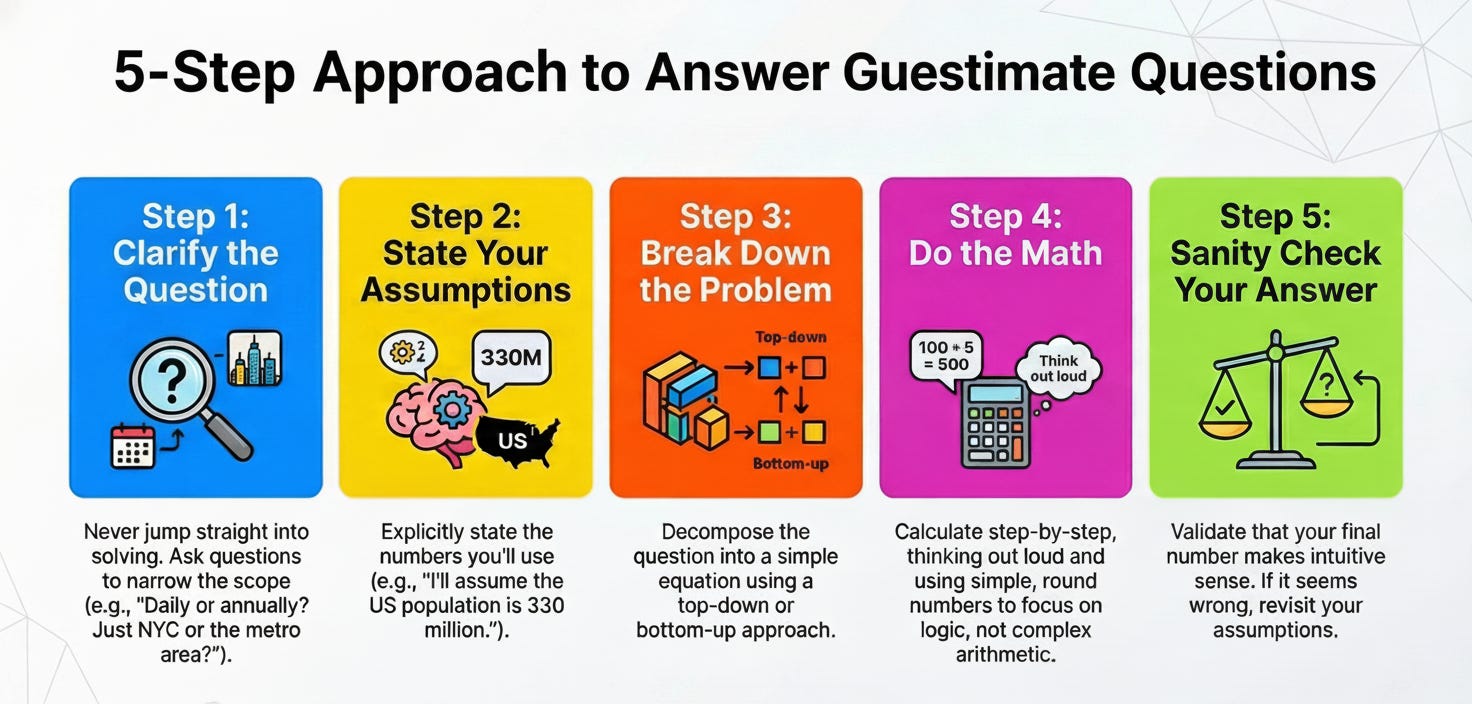
Let’s explore each step in detail
Step 1: Clarify the Question
Never, and I mean NEVER, jump straight into solving the problem. The first critical step is to make sure you understand exactly what you’re being asked to estimate.
Ask clarifying questions to narrow the scope and remove ambiguity. Here are some dimensions you might need to clarify:
Geographic scope: Are we talking about the US, globally, or a specific region? “How many coffee shops are there in the US?” is very different from “How many coffee shops are there in Seattle?”
Time period: Are we estimating for a day, month, year, or at a single point in time? “How many pizzas are ordered daily” versus “How many pizzas are ordered annually” require different approaches.
Definition of terms: What exactly counts? For example, if asked about “active users,” do we mean daily active users, monthly active users, or something else? If asked about “coffee shops,” do we include hotel lobbies and office buildings with coffee stations?
Current state or projection: Are we estimating the current situation or forecasting the future? “What’s the market size for EVs today?” versus “What will the EV market size be in 2030?”
Let’s look at an example. If asked, “How many Uber rides happen in San Francisco?”
Good clarifying questions would be:
“Are we estimating daily rides or annual rides?”
“Should I include both UberX and Uber Eats, or just passenger rides?”
“Are we talking about rides that start in San Francisco, or the broader Bay Area?”
“Is this for a typical day, or should I account for weekday versus weekend differences?”
The interviewer will appreciate these questions. They show you’re thoughtful and thorough. Plus, the answers will make your estimation much easier and more accurate.
Step 2: State Your Assumptions
Once you’ve clarified the question, the next step is to explicitly state your assumptions. This is absolutely critical and is where many candidates stumble.
Why are assumptions so important? Because they:
Make your reasoning transparent
Give the interviewer insight into your thought process
Provide a foundation for your calculations
Allow the interviewer to course-correct if you’re way off base
Your assumptions should be reasonable but don’t need to be perfect. The interviewer understands you’re estimating. What matters is that you can justify why you’re making each assumption.
For example, if estimating the number of coffee shops in the US:
“I’m going to make a few assumptions here. First, I’ll assume the US population is approximately 330 million people. Second, I’ll assume that about 60% of Americans drink coffee regularly. Third, I’ll assume the average coffee drinker purchases coffee from a coffee shop about twice per week. And fourth, I’ll assume the average coffee shop serves about 200 customers per day.”
Notice how each assumption is stated clearly and uses round numbers. You’re not trying to be precise down to the decimal point—you’re creating a reasonable foundation for your estimate.
Pro tip: If you’re genuinely unsure about an assumption, you can present it as a question to the interviewer: “I’m not certain, but I believe the average household size in the US is around 2.5 people. Does that sound reasonable to you?” This shows humility and creates a collaborative dynamic.
Step 3: Break Down the Problem
This is where your structured thinking really shines. You need to break down the big, scary question into smaller, manageable pieces that you can actually estimate.
There are two main approaches you can use:
Top-down approach: Start with a large number and work your way down by segmenting and filtering. For example, to estimate smartphone users in India, you might start with India’s total population, then multiply by the percentage who can afford smartphones, then adjust for age demographics.
Bottom-up approach: Start with a small unit and scale up. For example, to estimate the number of gas stations in the US, you might estimate how many gas stations are in a typical city, then multiply by the number of cities.
The approach you choose depends on the question, but often top-down is more intuitive for market sizing questions, while bottom-up works well for questions about physical objects or locations.
Let’s work through an example using both approaches:
Question: “How many cups of coffee are consumed in the US per day?”
Top-down approach:
US population: 330 million
Percentage who drink coffee: 60% = 198 million coffee drinkers
Average cups per coffee drinker per day: 2 cups
Total: 198 million × 2 = 396 million cups per day
Bottom-up approach:
Average household size: 2.5 people
Households in a typical neighborhood (100 houses): 100 households
Coffee-drinking households: 60% = 60 households
Cups per household per day: 5 cups (2 people × 2.5 cups average)
Cups per neighborhood: 60 × 5 = 300 cups
Neighborhoods in a city (population 100,000): 400 neighborhoods
Cups per city: 300 × 400 = 120,000 cups per city per day
Cities of this size in US: ~300
Total: 120,000 × 300 = 36 million cups... (seems low, we’d need to account for larger cities)
As you can see, the top-down approach is cleaner for this particular question. The key is to create a logical equation or tree structure that breaks the problem into components you can estimate.
A helpful technique is to literally write out the equation:
Total cups of coffee per day = (US population) × (% who drink coffee) × (cups per person per day)
This makes your logic crystal clear and helps you stay organized.
Step 4: Do the Math
Now comes the fun part—actually calculating your estimate. Here are some key principles:
Think out loud: Verbalize every step of your calculation. Don’t just scribble numbers silently. Your interviewer needs to follow your reasoning.
Use round numbers: This isn’t a test of your arithmetic skills. Round to numbers that make the math easy. If the population is 328 million, round to 330 million or even 300 million. The goal is directional accuracy, not precision.
Break calculations into steps: Don’t try to do complex math in your head. Break it into manageable chunks. 198 million × 2 can be thought of as 200 million × 2 = 400 million, minus 4 million = 396 million.
Write things down: If you’re at a whiteboard, write out each step. If you’re in a virtual interview, consider sharing your screen with a notepad or doc. This keeps you organized and helps the interviewer follow along.
Show your work: Even if you can calculate something mentally, explain it verbally so the interviewer understands your process.
Let’s continue our coffee example:
“Okay, so let me calculate this step by step. I have 330 million people in the US. 60% of 330 million is... well, 60% is a little more than half, so that’s approximately 198 million people who drink coffee. Now, if each of these coffee drinkers has about 2 cups per day on average, that’s 198 million times 2, which is approximately 400 million cups of coffee per day in the US.”
Notice how the candidate is talking through the math, using approximations where helpful, and keeping the calculation straightforward.
Step 5: Sanity Check Your Answer
You’ve arrived at a number—but you’re not done yet. The final critical step is to validate whether your answer makes intuitive sense.
This is where business judgment comes in. Ask yourself:
Is this number in the right ballpark given what I know about the world?
Are there any comparisons or benchmarks I can use to validate?
If I made an error, where might it be?
For our coffee example (400 million cups per day), you might sanity check by thinking:
“So that’s about 400 million cups per day. Let me check if that makes sense. That’s about 1.2 cups per person in the entire US population, which seems reasonable given that kids don’t drink much coffee, but coffee drinkers often have multiple cups. Alternatively, if Starbucks has about 15,000 locations in the US and serves maybe 500 customers per day, that’s 7.5 million cups just from Starbucks alone. So 400 million total including home-brewed, other chains, and independent shops seems reasonable. I’m confident in this estimate.”
If your number seems way off during the sanity check, don’t be afraid to revisit your assumptions. You might say:
“Hmm, actually that seems low to me. Let me reconsider my assumption about cups per drinker. I said 2 cups, but many coffee drinkers have their morning cup, maybe an afternoon cup, and some people drink 4-5 cups. Let me revise that to 2.5 cups per person, which would give me about 500 million cups per day. That feels more accurate.”
The interviewer will respect your willingness to iterate and refine your answer based on a sanity check.
Common Approaches and Techniques
Beyond the five-step framework, there are several specific techniques that can help you tackle different types of guesstimate questions more effectively.
1) Top-Down vs. Bottom-Up Estimation
We touched on this earlier, but it’s worth exploring more deeply.
Top-down is best when:
You’re estimating market size or user populations
You have a good sense of the total addressable market
The question involves percentages or segments of a whole
Bottom-up is best when:
You’re counting physical objects or locations
You can start with a small, relatable unit (a person, household, or neighborhood)
The question involves infrastructure or distribution
Many questions can be solved either way. The key is picking the approach that feels most intuitive to you and that you can execute clearly.
2) Using Analogies and Proxies
Sometimes you don’t have direct knowledge to make an assumption, but you can use analogies or proxies.
For example, if asked to estimate the number of piano tuners in Chicago (a classic Fermi problem), you might not know anything about piano tuning, but you can reason by analogy:
“I don’t know much about piano tuning specifically, but I imagine it’s similar to other specialized home services like appliance repair. I’d guess that a piano tuner can service about 4 pianos per day, works about 250 days per year, so that’s 1,000 pianos per tuner annually.”
Or you might use a proxy: “To estimate the number of electric vehicle charging stations, I can use gas stations as a proxy. There are about 150,000 gas stations in the US. Electric vehicles are about 5% of the market, but they need less frequent charging than gas cars need refueling. So I’d estimate maybe 20,000 charging stations currently.”
3) Segmentation Strategies
Breaking your population into segments can lead to more accurate estimates.
For instance, if estimating smartphone penetration in India, don’t treat the entire population as homogeneous. Segment by:
Urban vs. rural (different income levels and access)
Age groups (older populations have lower adoption)
Income brackets (affordability is a key factor)
This might look like:
“India has a population of about 1.4 billion. Let me segment this:
Urban population (35%): 490 million people
Smartphone penetration: 70% = 343 million
Rural population (65%): 910 million people
Smartphone penetration: 30% = 273 million
Total smartphone users: 616 million”
This segmented approach is more sophisticated and usually more accurate than treating everyone the same.
Common Mistakes Candidates Make ⚠️
Even with a solid framework, candidates often make predictable mistakes. Here are the most common pitfalls to avoid:
Jumping straight to math without clarifying.
Making assumptions without stating them.
Getting lost in unnecessary complexity. Not communicating your thought process.
Being wedded to your first approach.
Apologizing or showing lack of confidence.
Forgetting to sanity check.
Rushing through the process.
Awareness of these mistakes is half the battle. When you catch yourself making one, acknowledge it and course-correct.
Pro Tips for Success ✅
Here are tips that will elevate your performance:
Think out loud throughout your answer. Don’t go silent while you calculate. Verbalize every step of your reasoning so the interviewer can follow along and understand how you think.
Be structured but remain conversational. Yes, use the five-step framework, but don’t sound robotic. Engage naturally with the interviewer as you would with a colleague working through a problem together.
Draw diagrams or write equations. Visual representations help both you and the interviewer follow the logic. A simple equation written on a whiteboard like “Total Users = (Population) × (Internet Penetration %) × (Platform Adoption %)” makes your approach transparent.
Stay flexible and adapt based on feedback. If the interviewer pushes back on an assumption or seems more interested in a different approach, adjust. Being coachable is a highly valued trait in PMs.
Use round numbers aggressively. Round 328 million to 330 million or even 300 million. Round 47% to 50%. Make the math easy so you can focus on logic rather than arithmetic.
Practice time management: aim for ~10-15 minutes total. Here’s a rough time allocation:
Clarify: 1-2 minutes
State assumptions: 1-2 minutes
Break down problem: 2-3 minutes
Do the math: 3-4 minutes
Sanity check: 2-3 minutes
Discussion with interviewer: 2-5 minutes
Focus on the “why” behind your assumptions. Don’t just say “I assume 60% of people drink coffee” - explain why.
End strong with confidence. Present your final answer clearly and confidently: “Based on this analysis, I estimate approximately 400 million cups of coffee are consumed daily in the US.” Then pause for the interviewer’s reaction.
Know some useful reference numbers. Having common statistics in your back pocket helps:
US population: ~330 million
India population: ~1.4 billion
China population: ~1.4 billion
World population: ~8 billion
Number of US households: ~130 million
Average US household size: ~2.5 people
Number of Indian households: ~300 million
Average Indian household size: ~4.5 people
Build a personal “toolkit” of approaches. As you practice, document which approaches work best for different question types. For example: “For market sizing, I prefer top-down. For physical locations, I use bottom-up.”
Remember: interviewers aren’t expecting perfection or the exact right answer. They want to see how you think, how you structure ambiguous problems, and how you communicate complex reasoning. Confidence combined with structured thinking is the winning formula.
Practice Questions for Product Estimation Interview
To build your confidence and master the five-step framework, practice is essential.
Here are 40+ estimation questions organized by category. Work through these systematically, applying the framework to each one.
Market Sizing Questions
What is the total addressable market for electric vehicles in the United States?
Estimate the market size for online grocery delivery in India.
How large is the market for fitness wearables globally?
What’s the market size for cloud storage services for consumers in Europe?
Estimate the total market for baby products in the United States.
What is the size of the meal kit delivery market in North America?
How large is the market for premium coffee subscriptions in the US?
Estimate the market size for online education platforms globally.
What’s the total addressable market for smart home devices in the US?
How large is the market for pet insurance in the United Kingdom?
Product Metrics Questions
Estimate the number of daily active users on TikTok.
How much revenue does Amazon Prime generate annually?
Estimate the number of monthly active users on LinkedIn.
How many hours of content are uploaded to YouTube every day?
Estimate the annual revenue for DoorDash.
How many rides does Lyft facilitate per day in the United States?
Estimate the number of active Airbnb listings worldwide.
How much does Twitter generate in advertising revenue per year?
Estimate the number of daily transactions on Venmo.
How many subscribers does Disney+ have globally?
Real-World Estimation Questions
How many gas stations are there in the United States?
Estimate the number of pizza slices consumed in New York City on a Friday night.
How many Starbucks locations are there worldwide?
Estimate the number of smartphones sold globally each year.
How many flights take off from all US airports in a single day?
Estimate the number of cars manufactured globally per year.
How many hotel rooms are there in Las Vegas?
Estimate the number of coffee shops in your city.
How many ATMs are there in India?
Estimate the number of restaurants in London.
Estimate the daily water required at a McDonalds store.
Business Case Questions
How much would it cost to launch a food delivery service in a mid-sized city?
Estimate the annual operating costs for a public library system in a city of 500,000 people.
How much revenue could a new co-working space generate in Bangalore?
Estimate the cost to build and operate a new subway line in a major city.
How much would it cost to run a marketing campaign for a new smartphone launch?
Estimate the potential revenue from introducing a premium tier on a free social media app.
How much would it cost to open and operate a new retail store for a clothing brand?
Estimate the annual advertising revenue potential for a popular podcast with 1 million listeners.
How much would it cost to develop and launch a new mobile game?
Estimate the potential revenue from adding a subscription model to a news website.
Practice Strategy:
Start with questions you find easier and gradually work toward more complex ones. For each question:
Set a 10-15 minute timer
Work through all five steps of the framework
Record or write down your approach
Review and identify areas for improvement
Consider practicing with a partner who can play the role of the interviewer, ask follow-up questions, and provide feedback on your communication and structure. The more questions you practice, the more natural the framework will become.
Good luck with your interviews! 🚀