


You’ve nailed the product improvement question.
You’ve crushed the estimation case.
But then the interviewer leans back and asks,
→ “Tell me about a time you had to influence a decision without having direct authority.”
Suddenly, your mind goes blank.
You know you’ve done this before, probably dozens of times…
But which story should you tell? How much detail is too much? What are they really looking for?
Behavioural questions trip up even experienced product managers. Not because they lack relevant experiences, but because they haven’t learned how to package those experiences into compelling, structured narratives.
This guide will change that.
By the end, you’ll have a systematic approach to answering any behavioural question that comes your way.
Bonus: An Infographic Cheatsheet to answer behavioural questions

Why Behavioural Questions Matter More Than You Think?
Let’s be honest. Most PM candidates spend 80% of their prep time on product sense and case questions. Behavioural questions get treated as an afterthought, something you can “wing” because you’re just talking about yourself.
This is a mistake.
Here’s what interviewers are actually assessing with behavioural questions:
Leadership potential. Can you drive outcomes without positional authority? PMs don’t manage engineers or designers directly, yet they need to lead entire product teams.
Self-awareness. Do you understand your strengths, weaknesses, and growth areas? Can you reflect honestly on past failures?
Collaboration skills. How do you navigate disagreements? Do you build bridges or burn them?
Problem-solving under pressure. When things go wrong, and they always do, how do you respond?
Culture fit. Will you thrive in this company’s environment? Do your values align with theirs?
The behavioural interview is where interviewers decide if they actually want to work with you. Technical skills can be taught. Character and judgment are much harder to develop.
Understanding Behavioural Questions in the PM Context
Behavioural questions are rooted in a simple principle:
→ past behaviour is the best predictor of future behaviour.
Instead of asking hypothetical questions like “What would you do if...”, interviewers ask “Tell me about a time when...”
This forces you to draw from real experiences, which reveals far more about how you actually operate.
Common Themes in PM Behavioural Interviews
While questions vary, they tend to cluster around these themes:
Leadership and influence. How you drive outcomes through others, especially without formal authority.
Conflict and disagreement. How you handle pushback from stakeholders, engineers, or leadership.
Failure and learning. How you respond when things don’t go as planned.
Data and decision-making. How you use information to guide product choices.
Ambiguity and prioritization. How you operate when there’s no clear path forward.
Cross-functional collaboration. How you work with engineering, design, marketing, sales, and other teams.
Recognizing these themes helps you prepare strategically. You don’t need a unique story for every possible question. You need a small set of versatile stories that can be adapted to multiple themes.
Now, let’s deep dive into each step of the framework
How to answer behavioural questions? - Use The STAR Framework
You’ve probably heard of STAR before. It stands for Situation, Task, Action, Result. It’s the standard framework for structuring behavioural answers, and for good reason. It works.
But most candidates use STAR poorly. They either rush through it mechanically or ignore it entirely and ramble. Let’s break down how to use it effectively.
1) Situation: Set the Stage Quickly
The situation provides context, but it shouldn’t take more than 15-20% of your answer. Your interviewer doesn’t need the entire company history. They need just enough to understand the challenge you faced.
Good example: “I was the PM for our mobile checkout experience at a Series B e-commerce startup. We were losing 40% of users at the payment screen, and leadership had set an aggressive Q3 target to reduce abandonment by half.”
Bad example: “So I was working at this company, it was founded in 2018, and we had about 200 employees at the time. Our main product was an e-commerce platform, and I had been there for about 18 months when this happened. My manager was really great, and our team had five engineers...”
See the difference? The good example gives relevant context in two sentences. The bad example buries the point in unnecessary detail.
2) Task: Clarify Your Specific Responsibility
This is where you define what was expected of you specifically. Not your team. Not your company. You.
Good example: “As the PM, I was responsible for identifying the root causes of abandonment and shipping improvements before the end of Q3.”
Bad example: “The team needed to figure out what was wrong.”
The task section is often shortest, sometimes just one sentence. But it’s crucial because it establishes your ownership.
3) Action: This Is Where You Shine
The action section should comprise about 50-60% of your answer. This is where interviewers learn how you think and operate.
Critical rule: Use “I” not “we.” Even if it was a team effort, the interviewer wants to know what you specifically contributed. You can acknowledge the team, but be clear about your individual actions.
Good structure for actions:
What was your approach or strategy?
What specific steps did you take?
How did you handle obstacles or resistance?
What tradeoffs did you navigate?
Good example: “First, I dove into our analytics to understand where exactly users were dropping off. I discovered that 60% of abandonments happened when we asked users to create an account. I then ran five user interviews to understand the friction. Based on these insights, I proposed adding a guest checkout option. Our engineering lead pushed back, citing concerns about fraud and data quality. I worked with him to design a compromise: guest checkout with optional account creation after purchase, plus additional fraud detection. I wrote the PRD, prioritized the work with engineering, and we shipped in six weeks.”
4) Result: Quantify Your Impact
Always try to quantify results. Numbers are memorable and credible.
Good example: “Guest checkout reduced abandonment by 35%, bringing us close to our Q3 target. It also increased overall conversion by 12%, which translated to approximately $2M in additional annual revenue. The feature became a template that other teams adopted for their flows.”
Bad example: “It worked out really well and everyone was happy with the results.”
If you don’t have exact numbers, use directional language: “significant improvement,” “roughly doubled,” “reduced by approximately half.” Estimates are better than vague statements.
Common STAR Mistakes to Avoid
Too much situation, too little action. If you spend two minutes on context and thirty seconds on what you did, you’ve failed.
Vague actions. “I worked with the team to solve it” tells the interviewer nothing. Be specific.
No clear result. Every story needs an ending. What happened? What did you learn?
Forgetting the “so what.” Connect your result to business impact. Reducing bugs by 50% is good. But, reducing bugs by 50%, which improved customer satisfaction scores and reduced support costs by $100K, is much better.
We share only vetted PM jobs on our whatsApp channel.
Building Your Story Bank
Here’s a secret that will save you hours of interview prep: you don’t need a different story for every question. You need 5-7 strong, versatile stories that can be adapted to multiple question types.
The Categories to Cover
Build your story bank with at least one story for each category:
Leadership story. A time you led a team or initiative, ideally without formal authority.
Conflict story. A disagreement with a stakeholder, engineer, or leader that you navigated successfully.
Failure story. A meaningful setback and what you learned from it. This is non-negotiable. Everyone has failures. Interviewers are suspicious of candidates who can’t discuss them.
Data-driven decision story. A time you used data to inform a product decision or change direction.
Cross-functional collaboration story. A time you worked effectively across multiple teams or disciplines.
Ambiguity story. A time you had to make progress without clear direction or complete information.
Impact story. Your proudest product achievement with clear, quantifiable results.
How to Document Your Stories
For each story, write out:
One-line summary (for quick mental retrieval)
Situation (2-3 sentences)
Task (1 sentence)
Actions (5-7 bullet points of specific things you did)
Results (quantified wherever possible)
Key themes this story demonstrates (leadership, data, conflict, etc.)
Potential questions this story could answer
Adapting Stories to Different Questions
A single story can often answer multiple questions. Your “conflict with engineering” story might also work for “influencing without authority,” “handling disagreement,” or “navigating technical constraints.”
When you hear a question, quickly scan your story bank mentally and pick the most relevant match. Then adjust your emphasis based on what the question is really asking.
For a “conflict” question, emphasize the disagreement and how you resolved it. For an “influence” question, emphasize how you persuaded others. Same story, different framing.
Top 10 Behavioural Questions for PM Interviews
Let’s walk through the most common questions and how to approach each one.
1. Tell me about a time you influenced without authority.
What they’re assessing: Your ability to drive outcomes through persuasion, not power.
Approach: Choose a story where you changed someone’s mind or got buy-in for an unpopular idea. Emphasize the specific tactics you used: data, storytelling, finding shared goals, building relationships.
2. Describe a product decision you made with incomplete data.
What they’re assessing: Your comfort with ambiguity and your judgment under uncertainty.
Approach: Show your framework for making decisions without perfect information. Did you identify what data you did have? Did you make the decision reversible? Did you set up ways to learn quickly?
3. Share a time you failed and what you learned.
What they’re assessing: Self-awareness, humility, and growth mindset.
Approach: Choose a real failure, not a humble brag disguised as a failure. Be honest about what went wrong and your role in it. Spend most of your time on what you learned and how you’ve applied that learning since.
4. How did you handle a disagreement with engineering or design?
What they’re assessing: Your collaboration skills and respect for other disciplines.
Approach: Show that you sought to understand their perspective first. Demonstrate how you found common ground or reached a compromise. Never throw other functions under the bus.
5. Tell me about your most impactful product launch.
What they’re assessing: Your ability to drive results and your understanding of what “impact” means.
Approach: Focus on business outcomes, not just shipping features. Explain your role in achieving those outcomes. Connect the launch to broader company goals.
6. Describe a time you had to say no to a stakeholder.
What they’re assessing: Your ability to prioritize and manage expectations.
Approach: Show that you understood their request and took it seriously. Explain your reasoning for saying no. Describe how you delivered the no in a way that maintained the relationship.
7. How did you prioritize competing demands?
What they’re assessing: Your prioritization framework and decision-making process.
Approach: Explain the criteria you used to evaluate options. Show how you communicated priorities to stakeholders. Discuss any tradeoffs you made explicitly.
8. Share a time you used data to change direction.
What they’re assessing: Your analytical skills and intellectual honesty.
Approach: Describe what the data showed and how it contradicted your assumptions. Explain how you convinced others to change course. Show the outcome of the pivot.
9. Tell me about leading a cross-functional team.
What they’re assessing: Your ability to align diverse stakeholders and drive execution.
Approach: Describe how you got alignment on goals. Explain how you managed different working styles and priorities. Show how you kept the team motivated and on track.
10. Describe handling a product crisis or urgent issue.
What they’re assessing: Your composure under pressure and problem-solving speed.
Approach: Set up the stakes clearly. Walk through your immediate response and how you triaged. Explain how you communicated with stakeholders. Describe both the resolution and any process improvements you made afterward.
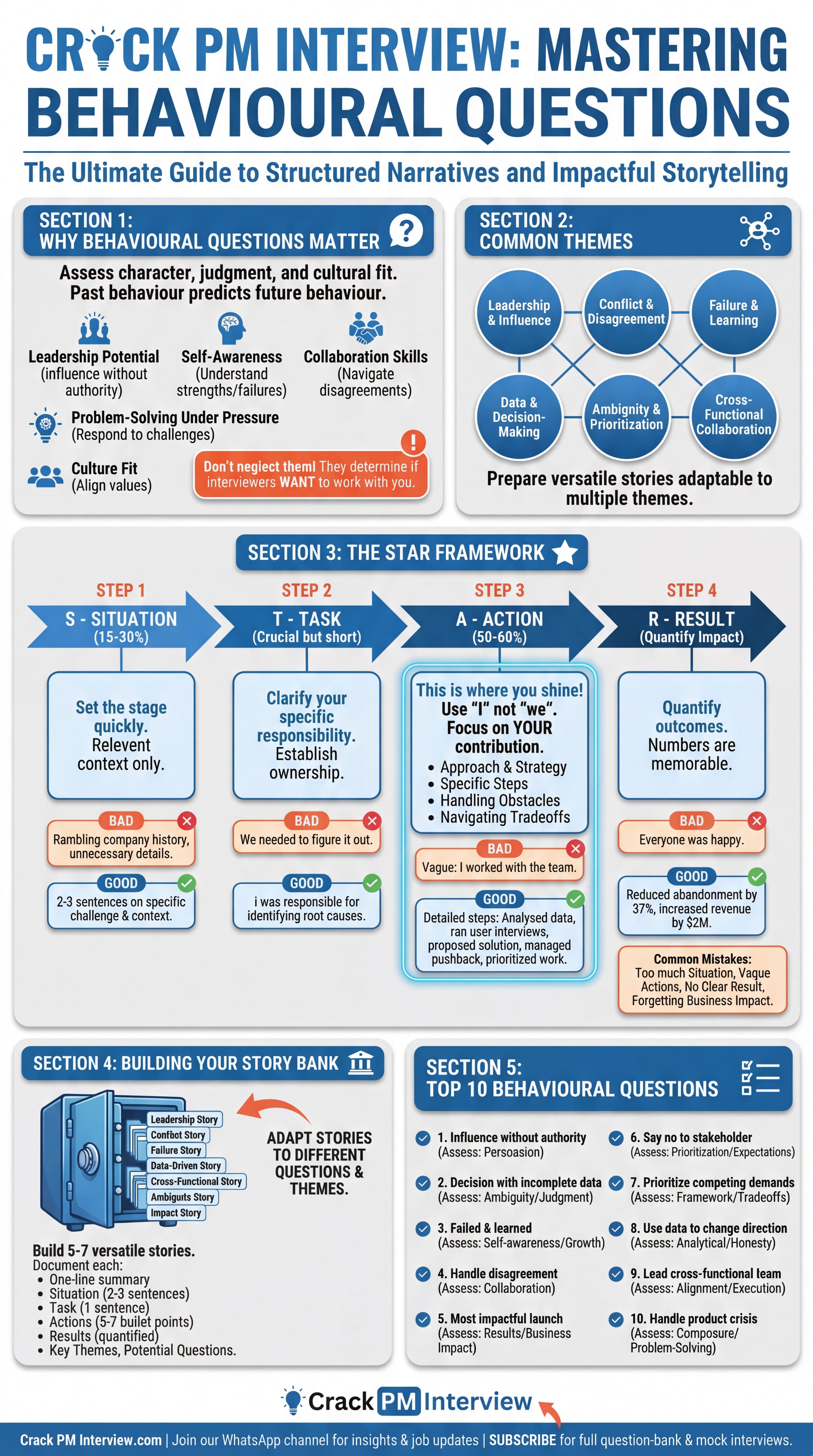
Infographic Cheatsheet to Answer Behavioural Questions in PM Interviews
Delivery Tips for Maximum Impact ✅
Even the best stories fall flat with poor delivery. Here are tips that will elevate your behavioural interview performance:
Keep answers to 2-3 minutes. Two minutes is ideal, three is the maximum. If running long, cut situation details first, protect your action section.
Practice out loud, not in your head. Record yourself on your phone. You’ll catch verbal tics, unclear explanations, and pacing issues you’d never notice otherwise.
Read interviewer cues. Leaning in and nodding? You’re on track. Glancing at the clock? Wrap up quickly. Follow-up questions usually mean they’re engaged.
Balance “I” and “We.” Use “I” for your specific contributions, “we” for team outcomes. Example: “I identified the root cause through user research, then worked with our engineer to design a solution. We shipped in two weeks.”
Be conversational, not robotic. Know your key points but don’t script every word. Think of it like telling a friend about something interesting at work.
Pause before answering. Taking 5-10 seconds to collect your thoughts signals confidence, not uncertainty. Rushed answers often miss the mark.
Mirror the question in your opening. Start with “A great example of influencing without authority was when...” This confirms you understood and keeps you on track.
End with impact and learning. Always close strong. State your quantified result, then add what you learned or would do differently.
Key Insight: Interviewers aren’t just evaluating your past experiences, they’re assessing how you communicate and think on your feet.
Clear structure + authentic delivery + quantified results = winning formula.
Red Flags to Avoid 🚩
Even with the STAR framework, candidates make predictable mistakes. Here are the most common pitfalls to avoid:
Being too vague. “I worked with the team to solve the problem” tells interviewers nothing. Be specific: what exactly did you do, what tools did you use, what was your unique contribution?
Blaming others or external factors. Even if someone else caused the problem, focus on what you did to address it. Blame signals lack of ownership.
No clear result or learning. Every story needs an ending. If you can’t articulate what happened or what you learned, the story feels incomplete and wastes the interviewer’s time.
Memorized, robotic delivery. If you sound like you’re reciting from memory, interviewers question your authenticity. Practice enough to be smooth, not scripted.
Stories that don’t showcase PM skills. Your fitness journey might be inspiring, but it doesn’t belong in a PM interview unless directly relevant to the question.
Taking credit for others’ work. Interviewers have strong networks. Exaggerating your role destroys credibility instantly.
Rambling without structure. Going on tangents or circling back repeatedly signals disorganized thinking. Stick to STAR.
Only highlighting successes. Candidates who can’t discuss failures seem either inexperienced or lacking self-awareness. Have a genuine failure story ready.
Negative comments about past employers. Even if justified, criticizing former companies or colleagues raises red flags about your professionalism.
Key Insight: Awareness of these mistakes is half the battle. If you catch yourself making one mid-answer, acknowledge it and course-correct: “Actually, let me be more specific about my individual contribution here...”.
Putting It All Together
Behavioural questions are your opportunity to bring your resume to life. They transform bullet points into compelling narratives that help interviewers see you as a person they want on their team.
Here’s your action plan:
This week: Identify 5-7 stories from your experience that cover the key themes. Write them out using the STAR format.
Next week: Practice telling each story out loud. Time yourself to ensure you’re hitting the 2-3 minute target.
Before your interview: Review your story bank and identify which stories map best to common questions. Think about how you’d adapt each story for different question types.
During the interview: Listen carefully to the question, pick the most relevant story, and structure your answer using STAR. Watch for interviewer cues and adjust as needed.
The candidates who ace behavioural interviews aren’t necessarily the ones with the most impressive experiences. They’re the ones who can articulate their experiences clearly, connect them to what the interviewer is looking for, and tell their stories with authenticity and confidence.
You have great experiences. Now go tell your story.
Found this helpful? Subscribe to Crack PM Interview for more tactical advice on landing your dream product role.
The 'wing it' part, so true. Is over-prepp a thing? Brilliant.
Very nicely written